Berto Jongman: Being Anonymous a Virtual Crime

07 Other Atrocities, Corruption, Cultural Intelligence, Government, IO Impotency, Military
Berto Jongman
Berto Jongman

Attempts to stay anonymous on the web will only put the NSA on your trail

The sobering story of Janet Vertesi's attempts to conceal her pregnancy from the forces of online marketers shows just how Kafkaesque the internet has become

John Naughton

The Observer, 10 May 2014

When searching for an adjective to describe our comprehensively surveilled networked world – the one bookmarked by the NSA at one end and by Google, Facebook, Yahoo and co at the other – “Orwellian” is the word that people generally reach for.

But “Kafkaesque” seems more appropriate. The term is conventionally defined as “having a nightmarishly complex, bizarre, or illogical quality”, but Frederick Karl, Franz Kafka's most assiduous biographer, regarded that as missing the point. “What's Kafkaesque,” he once told the New York Times, “is when you enter a surreal world in which all your control patterns, all your plans, the whole way in which you have configured your own behaviour, begins to fall to pieces, when you find yourself against a force that does not lend itself to the way you perceive the world.”

A vivid description of this was provided recently by Janet Vertesi, a sociologist at Princeton University. She gave a talk at a conference describing her experience of trying to keep her pregnancy secret from marketers. Her report is particularly pertinent because pregnant women are regarded by online advertisers as one of the most valuable entities on the net. You and I are worth, on average, only 10 cents each. But a pregnant woman is valued at $1.50 because she is about to embark on a series of purchasing decisions stretching well into her child's lifetime.

Professor Vertesi's story is about big data, but from the bottom up. It's a gripping personal account of what it takes to avoid being collected, tracked and entered into databases.

. . . . . . . .

In preparing for the birth of her child, Vertesi was nothing if not thorough. Instead of using a web-browser in the normal way – ie leaving a trail of cookies and other digital tracks, she used the online service Tor to visit babycenter.com anonymously. She shopped offline whenever she could and paid in cash. On the occasions when she had to use Amazon, she set up a new Amazon account linked to an email address on a personal server, had all packages delivered to a local locker and made sure only to pay with Amazon gift cards that had been purchased with cash.

The really significant moment came when she came to buy a big-ticket item – an expensive stroller (aka pushchair) that was the urbanite's equivalent of an SUV. Her husband tried to buy $500 of Amazon gift vouchers with cash, only to discover that this triggered a warning: retailers have to report people buying large numbers of gift vouchers with cash because, well, you know, they're obviously money launderers.

. . . . . . . .

Even more sobering, though, are the implications of Professor Vertesi's decision to use Tor as a way of ensuring the anonymity of her web-browsing activities. She had a perfectly reasonable reason for doing this – to ensure that, as a mother-to-be, she was not tracked and targeted by online marketers.

But we know from the Snowden disclosures and other sources that Tor users are automatically regarded with suspicion by the NSA et al on the grounds that people who do not wish to leave a digital trail are obviously up to no good. The same goes for people who encrypt their emails.


Read full article.

Berto Jongman: NSA Kills People Based on Metadata

Advanced Cyber/IO, Corruption, Government, IO Impotency, Military
Berto Jongman
Berto Jongman

We Kill People Based on Metadata’

David Cole

NY Review of Books, 10 May 2014

EXTRACT

Supporters of the National Security Agency inevitably defend its sweeping collection of phone and Internet records on the ground that it is only collecting so-called “metadata”—who you call, when you call, how long you talk. Since this does not include the actual content of the communications, the threat to privacy is said to be negligible. That argument is profoundly misleading. Of course knowing the content of a call can be crucial to establishing a particular threat. But metadata alone can provide an extremely detailed picture of a person’s most intimate associations and interests, and it’s actually much easier as a technological matter to search huge amounts of metadata than to listen to millions of phone calls. As NSA General Counsel Stewart Baker has said, “metadata absolutely tells you everything about somebody’s life. If you have enough metadata, you don’t really need content.” When I quoted Baker at a recent debate at Johns Hopkins University, my opponent, General Michael Hayden, former director of the NSA and the CIA, called Baker’s comment “absolutely correct,” and raised him one, asserting, “We kill people based on metadata.”

Read full article.

Richard Wright: Intelligence Analysis is Not Done by Computers

IO Impotency, IO Sense-Making
Richard Wright
Richard Wright

Intelligence Analysis

Follow up on Robert Steele & Anonymous: Most Analysis Software Sucks — And Story of How Steele Correctly Called BSA Not Being Signed in Afghanistan

The usefulness of computer aids to intelligence analysis (“tools”) depends a good deal on what sort of ‘intelligence’ you are talking about. Intelligence is information that has been subjected to a process of research and analysis to determine its relative accuracy and relevance. When trying to determine if “analytic software” can help this process it is necessary to look at the kind of information that is being processed.

In the field of technical intelligence, i.e. SIGINT, there are a number of “tools” that are very useful. Most of these so-called tools are retrieval programs of various sorts that allow the analyst to manipulate the data in various useful ways and some of these capabilities go back over ten years ago (clustering and linking related bits if information and geographic displays using GIS). The most important unclassified technical advance impacting on analysis today is the availability of authentic data mining programs for the analyst. Data mining is NOT simple data retrieval, as many birdbrains claiming to speak for the IC appear to believe. Data mining proper uses a suite of sophisticated algorithms capably of detecting hidden patterns and trends, finding anomalies that may not be apparent, and even changing the original query structure to reflect retrieved information. Oracle has such a program based on the Oracle relational database that has been around in one form or another for at least 15 years. Data mining obviously would be effective against “big data.” The problem with all this is that these tools are designed to make research and analysis easier especially when dealing with large amounts of unevaluated information. As “anonymous” observed they cannot replace an engaged and target smart analyst.

Continue reading “Richard Wright: Intelligence Analysis is Not Done by Computers”

Owl: Nuke May Have Been Unleashed in Iran – Did an Error Survive in CIA’s Plans for the Bomb as Given to the Iranians?

05 Iran, 08 Proliferation, Government, IO Deeds of War
Who?  Who?
Who? Who?

Nuke May Have Been Unleashed in Iran

“Iranian Fars News Service reported a massive explosion in Qazvin, Iran today. The origins may have been nuclear.
Arutz Sheva reported:

An immense explosion has been heard throughout the northern Iranian city of Qazvin, semi-official Fars news agency reported, and many casualties are expected from the blast.

Around 1.1 million people live in the city, which is located about 100 miles north of Tehran.

The blast may be related to nuclear development in Iran, according to the Los Angeles Times. Iranian officials in the past have strongly denied claims by Mujahedin Khalq Organization, or MKO, a cult-like Iranian exile group, that it has a secret nuclear enrichment facility in Abyek, near the major city, according to the daily.

The source of the blast remains undetermined. Several mystery explosions have been reported in the past several years in the region, none of which were ever verified.”

More:

Massive Explosion in Qazvin, Iran – May Have Nuclear Origins …Update: Roads Blocked Off for 2kmMassive Explosion in Qazvin, Iran – May Have Nuclear Origins …Update: Roads Blocked Off for 2km

Phi Beta Iota: It has been known since 2005 that CIA gave the Iranians the complete plans for making a nuclear bomb, with many errors called “rudimentary” at the time, easily discovered and fixed by Russians working for Iran. Perhaps one of the errors was not so rudimentary after all.

See Also:

Iran CIA nuclear plans Merlin @ Google

Tom Atlee: “Dark Google,” privacy and power

Civil Society, Collective Intelligence, Commerce, Commercial Intelligence, Cultural Intelligence, Ethics, IO Impotency
Tom Atlee
Tom Atlee

As the information age and big data colonize everything in life – expanding now into reality itself – we face an erosion not only of privacy but of choice. Even as we think we have greater choice and power, really important choices and power are being subtly stolen from us by folks who don't want us to know or do anything about it. We need to take back our lives while we still can.

“Dark Google”, privacy and power

Dear friends,

Sir Francis Bacon and Thomas Hobbes told us that “Knowledge is power.” We need to integrate their insight with Sir John Acton's observation that “Power tends to corrupt, and absolute power corrupts absolutely.”

In this runaway Information Age we need to realize that one-way concentrations of knowledge power are dangerous when they are not answerable, not responsive to oversight and feedback. The article below, “Dark Google”, makes this point powerfully regarding Google and the NSA. The author, Harvard's Shoshana Zuboff, is eminently qualified to issue this warning.

Continue reading “Tom Atlee: “Dark Google,” privacy and power”

Robert Steele & Anonymous: Most Analysis Software Sucks — And Story of How Steele Correctly Called BSA Not Being Signed in Afghanistan

IO Tools
Robert David STEELE Vivas

ROBERT STEELE: I have been re-kicking the tires on the obvious aspiring analytic software packages, and find all of them unworthy for multiple reasons ranging from an inability to ingest data to an obscene amount of training being required to extract data to a general uselessness at making intuitive leaps. I asked one of the absolute masters what they thought, and below is the answer they gave me. Following this deeply critical commentary from someone I look up to, I provide the short story on how I appear to have been the only person in the US system that understood the Bi-Lateral Agreement (BSA) with Afghanistan would not be signed. No software was involved in any way.

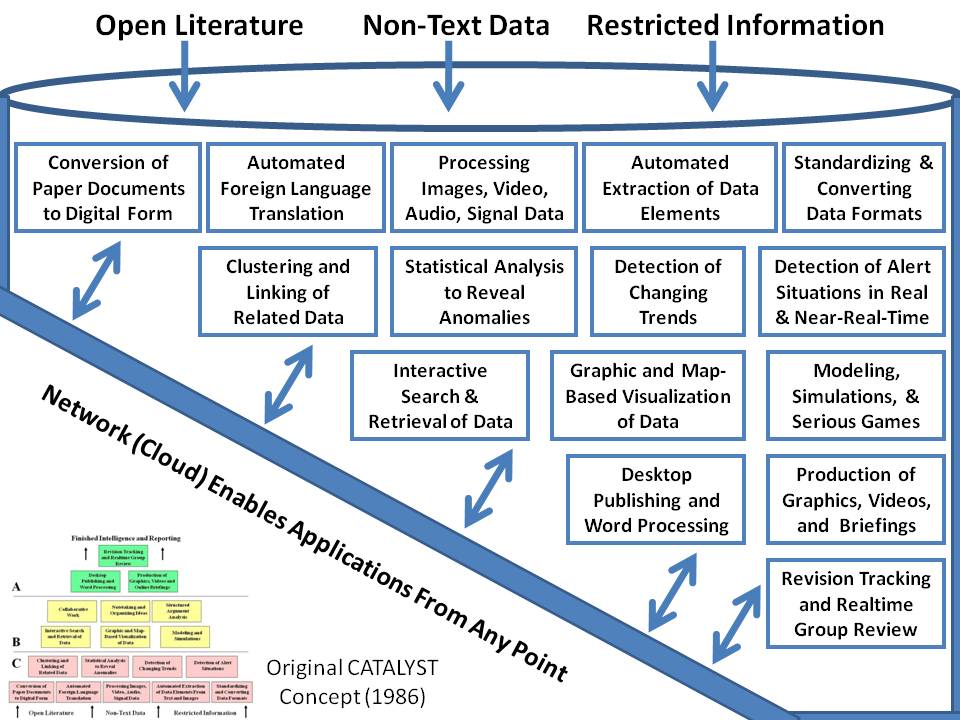
The question as I posed it: is there any analytic software out there that might be a candidate for a fresh start against the eighteen CATALYST functionalities? Is there any analytic software out there that is worth a damn, apart from sources, analysts, context, and smart commanders that will entertain doubts, anomalous thoughts, and best guesses?

Click on Image to Enlarge

ANONYMOUS: I wish I had a good unchallenged answer to your question. The fact is that all analysis software is basically useless unless the analyst has a good handle on what is actually going in (imported) and what is going out (exported). I worked with Analyst Notebook from the very beginning (infancy) to its maturity, with all the bells and whistles attached, but the ultimate analysis comes from the analyst and even then making predictions with the analysis is still shoddy. I have also used CrimeLink, which is almost a clone of Analyst Notebook, and the same goes for that piece of software: it will only provide information, not intelligence, in a nice to use format (same as Palintir) that the analyst still has to massage in order to create intelligence.

Continue reading “Robert Steele & Anonymous: Most Analysis Software Sucks — And Story of How Steele Correctly Called BSA Not Being Signed in Afghanistan”

Nik Peachey: The fully automated bibliography, research, citation, and internet highlighting tool

IO Tools
Nik Peachey
Nik Peachey

This looks like an interesting attempt to develop tools for digital study skills

The fully automated bibliography, research, citation, and internet highlighting tool.

Our innovative academic research platform allows students and researchers to save, organize, and automatically cite online or offline information throughout the duration of the writing process, and store content privately or aggregate it by topic to be shared with the community

noble gold