Berto Jongman: US National Security Achilles Heel – Electromagnetic Spectrum’s Vulnerability to Being Fried

IO Impotency
Berto Jongman
Berto Jongman

U.S. National Security’s Achilles Heel – The Electromagnetic Spectrum

Over the past four years bills on cybersecurity, Electromagnetic Pulse threats, and other forms of “purposeful interference” with U.S. cyberspace have been introduced only to go nowhere.

By now it has been well established that EMP, whether in the form of a Carrington Event of solar origin or the explosion of a high-radiation-yield nuclear device in the atmosphere above the United States could knock out the country’s electrical grid and therewith threaten the lives of 9 of 10 Americans, making a conventional nuclear attack seem like child’s play.

Although a super solar fare on September 1, 1859, was observed and documented by the English astronomer Richard Carrington, and it is known that U.S. adversaries like Russia, China, Iran, and North Korea either have or can construct and explode a nuclear device in the atmosphere above large parts of the country, these threats are not taken seriously.

On December 23, 2013, the Defense Threat Reduction Agency issued a solicitation “to … conduct satellite system performance modeling, satellite system response-to-environments modeling, high altitude weapons electromagnetic pulse effects modeling, and disturbed atmosphere effects modeling…”

Read full article.

Continue reading “Berto Jongman: US National Security Achilles Heel – Electromagnetic Spectrum's Vulnerability to Being Fried”

Stephen A. Arnold: 72% Do Not Trust Google Glass

Commerce, Corruption, IO Impotency
Stephen E. Arnold
Stephen E. Arnold

Predictably No One Trusts Google Glass

A portion of Back To The Future II where Michael J. Fox as Marty McFly invades the far-flung future of 2015. Among flying cars, self-drying clothes, and hover boards a few of the citizens where these weird glasses that they use to watch TV and do other activities. The people wearing these devices look weird and are committing a horrendous fashion faux pas. This is how many people view Google Glass, but fashion statement aside they also don’t trust the digital accessory because of privacy concerns. TechEye.net explains in “Americans Distrust Google Glass” that a recent market survey from Toluna explained that more than 72 percent of Americans do not want to spend the money on the device, because they’re worried their private data could become public and being recorded without consent.

Continue reading “Stephen A. Arnold: 72% Do Not Trust Google Glass”

SchwartzReport: No One Trusts Washington on Climate Change – Loss of Legitimacy is EXPENSIVE

03 Environmental Degradation, Corruption, Cultural Intelligence, Government, IO Impotency
Stephan A. Schwartz
Stephan A. Schwartz

The ongoing disinformation campaign financed by carbon interests such as the Koch brothers, combined with the corruption of every branch of our government, has left us in this condition.

No One Trusts Washington on Climate Change
CHRISTOPHER CALDWELL, Senior Editor – Financial Times (U.K.)

In the age of the Iraq war and Obamacare, the government is hardly a trustworthy body.

The 841-page National Climate Assessment released by the US government this week has been described as ‘sobering”, but Americans do not appear sobered. The report goes into astonishing detail about what severe climate change would mean – and what it means already to specific villages, mountains and beaches.

. . . . . . .

Continue reading “SchwartzReport: No One Trusts Washington on Climate Change – Loss of Legitimacy is EXPENSIVE”

Abe Lederman: Deep Web versus Dark Web — Correcting TIME Magazine’s 2013 Errors About the “Secret Web”

Advanced Cyber/IO
Abe Lederman
Abe Lederman

PHI BETA IOTA: As recently as 2013, TIME Magazine has made the mistake — in a cover story no less — of equating the Deep Web to the Dark Web. One is unindexed and legal, the other is anonymous and often invisible as well as criminal. For TIME Magazine to not know the difference — and to ignore a very professional letter from Abe Lederman, founder of Deep Web Technologies seeking to correct the record, is in our view emblematic of the sad ignorance as well as editorial shallowness that characterizes the mainstream media. Below, with profound respect for the ethics, accomplishments, and enormous future potential of Abe Lederman and his company, Deep Web Technologies, we are happy to post pointers to the two TIME Magazine stories that are in error (the authors are Lev Grossman and Jay Newton-Small); and to the blog correction posted by Mr. Lederman that includes a copy of the Letter to the Editor that TIME Magainze in its insousance failed to acknowledge, much less publish. TIME did fine on the Dark Web. They know nothing at all about the much larger, much more important Deep Web . Here is the authentic perspective of Abe Lederman. We are glad to shine a light on his hard-earned knowledge.

TIME: The Secret Web: Where Drugs, Porn and Murder Live Online (11 November 2013)

TIME: Why The Deep Web Has Washington Worried (31 October 2013)

LEDERMAN: The Deep Web isn’t all drugs, porn, and murder

See Also:

2014 Deep Web Technologies

2014 How the Deep Web Works

2010 Interview with Deep Web Technologies’ Abe Lederman

2008 Deep Web Technologies: An Interview with Abe Lederman by Stephen E. Arnold

Berto Jongman: Washington Post Discovers Deep Web — and the World Bank’s Unindexed PDFs — PBI Technical Team Comments

Eagle: Can a $7 USB Stick Provide Billions with Computer Access?

Advanced Cyber/IO
300 Million Talons...
300 Million Talons…

Keepod: Can a $7 stick provide billions computer access?

By Dan Simmons

BBC, 9 May 2014

The USB flash drive is one of the most simple, everyday pieces of technology that many people take for granted. Now it's being eyed as a possible solution to bridging the digital divide, by two colourful entrepreneurs behind the start-up Keepod. Nissan Bahar and Franky Imbesi aim to combat the lack of access to computers by providing what amounts to an operating-system-on-a-stick. In six weeks, their idea managed to raise more than $40,000 (£23,750) on fundraising site Indiegogo, providing the cash to begin a campaign to offer low-cost computing to the two-thirds of the globe's population that currently has little or no access. The test bed for the project is the slums of Nairobi in Kenya.

. . . . . . .

Very few people here use a computer or have access to the net. But Mr Bahar and Mr Imbesi want to change that with their Keepod USB stick. It will allow old, discarded and potentially non-functional PCs to be revived, while allowing each user to have ownership of their own “personal computer” experience – with their chosen desktop layout, programs and data – at a fraction of the cost of providing a unique laptop, tablet or other machine to each person. In addition, the project avoids a problem experienced by some other recycled PC schemes that resulted in machines becoming “clogged up” and running at a snail's pace after multiple users had saved different things to a single hard drive.

Read full article.

Continue reading “Eagle: Can a $7 USB Stick Provide Billions with Computer Access?”

Berto Jongman: Washington Post Discovers Deep Web — and the World Bank’s Unindexed PDFs — PBI Technical Team Comments

Advanced Cyber/IO, Commercial Intelligence, Earth Intelligence, Ethics
Berto Jongman
Berto Jongman

Only fifteen years after Abe Lederman said the same thing at OSS!

The solutions to all our problems may be buried in PDFs that nobody reads

What if someone had already figured out the answers to the world's most pressing policy problems, but those solutions were buried deep in a PDF, somewhere nobody will ever read them?

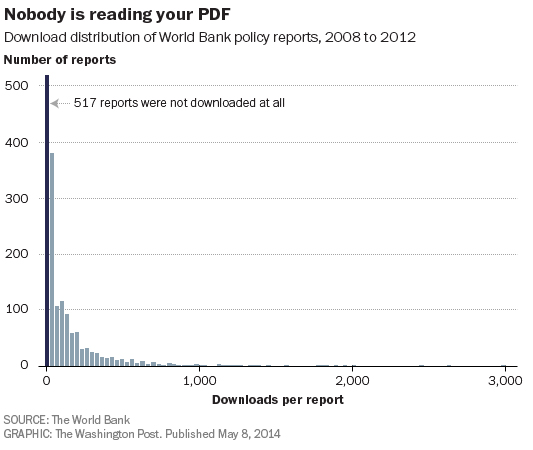
Click on Image to Enlarge

According to a recent report by the World Bank, that scenario is not so far-fetched. The bank is one of those high-minded organizations — Washington is full of them — that release hundreds, maybe thousands, of reports a year on policy issues big and small. Many of these reports are long and highly technical, and just about all of them get released to the world as a PDF report posted to the organization's Web site.

The World Bank recently decided to ask an important question: Is anyone actually reading these things? They dug into their Web site traffic data and came to the following conclusions: Nearly one-third of their PDF reports had never been downloaded, not even once. Another 40 percent of their reports had been downloaded fewer than 100 times. Only 13 percent had seen more than 250 downloads in their lifetimes. Since most World Bank reports have a stated objective of informing public debate or government policy, this seems like a pretty lousy track record.

Read full article.

Continue reading “Berto Jongman: Washington Post Discovers Deep Web — and the World Bank's Unindexed PDFs — PBI Technical Team Comments”

noble gold