Mini-Me: 50% of US Troops in Chronic Pain on Opioids

07 Health, Military
Who, Mini-Me?
Who, Mini-Me?

Huh?

Half of American Combat Soldiers in Chronic Pain Use Opioids

About half of the American soldiers deployed to Iraq and Afghanistan return home to the U.S. in chronic pain, according to a new study that also found about one in seven soldiers were using opioid pain relievers.

The study, the first to assess the prevalence of chronic pain and opioid use in the infantry after combat deployment, is being published in JAMA Internal Medicine.

Continue reading “Mini-Me: 50% of US Troops in Chronic Pain on Opioids”

2014 Robert Steele On Defense Intelligence – Seven Strikes

Corruption, Director of National Intelligence et al (IC), DoD, Ineptitude, Military, Office of Management and Budget, Officers Call, Peace Intelligence, Threats, True Cost
Robert Steele
Robert Steele

On Defense Intelligence: Seven Strikes

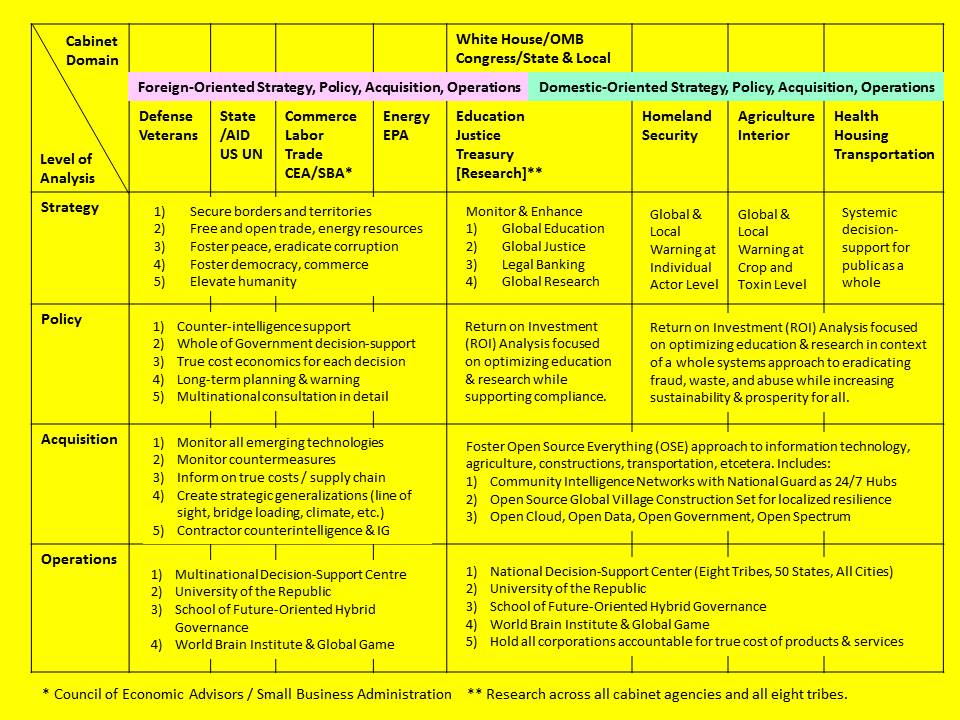
I consider defense intelligence today to be incoherent and ineffective. It has no grasp of the totality of the threat; it is largely worthless in providing SecDef with evidence-based decision support relevant to strategy, policy, acquisition, and operations; and it does not help DoD within the Cabinet when decision-support is needed to keep the Department of State honest (on the Afghan run-off election, for example), or to make the case for Whole of Government (USG) alternatives to military employment, particularly in the critical peaceful preventive measures and post-war stabilization & reconstructions domains.

Continue reading “2014 Robert Steele On Defense Intelligence – Seven Strikes”

Georgi Alexandrov Stankov: Announcement on the New Theory of the Universal Law

Collective Intelligence, Cultural Intelligence, Earth Intelligence, Extraterrestial Intelligence

Announcement on the New Theory of the Universal Law

Herewith I announce the donation of

ONE MILLION EURO (€ 1 000 000,-)

to the first scientific institution that recognizes the eternal validity of the New Theory of the Universal Law and complies with the following rules as set below.

The Objective of this prize competition was fairly simple:

Continue reading “Georgi Alexandrov Stankov: Announcement on the New Theory of the Universal Law”

Mini-Me: Confidence in US Government Plummets

Civil Society, Cultural Intelligence, Government
Who?  Mini-Me?
Who? Mini-Me?

Huh?

Poll: Confidence in government plummets

Kendall Breitman

Politico.com, 30 June 2014

Americans are losing confidence in all three branches of government, as confidence in the Supreme Court and Congress has dropped to record lows and the White House has hit a six-year dip, according to a new poll.

In a Gallup poll released Monday, 30 percent of Americans expressed confidence in the Supreme Court, 7 percent in Congress and 29 percent in the presidency.

Continue reading “Mini-Me: Confidence in US Government Plummets”

SchwartzReport: Joseph Stiglitz – Inequality Not Inevitable

Civil Society, Commerce, Commercial Intelligence, Cultural Intelligence, Government
Stephan A. Schwartz
Stephan A. Schwartz

The Great Divide

Inequality Is Not Inevitable

By JOSEPH E. STIGLITZ

AN insidious trend has developed over this past third of a century. A country that experienced shared growth after World War II began to tear apart, so much so that when the Great Recession hit in late 2007, one could no longer ignore the fissures that had come to define the American economic landscape. How did this “shining city on a hill” become the advanced country with the greatest level of inequality?

One stream of the extraordinary discussion set in motion by Thomas Piketty’s timely, important book, “Capital in the Twenty-First Century,” has settled on the idea that violent extremes of wealth and income are inherent to capitalism. In this scheme, we should view the decades after World War II — a period of rapidly falling inequality — as an aberration.

This is actually a superficial reading of Mr. Piketty’s work, which provides an institutional context for understanding the deepening of inequality over time. Unfortunately, that part of his analysis received somewhat less attention than the more fatalistic-seeming aspects.

Read full article.

noble gold