Another depressing story of government-corporate corrupt cooperation, especially involving intelligence and law enforcement agencies. An image of fascism in motion. This section of the article refers to Canadian activities of said agencies:
This book has been ordered and will be reviewed shortly. There are no guest reviews to be drawn from.
Amazon Book Description:
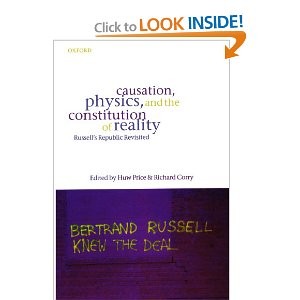
The difference between cause and effect seems obvious and crucial in ordinary life, yet missing from modern physics. Almost a century ago, Bertrand Russell called the law of causality ‘a relic of a bygone age'. In this important collection 13 leading scholars revisit Russell's revolutionary conclusion, discussing one of the most significant and puzzling issues in contemporary thought.
Things have come to a strange state of affairs when Washington regards Avigdor Lieberman, Israel’s far-right foreign minister, as the voice of moderation in the Israeli cabinet.
In recent days, the media has given flashy prominence to a story about top political figures in China stashing great sums offshore — the list of culprits going back many years to Deng Hsiao-ping. We are told this is corrupt and evil, so we are to be shocked and outraged, when we are told repeatedly that ordinary Chinese workers only make $30 a month.
This is black propaganda, to balance recent news that China has now surpassed America industrially. Also, it isn’t really news.
Amazon Page
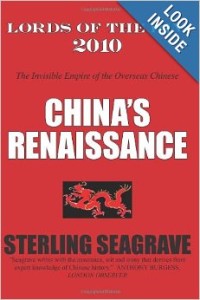
As we pointed out in our book LORDS OF THE RIM, Chinese who had money — the rich and the middle class — have been stashing it offshore for upwards of a thousand years, to keep emperors from seizing it. So nothing's new about this recent propaganda blast, except the attempt to blacken the names of current top Chinese leaders. They, or their relatives, always stashed hoards offshore. Which is how they came to control The Philippines, Taiwan, much of Indo-China, most of Siam, and large parts of what is now Indonesia and Malaysia. From these hoards emerged today's giant companies, banks, and oligarchs of the Pacific Rim, including some of the biggest Asian multinationals.
Lord Martin Rees, Fellow of Trinity College and Emeritus Professor of Cosmology and Astrophysics at the University of Cambridge, is interviewed about catastrophic risks.
You recently set up the Cambridge Centre for the Study of Existential Risk, along with philosopher Huw Price and Skype co-founder Jaan Tallinn. What do you hope to achieve? We believe governments and corporations are in denial about new risks that have only a small likelihood of occurring, but which would be truly catastrophic if they did occur. We’d like people to spend more time and energy thinking about these risks, rather than focusing mainly on risks that are more familiar but relatively limited, like train crashes.