Stephen Lendman: Police in the USA – License to Kill [with Impunity]

06 Family, 07 Other Atrocities, 09 Justice, 11 Society, Corruption, Idiocy, Ineptitude, Law Enforcement
Stephen Lendman
Stephen Lendman

Police in America: Licensed to Kill

by Stephen Lendman

Miriam Carey is the latest victim. She deserved to live, not die. More on her below.

Incidents occur daily across America. Blacks and Latinos are most vulnerable. Police shoot innocent suspects for any reason or none all.

Rarely are officers or their superiors held accountable. On average, US police kill one or two people daily. Most often, incidents go unnoticed.

Violence in America is systemic. Previous articles discussed it. America glorifies wars. It does so in the name of peace.

It has by far the highest homicide rate among all developed nations. It’s obsessed with owning guns.

Violent films are some of the most popular. So are similar video games. Peace, stability and security are convenient illusions. Imperial wars and domestic violence crowd them out.

Communities, neighborhoods, schools, work places, commercial areas and city streets are affected. Driving while black is dangerous.

A 1999 ACLU report discussed it. Titled “Driving While Black: Racial Profiling On Our Nation’s Highways,” it said:

It’s longstanding practice in America. In 1967, dozens of witnesses told Kerner Commission members that “stopping of Negroes on foot or in cars without obvious basis” was a key reason for riots the previous summer in cities across America.

The Fourth Amendment assures “(t)he right of the people to be secure in their persons, houses, papers, and effects, against unreasonable searches and seizures.”

The Eight Amendment prohibits “cruel and unusual punishments.”

What’s crueler than state-sponsored cold-blooded murder.

The Fifth Amendment prohibits “depriv(ing) (anyone) of life, liberty, or property, without due process of law.”

The 14th Amendment forbids states from “depriv(ing) any person of life, liberty, or property, without due process of law.” It affirms “equal protection of the laws.”

Police across America spurn constitutional and US statute laws. They do so with impunity. According to ACLU:

Continue reading “Stephen Lendman: Police in the USA – License to Kill [with Impunity]”

Berto Jongman: Food Security — Rotten Intelligence, Worse Ethics

01 Agriculture, 05 Energy, 11 Society, 12 Water, Collective Intelligence, Earth Intelligence
Berto Jongman
Berto Jongman

Uncertainty on figures hampering food security efforts

Mark Kinver

BBC News, 4 October 2013

More than 600 scientists gathered in the Netherlands for a global food security conference, described as the first of its kind.

Organisers said science could help end uncertainty surrounding efforts to meet the food needs of future generations.

They added that, until now, there were many policy debates on food security but there was no scientific forum for researchers to share knowledge.

The next food security conference will be held in the US in 2015.

“A really key message from the conference for us is that we have got lots of estimates about needs of population growth etc, but at the moment we are so uncertain of the exact numbers – the uncertainty is really very high,” said conference co-chairman Ken Giller, professor of plant production systems at Wageningen University.

“We talk about the current population being seven billion, moving to 9.2 billion in 2050 and the estimate is that we need to increase production 70% or more.

“But there are many different ways of addressing that. If we don't know what the problem is then we can't get started in addressing them.”

Continue reading “Berto Jongman: Food Security — Rotten Intelligence, Worse Ethics”

Berto Jongman: CIA and Death of Hastings?

07 Other Atrocities
By Kimberly Dvorak

Above: Jeff Powers talks with contributing reporter Kimberly Dvorak, who discusses the latest information on the death of journalist Michael Hastings.

— Includes Short New Video

San Diego 6 continues to receive numerous inquiries regarding the status of its investigation into the death of National Security reporter Michael Hastings. Hastings died in a single car accident in Los Angeles on June 18, 2013. Videos of the crash scene depict several explosions that resulted in a huge fireball. The 911 call transcripts obtained by San Diego 6 also confirmed multiple explosions.

The Los Angeles Police Department determined early in the investigation process that no foul play was suspected in Hastings’ single car accident, yet nearly four months later the LAPD refuses to release its investigative report. Continue reading “Berto Jongman: CIA and Death of Hastings?”

Berto Jongman: Postwar Model

Collective Intelligence, Cultural Intelligence, Peace Intelligence
Berto Jongman
Berto Jongman

Postwar

Robert Chesney

University of Texas School of Law

September 27, 2013

Harvard National Security Journal (2014 Forthcoming)

Abstract:

Does it really matter, from a legal perspective, whether the U.S. government continues to maintain that it is in an armed conflict with al Qaeda? Critics of the status quo regarding the use of lethal force and military detention tend to assume that it matters a great deal, and that shifting to a postwar framework will result in significant practical change. Supporters of the status quo tend to share that assumption, and oppose abandoning the armed-conflict model for that reason. But both camps are mistaken about this common premise. For better or worse, shifting from the armed-conflict model to a postwar framework would have far less of a practical impact than both assume.

Continue reading “Berto Jongman: Postwar Model”

Jon Rappoport: SHOCK – Deaths from Medical Drugs and Vitamins Far Exceed Deaths from Wars

07 Health, 07 Other Atrocities, 10 Transnational Crime, 11 Society, Commerce, Corruption, Government
Jon Rappoport
Jon Rappoport

Shock: Comparing deaths from medical drugs, vitamins, and all US wars

People want to believe medical science gives us, at any given moment, the best of all possible worlds.

And of course, the best of all possible worlds must have its enemies: the quacks who sell unproven snake oil.

So let’s look at some facts.

As I’ve been documenting in my last several articles, the medical cartel has been engaged in massive criminal fraud, presenting their drugs as safe and effective across the board—when, in fact, these drugs have been killing and maiming huge numbers of people, like clockwork.

I’ve cited the review, “Is US Health Really the Best in the World?”, by Dr. Barbara Starfied (Journal of the American Medical Association, July 26, 2000), in which Starfield reveals the American medical system kills 225,000 people per year—106,000 as a direct result of pharmaceutical drugs.

Continue reading “Jon Rappoport: SHOCK – Deaths from Medical Drugs and Vitamins Far Exceed Deaths from Wars”

David Swanson: Is USG Tripping on Drugs?

03 Economy, 11 Society, Cultural Intelligence
David Swanson
David Swanson

Is the Federal Government a Drug-Induced Hallucination?

You laugh, but that could be a side-effect.  Consider:

The Capitol Police just murdered an unarmed mother fleeing her car on foot, declared her child “unharmed,” and received the longest standing-ovation in Congress since Osama bin Laden's Muslim sea burial.  Try holding your breath until Congress takes the standing ovation back, and you'll wish your were in the “Holy Land” having your house sprayed with “Skunk” artificial sewage by the Israeli military or in Old Town Alexandria tasting the air of the authentic raw sewage across the river until it's “treated” and spread on farms in the exurbs for the benefit of we the people.

Why? Because freedom.

Continue reading “David Swanson: Is USG Tripping on Drugs?”

David Swanson: Beginning the Ending of War (Again)

Cultural Intelligence, Peace Intelligence
David Swanson
David Swanson

Beginning the Ending of War

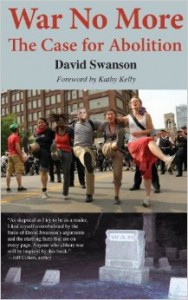
This article is the Introduction to the new book War No More: The Case for Abolition, published in October 2013.

As I write this, in September 2013, something extraordinary has just happened. Public pressure has led the British Parliament to refuse a prime minister's demand for war for the first time since the surrender at Yorktown, and the U.S. Congress has followed suit by making clear to the U.S. president that his proposed authorization for war on Syria would not pass through either the Senate or the House.

Now, this may all fall apart in a week or a month or a year or a decade. The forces pressing for a war on Syria have not gone away. The civil war and the humanitarian crisis in Syria are not over. The partisan makeup of the Parliament and the Congress played a role in their actions (although the leaders of both major parties in Congress favored attacking Syria). Foreign nations' intervention played a role. But the decisive force driving governments around the world and U.S. government (and military) insiders to resist this war was public opinion. We heard the stories of children suffering and dying in Syria, but we rejected the idea that killing more Syrians with U.S. weapons would make Syria better off.

Those of us who believe that we should always have the right to reject our government's arguments for war should feel empowered. Now that it's been done, we cannot be told it's impossible to do it again … and again, and again.

Amazon Page
Amazon Page

In the space of a day, discussions in Washington, D.C., shifted from the supposed necessity of war to the clear desirability of avoiding war. If that can happen once, even if only momentarily, why can it not happen every time? Why cannot our government's eagerness for war be permanently done away with? U.S. Secretary of State John Kerry, who led the unsuccessful marketing campaign for an attack on Syria, had famously asked, many years earlier, during what the Vietnamese call the American War, “How do you ask a man to be the last man to die for a mistake?” We have it within our power to make war a thing of the past and to leave Secretary Kerry the last man to have tried to sell us a dead idea.

(An argument will be made that the threat of war aided diplomatic efforts to disarm the Syrian government. It should not be forgotten that when Kerry suggested that Syria could avoid a war by handing over its chemical weapons, everyone knew he didn't mean it. In fact, when Russia called his bluff and Syria immediately agreed, Kerry's staff put out this statement: “Secretary Kerry was making a rhetorical argument about the impossibility and unlikelihood of Assad turning over chemical weapons he has denied he used. His point was that this brutal dictator with a history of playing fast and loose with the facts cannot be trusted to turn over chemical weapons, otherwise he would have done so long ago. That's why the world faces this moment.” In other words: stop getting in the way of our war! By the next day, however, with Congress rejecting war, Kerry was claiming to have meant his remark quite seriously and to believe the process had a good chance of succeeding.)

In this book I make the case outlined in the four section titles: War can be ended; War should be ended; War is not going to end on its own; We have to end war. 

Continue reading “David Swanson: Beginning the Ending of War (Again)”

noble gold