Phi Beta Iota: All our sources call into question all claims that CW has been used by anyone. The highest probability is that the rebels are faking it hoping to lure the USA into Syria the way the USA lured Russia into Afghanistan. We tend not to believe that the USA is behind the effort, or it would have come off much more credibly (witness the Boston false flag endeavor). Truth is a casualty across all fronts on the matter of Syria.
This story was sent to me by several people, two of whom live in the Texas towns described here where water, as a result of Fracking, has become a very real issue.
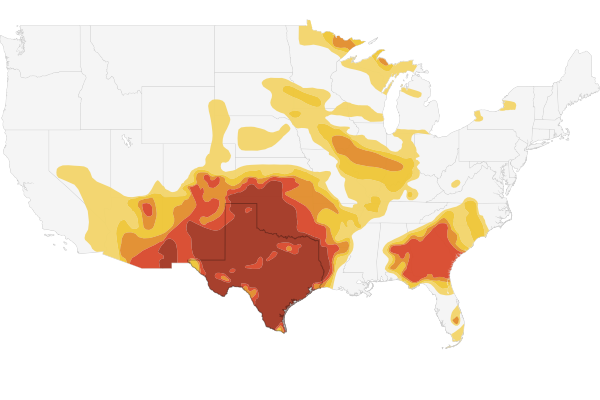
More than 30 towns in West Texas will soon be out of water as a direct result of diverting their underground water supplies for use in hydraulic fracking. Largely unregulated fracking, it should be said. Largely unregulated fracking that is definitely putting arsenic into the ground it happens to be drying out. Before you start acting horrified, though, consider: this is exactly what Texas’ mental-midget teabillies voted for.
Despite the vast consensus of climate scientists, the highly publicized destructive effects of fracking on water supplies, fracking’s seismic impact, and the evidence of their own senses, the mentally deficient residents of Texas keep electing politicians who believe climate change is a myth, and who think the best course of action to address Texas’ crippling drought is several days of organized prayer. Really.
Maybe Rick Perry and the idiots that voted him back into office will be able to pray in some new drinking water while the non-stupid people of Texas pray for a governor with a triple-digit IQ. While you’re waiting to see how that works out for the citizens of West Texas, take some time to watch this interview with Antonia Juhasz, an oil and energy analyst, author, and journalist.
Fair warning, though: if you live in Texas, you probably won’t enjoy it.
Mr. Chairman, Senator Lugar, and Members of the Committee: I thank you for the opportunity to appear before you today to discuss U.S. strategy in Afghanistan and the possible effects on Pakistan of our future policies there.
U.S. Involvement, Eighth Year or 30th Year?
The search for a successful outcome in Afghanistan and neighboring Pakistan requires an understanding of how we arrived at this critical point in our Afghan undertaking, as well as new thinking on how we might proceed. I have been involved in the region since the mid-1980s, when I was ordered to Pakistan by CIA director Bill Casey to manage America’s covert assistance to the Afghan resistance in their war against the occupation forces of the Soviet Union. I have remained active in Afghan and Pakistan matters in the intervening years, assisting in 2008, on the negotiations on legislation concerning Reconstruction Opportunity Zones in Pakistan and Afghanistan. More recently, I have been active in support of the United States Government’s efforts to stabilize Afghanistan through development and business stability operations.
As we discuss future policy options, we should bear in mind that America is not beginning its 9th year of involvement in Afghanistan; it is, rather, closing in on thirty years of intermittent association with a regional conflict that began with the Soviet Union’s 1979, invasion of Afghanistan. It is a history of three decades of action, neglect, and reaction that have had profound effects on American security and on Afghanistan, Pakistan and the other important players in the region.
ISLAMABAD: Pakistan and Afghanistan are moving towards joint management of common rivers starting with construction of a 1,500MW hydropower project on Kunar River — a major tributary of Kabul River contributing almost 13 million acres feet (MAF) annually to Pakistan.
DUSHANBE (NNI): Officials of water and energy sector from Iran, Afghanistan and Tajikistan held a trilateral meeting on the sidelines of an international conference on water cooperation on Wednesday.
During the meeting, Alireza Daemi, director of Water Catchment Department of the Iranian Energy Ministry and water and energy ministers of Afghanistan and Tajikistan emphasized the necessity of cooperation in implementing joint energy projects.
The construction process of Tajikistans Sangtoudeh-II power plant which will be completed by yearend with joint investment of Iran and Tajikistan was also discussed.
Phi Beta Iota: Below the line is a comprehensive index to posts on Syria by 4th Media, Berto Jongman, Chuck Spinney, David Swanson, DefDog, Franklin Lamp, Gordon Duff, Graphics, John Maguire, Kevin Barrett, Marcus Aurelius, Mini-Me, Neal Rauhauser, NIGHTWATCH, Owl, Paul Craig Roberts, Review, Stuart Littlewood, and Vladimir Putin.
Click on Image to EnlargeClick on Image to EnlargeAmazon Page
Did you know that yesterday, 23 August 2013, was the World Wide Web's birthday? It is 22 years and one day since the official Internaut Day – the day when Sir Tim Berners-Lee opened up the web to new users and kicked off a global communications revolution.
How fitting then that it was in the web's 21st year, the year that traditionally signals the final transition from innocence to maturity, in which the scales fell from our eyes and we began to understand the vast scope and ambition of government internet surveillance.
If the Internet Engineering Task Force has its way then it may also become known as the year when we began to toughen up and make a web that's fit for a grown-up world.
Emphasis below added by Milt Bearden, former CIA chief in Pakistan also responsible for the field aspects of the CIA's covert support against Soviet forces in Afghanistan.
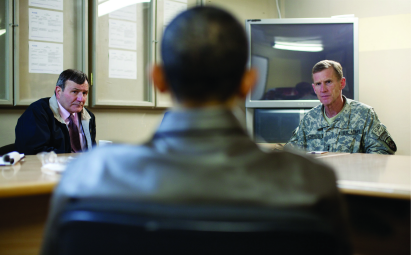
Eikenberry, Obama, and General Stanley McChrystal in Afghanistan, March 2010. (Pete Souza / White House)
KARL W. EIKENBERRY is William J. Perry Fellow in International Security at the Center for International Security and Cooperation at the Freeman Spogli Institute for International Studies at Stanford University. He served as Commanding General of the Combined Forces Command–Afghanistan from 2005 to 2007 and as U.S. Ambassador to Afghanistan from 2009 to 2011.
Since 9/11, two consecutive U.S. administrations have labored mightily to help Afghanistan create a state inhospitable to terrorist organizations with transnational aspirations and capabilities. The goal has been clear enough, but its attainment has proved vexing. Officials have struggled to define the necessary attributes of a stable post-Taliban Afghan state and to agree on the best means for achieving them. This is not surprising. The U.S. intervention required improvisation in a distant, mountainous land with de jure, but not de facto, sovereignty; a traumatized and divided population; and staggering political, economic, and social problems. Achieving even minimal strategic objectives in such a context was never going to be quick, easy, or cheap.
Of the various strategies that the United States has employed in Afghanistan over the past dozen years, the 2009 troop surge was by far the most ambitious and expensive. Counterinsurgency (COIN) doctrine was at the heart of the Afghan surge. Rediscovered by the U.S. military during the wars in Afghanistan and Iraq, counterinsurgency was updated and codified in 2006 in Field Manual 3-24, jointly published by the U.S. Army and the Marines. The revised
doctrine placed high confidence in the infallibility of military leadership at all levels of engagement (from privates to generals) with the indigenous population throughout the conflict zone. Military doctrine provides guidelines that inform how armed forces contribute to campaigns, operations, and battles. Contingent on context, military doctrine is
meant to be suggestive, not prescriptive.
Broadly stated, modern COIN doctrine stresses the need to protect civilian populations, eliminate insurgent leaders and infrastructure, and help establish a legitimate and accountable host-nation government able to deliver essential human services. Field Manual 3-24 also makes clear the extensive length and expense of COIN campaigns: “Insurgencies are protracted by nature. Thus, COIN operations always demand considerable expenditures of time and resources.”





 How fitting then that it was in the web's 21st year, the year that traditionally signals the final transition from innocence to maturity, in which the scales fell from our eyes and we began to understand the vast scope and ambition of