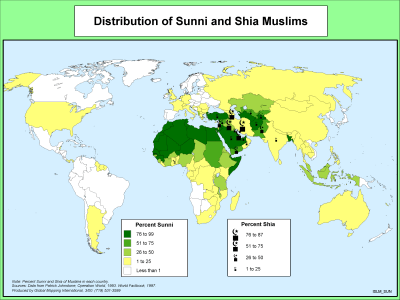
Syria-Lebanon: According to a Beirut newspaper, the Syrian opposition group affiliated with al Qaida, the Al-Nusrah Front, has distributed a statement announcing that it will commence military operations in Lebanon.
The statement said, “If Hizballah is not deterred from killing our mujahideen brethren in Syria, and if its members do not withdraw from the Syrian areas of Al-Qusayr in three days, we will harshly respond in the different Lebanese territories, particularly in the border areas, Al-Biqa, and Beirut's Southern Suburb, where the rejectionist members of Hizballah are spreading. We will target markets, schools, public institutions, and parks.”
Comment: The term rejectionist is a derogatory description of the Shiites, Hizballah. Syrian opposition sources claim fierce fighting is occurring in al Qusayr, Syria, which is close to the northeastern Lebanon border. Hizballah is fighting in support of the Syrian army forces.
The significance of the statement is that it means al Qaida could have a franchise operating in Lebanon by next week. The Al-Nusrah Front has the capability to carry out this threat and spread the Syrian fighting deeper into Lebanon.
Pakistan: Press reports indicate a US drone attack killed a senior Pakistani Taliban leader and, variously, from four to seven comrades today. The Pakistani Taliban denied that Wali ur Rehman Mehsud was killed.
Comment: Reaction to this drone attack has been mixed, but the timing relative to political developments in Pakistan is unfortunate. The new parliament has not yet convened and the new government is not in place. Prime Minister-nominee Nawaz Sharif promised peace talks with the Pakistani Taliban to try to restore law and order and he promised to stop the drone strikes.
One commentator said the attack shows the US has no respect for Pakistan. Another opined that peace talks with the Pakistani Taliban are now dead.
Identifying user sentiment has become one of the most powerful analytic tools provided by text processing companies, and Bitext’s integrative software approach is making sentiment analysis available to companies seeking to capitalize on its benefits while avoiding burdensome implementation costs. A few years ago, Lexalytics merged with Infonics. Since that time, Lexalytics has been marketing aggressively to position the company as one of the leaders in sentiment analysis. Exalead also offered sentiment analysis functionality several years ago. I recall a demonstration which generated a report about a restaurant which provided information about how those writing reviews of a restaurant expressed their satisfaction.
Today vendors of enterprise search systems have added “sentiment analysis” as one of the features of their systems. The phrase “sentiment analysis” usually appears cheek-by-jowl with “customer relationship management,” “predictive analytics,” and “business intelligence.” My view is that the early text analysis vendors such as Trec participants in the early 2000’s recognized that key word indexing was not useful for certain types of information retrieval tasks. Go back and look at the suggestions for the benefit of sentiment functions within natural language processing, and you will see that the idea is a good one but it has taken a decade or more to become a buzzword. (See for example, Y. Wilks and M. Stevenson, “The Grammar of Sense: Using Part-of-Speech Tags as a First Step in Semantic Disambiguation, Journal of Natural Language Engineering,1998, Number 4, pages 135–144.)
Some of the most lethal episodes of armed violence in recent years have taken place in countries that do not suffer from conflict according to its conventional definitions. At the same time new armed conflicts in Mali and Syria appear to be shaped not just by political differences, but also criminal motives, jihadist ideology and an extraordinary level of violent factionalism. The hybrid character of both armed violence and conflict stands at the heart of current global security concerns. But the specific challenges posed by armed violence in non-conflict settings have yet to receive a coherent response from peace and development professionals. The coercive power exerted by non-state armed groups over communities and territories, and their connection with transnational networks make it hard to negotiate anything more than short-term deals aimed at reducing violence or providing humanitarian relief. Legal provisions to protect civilian lives are particularly difficult to enforce. Hostility towards these groups from states and the international community is deep and widespread, particularly when they are associated with terrorist acts or organised crime. However, this report outlines four areas of future research in policy and programming that would be highly relevant to the work of organisations devoted to peace and humanitarian affairs: the nature of an outreach strategy to armed groups, the legal instruments that are available, the sort of community engagement that should be sought, and the approach towards formal economic and political structures. Establishing a broad network of practitioners, scholars and policymakers is suggested as a means to make progress on all these fronts.
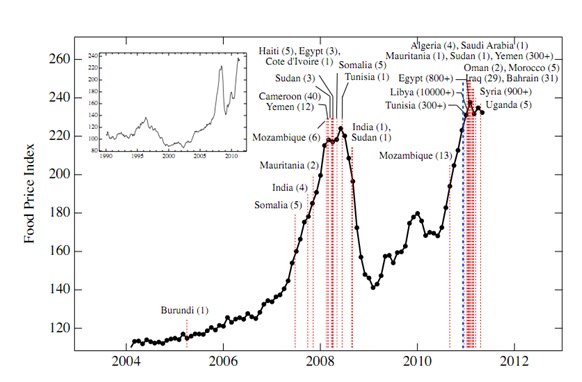
What’s the number one reason we riot? The plausible, justifiable motivations of trampled-upon humanfolk to fight back are many—poverty, oppression, disenfranchisement, etc—but the big one is more primal than any of the above. It’s hunger, plain and simple. If there’s a single factor that reliably sparks social unrest, it’s food becoming too scarce or too expensive. So argues a group of complex systems theorists in Cambridge, and it makes sense.
In a 2011 paper, researchers at the Complex Systems Institute unveiled a model that accurately explained why the waves of unrest that swept the world in 2008 and 2011 crashed when they did. The number one determinant was soaring food prices. Their model identified a precise threshold for global food prices that, if breached, would lead to worldwide unrest.
Click on Image to Enlarge
The MIT Technology Review explains how CSI’s model works: “The evidence comes from two sources. The first is data gathered by the United Nations that plots the price of food against time, the so-called food price index of the Food and Agriculture Organisation of the UN. The second is the date of riots around the world, whatever their cause.” Plot the data, and it looks like this:
Pretty simple. Black dots are the food prices, red lines are the riots. In other words, whenever the UN’s food price index, which measures the monthly change in the price of a basket of food commodities, climbs above 210, the conditions ripen for social unrest around the world. CSI doesn’t claim that any breach of 210 immediately leads to riots, obviously; just that the probability that riots will erupt grows much greater. For billions of people around the world, food comprises up to 80% of routine expenses (for rich-world people like you and I, it’s like 15%). When prices jump, people can’t afford anything else; or even food itself. And if you can’t eat—or worse, your family can’t eat—you fight.
I recently finished reading Roger Thompson's Lessons Not Learned: The U.S. Navy's Status Quo Culture (Naval Institute Press, 2007). I urge those who think we enjoy now and will enjoy in the future some sort of superiority on the seas to read this book. You will find tidbits that you contest, but you will also find overwhelming evidence that the biggest, most expensive navy in the world has hollowed itself out thanks to its own rampant hubris and careerism. This has been the case for a long time, and there is nothing on the horizon to indicate any real improvement.
I encountered exactly the kind of behavior Thompson describes when I worked at GAO. I was assigned to look at the Navy's operational testing of its vaunted Aegis air defense system on CG-47-class cruisers. I found that in cooperative, even fudged testing (as described by inaccurate and incomplete test reports) Aegis performed at a mediocre level against the easier targets and extremely poorly against the most stressful targets–such as the extremely low, extremely fast anti-ship cruise missiles that today populate the inventories of Iran, North Korea, China, Syria and others. The Navy was incensed, convened a kangaroo-court hearing at the Seapower Subcommittee of the House Armed Services Committee and declared the problem solved because it won a superficial public relations battle over GAO with the porkers and Navy boosters who densely populated the subcommittee. The Navy proved itself much more adept at PR struggles than it has in anti-mine warfare in real combat since World War II and in anti-submarine exercises over the same period, as Thompson explains in painful detail.
Pierre Sprey wrote a review of Roger Thompson's excellent book; it follows:
Lessons Not Learned: An Appreciation
For a comprehensive, thoughtful and independent-minded critique of today’s U.S. Navy, I know of no work better than Professor Roger Thompson’s Lessons Not Learned: The U.S. Navy’s Status Quo Culture. I recommend the book as essential reading for anyone interested in or professionally involved in naval matters, whether officer, civilian analyst, contemporary historian, defense journalist or navy buff. It is of particular value and importance to those who are courageous enough and patriotic enough to be committed to military reform. The military reform literature is well endowed with strong critiques of American air and ground forces, but is relatively weak in insightful writings on the Navy’s ineffectiveness and waste of men and money. Thompson’s book fills that gap.
Lessons Not Learned is particularly hard-hitting in documenting the evidence for the U.S. Navy’s ongoing and shocking vulnerability to diesel subs and mines. As he makes clear, both weapons systems are nearly ubiquitous in the maritime Third World and the presence of either turns U.S. control of the seas into a delusion. Equally valuable are Prof. Thompson’s blunt comparisons of the strengths and weaknesses of American naval forces vis a vis the strengths of smaller allied forces. Unsurprisingly, these disparities in combat readiness, tactical skills and exercise outcomes prove to be greatest in anti-mine warfare and anti-submarine warfare—though sadly declining American aerial tactical skills are certainly not glossed over.
But Thompson’s most valuable contribution of all is the thread that runs throughout the book: the most crucial weakness of the U.S. Navy is not materiel or money. It is, plain and simply, the closed-mindedness, hubris and rampant careerism of the Navy’s leadership, greatly magnified by a mindless up-or-out personnel system. That leads to an enlisted force with inadequate skills, morale and training plus an officer corps more focused on promotion and plush retirement jobs than on building a navy competent to win wars.
10,000 angry kids scared the shit out of the powers that be….proved to the government that its views about everything are wrong, and no longer matters — 10,000 angry kids can kick ass whenever and wherever they want.



 We Are Now One Year Away From Global Riots, Complex Systems Theorists Say