Steve Aftergood: 2014 US Intelligence Community Budget $62.8 Billion

Corruption, Government, Ineptitude, IO Deeds of War, IO Impotency
Steven Aftergood
Steven Aftergood

Intelligence Budget Requests for 2014 Disclosed

Some $4 billion is being cut from the National Intelligence Program this year as a result of sequestration, Director of National Intelligence James Clapper told the House Intelligence Committee at a hearing today. He said that the consequences will be severe. Acquisition programs will be “wounded,” ongoing programs will have to be curtailed, and the ensuing degradation of intelligence capabilities will be “insidious” with unforeseeable effects, he said.

Meanwhile, the Office of the Director of National Intelligence disclosed yesterday that the FY 2014 budget request for the National Intelligence Program (NIP) is $48.2 billion.  However, this figure excludes the pending funding request for Overseas Contingency Operations (OCO), so it cannot be directly compared to previous budget allocations, such as the $53.9 billion that was appropriated in FY 2012, or the $52.6 billion that was requested for FY 2013. A summary of the FY 2014 budget request is here.

The Secretary of Defense also disclosed the FY 2014 budget request for the Military Intelligence Program (MIP) yesterday, which was $14.6 billion. It also did not include the funding request for Overseas Contingency Operations.  This is a slight decline from the $14.7 billion base request for the MIP last year.  (An additional $4.5 billion was known to have been requested for OCO in the past fiscal year.)

Total intelligence spending (NIP plus MIP) peaked in Fiscal Year 2010, and has been on a downward slope since then. Intelligence budget disclosures from the last several years are tabulated here.

The NIP intelligence budget request was publicly disclosed for the first time in February 2011, in response to a requirement enacted by Congress in the FY 2010 intelligence authorization act. The MIP intelligence budget request was disclosed for the first time in February 2012, even though there was no specific statutory requirement to do so.

FISCAL YEAR NIP BUDGET MIP BUDGET TOTAL
2012 53.9 billion 21.5 billion 75.4 billion
2011 54.6 billion 24 billion 78.6 billion
2010 53.1 billion 27 billion 80.1 billion
2009 49.8 billion 26.4 billion 76.2 billion
2008 47.5 billion 22.9 billion 70.4 billion
2007 43.5 billion 20 billion 63.5 billion

Phi Beta Iota: With Special Operations now playing a greater intelligence role, one could argue that both the black and the green budgets should be considered together to get a true total of US Government secret and covert operations — and of course that is only what is on the books, not all the stuff funded by Saudi Arabia, indirectly via Israel, and other third party players.  The “priorities” in the highlights are vapor — and reaffirm that the US IC is not at all interested in actually producing decision support for Whole of Government planning, programming, budgeting, and execution (PPBS/E).


Berto Jongman: Andriod Smartphone Hack Controls Aircraft

IO Impotency
Berto Jongman
Berto Jongman

Researcher hacks aircraft controls with Android smartphone

This may give the TSA some ideas

Free whitepaper – IT infrastructure monitoring strategies

A presentation at the Hack In The Box security summit in Amsterdam has demonstrated that it's possible to take control of aircraft flight systems and communications using an Android smartphone and some specialized attack code.

Hugo Teso, a security researcher at N.Runs and a commercial airline pilot, spent three years developing the code, buying second-hand commercial flight system software and hardware online and finding vulnerabilities within it. will cause a few sleepless nights among those with an interest in aircraft security.

Teso's attack code, dubbed SIMON, along with an Android app called PlaneSploit, can take full control of flight systems and the pilot's displays. The hacked aircraft could even be controlled using a smartphone's accelerometer to vary its course and speed by moving the handset about.

“You can use this system to modify approximately everything related to the navigation of the plane,” Teso told Forbes. “That includes a lot of nasty things.”

Read full article.

Arabia Rising: Understanding Transformations & Revolutions in the Middle East

Worth A Look
Arabia Rising
Arabia Rising

Esam Al-Amin, The Arab Awakening Unveiled: Understanding Transformations and Revolutions in the Middle East. Washington, DC: American Educational Trust, 2013.

Jadaliyya (J): What made you write this book, and how would you describe it?

Esam Al-Amin (EA): The Arab Awakening Unveiled: Understanding Transformations and Revolutions in the Middle East is a collection of essays about the Arab uprisings and awakening movement, arguably the most important phenomenon that has taken place in the Middle East in the past century. I hope that the book provides thoughtful analysis and a keen understanding of this historical moment, as well as important aspects of US policy towards the Middle East and the Muslim World. For example, the book examines the main causes and effects of the Arab revolutions, especially in Egypt, and describes in details the role of each player in the political dynamics that has been taking place in the last two years across the Arab World, but particularly in Egypt. In addition, American foreign policy objectives and maneuvers vis-à-vis the changes brought about by the uprisings are also discussed and analyzed in many of these articles.

J: What particular topics does this work address?

Continue reading “Arabia Rising: Understanding Transformations & Revolutions in the Middle East”

Penguin: Commercial Co-Optation (Corruption) of Civil Rights & Non-Profits Across USA — and Mayor Bloomberg Did the Right Thing?

Civil Society, Commerce, Corruption
Who, Me?
Who, Me?

This trend is about to continue and we can expect more and more technological solutions that are tailored to the HLS needs. In many cases the industries, especially in Israel, “teach” the market what it needs. This may look a twisted process, but it is not. On the contrary, This is a very healthy trend that can result in more robust solutions in the international home land security efforts.

Corrupting Civil Rights: Sham Colleges, Loan Usury, and Soda

New York City MayBloomberg and the Eagleor Michael Bloomberg recently made national headlines by attempting to regulate big, sugary drinks.  He spearheaded a new municipal law that greatly curbs the sale of such beverages over 16 ounces in size, and mandated calorie counts as part of the labeling.

But Bloomberg suffered a major setback when New York State Supreme Court Justice Milton Tingling (I am not making that name up) struck down the law before it could take effect.  Now a torturous appeals processes lies ahead.

Staunching the Bloomberg bill was an enormous victory for the beverage industry.  But this story is about far more than the failings of a paternalistic politician, about multinationals interfering in public policy, or about rampant obesity in America.  It’s also about how many America’s civil rights organizations have been co-opted by corporate interests.

The very day after Tingling announced his decision, The New York Times published a devastating article detailing how “dozens of Hispanic and African-American civil rights groups, health advocacy organizations, and business associations have joined the beverage industry in opposing soda regulation around the country in recent years.”

It turns out the beverage industry has been lavishing money upon these organizations.  According to the article, it has given tens of millions of dollars over the last decade to non-profits that serve African Americans and Hispanics, including: “National Hispana Leadership Institute, scholarships for local chapters of the National Association for the Advancement of Colored People, financial literacy classes offered by the National Puerto Rican Coalition, and programs from the National Hispanic Medical Association.”

It seems all of that spending paid off when two of the biggest civil rights groups in New York City, the Hispanic Federation and the local chapter of the N.A.A.C.P., repaid the favor by filing an amicus brief supporting the beverage industry’s successful challenge to the Bloomberg’s law.  It also echoed the industry’s success from last year, when it spent millions to buy-off African American and Latino leaders in Richmond, California, who joined them to beat back a proposed penny per ounce tax on sugary beverages.

Read full article with many examples.

Koko: China Rules Africa — and Ghost Towns…. + China Meta-RECAP

02 China, 08 Wild Cards
Koko
Koko

2013-04-03  Applause for China-Africa cooperation (Zambia)

2012-09-18  In Africa’s warm heart, a cold welcome for Chinese (Malawi)

2012-09-03  China in Africa, a Sierra Leonean viewpoint

2012-07-04  Why has China built a ghost town in Africa? Eerie footage shows brand new Angolan city designed for 500,000 lying empty

2011-07-19  Cameron warns Africans over the ‘Chinese invasion' as they pour billions into continent

2008-09-28  PETER HITCHENS: How China has created a new slave empire in Africa

2008-07-18  How China's taking over Africa, and why the West should be VERY worried

2007-08-31  Why China is trying to colonise Africa

See Also:

Continue reading “Koko: China Rules Africa — and Ghost Towns…. + China Meta-RECAP”

John Robb: The Future of Food — Total Transparency & The Beginning of True Cost Economics

01 Agriculture, 03 Economy, 03 Environmental Degradation, 07 Health, 11 Society, Advanced Cyber/IO, Civil Society, Commerce, Commercial Intelligence, Ethics, Liberation Technology, True Cost Meme
John Robb
John Robb

Here's How to Build a More Resilient Food System…

By John Robb

Want to get a glimpse of the future of food?

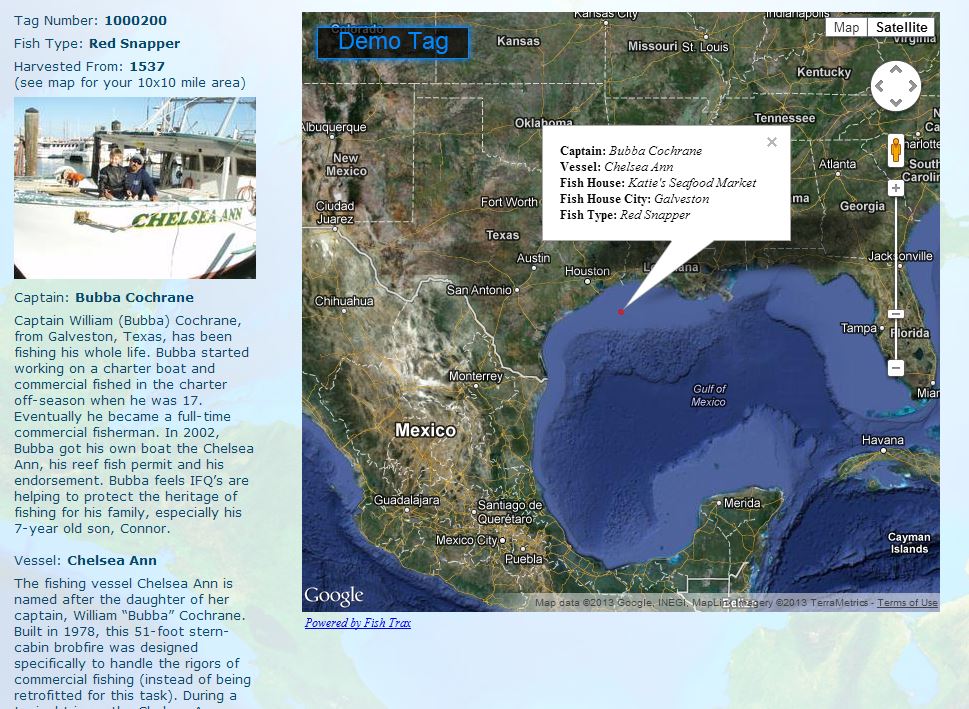
This is the page from Gulf Wild program. When you buy a fish that has a Gulf Wild ID number on it, you can find out everything about it.

Simply enter this ID number on their website or (cell phone) and it will provide you with:

Click on Image to Enlarge
  1. The bio and history of the fisherman who caught the fish.
  2. What the fish is, where the fish was caught (with a map) down to 10 miles, and when it was caught.
  3. Info on fishing practices (e.g. was it caught as part of a sustainable fisheries program?).

NOTE: Canada has a similar program called “This Fish

I believe we're going to see programs like this for all of the food (and an increasing number of products) we buy, from meats to vegetables.

Why? Info like this is addicting. Once you get it, you want it on everything.

Fortunately, it's also really easy to put a service like this together for local producers, and that's a good thing.

Here's why: This type of insight would positively differentiate fresh, high quality local produce from the generic products of indefinite age, quality, and origin we get from the global industrial system.

That would be a good thing, since it would help make local food more plentiful and that makes us ALL more resilient.

Resiliently Yours,
JOHN ROBB

Berto Jongman: Shodan – scariest search engine on the Internet — find one device with zero day crack, then find them all…

Advanced Cyber/IO
Berto Jongman
Berto Jongman

Shodan: The scariest search engine on the Internet

By David Goldman @CNNMoneyTech April 8, 2013: 1:41 PM ET

“When people don't see stuff on Google, they think no one can find it. That's not true.”

That's according to John Matherly, creator of Shodan, the scariest search engine on the Internet.

Shodan runs 24/7 and collects information on about 500 million connected devices and services each month.

It's stunning what can be found with a simple search on Shodan. Countless traffic lights, security cameras, home automation devices and heating systems are connected to the Internet and easy to spot.

Learn more.

noble gold