David S. Kris and J. Douglas Wilson’s second edition of National Security Investigations & Prosecutions is a necessary read, or at least necessary to have in your library, for just about anyone who practices, teaches, or writes about national security law. Kris and Wilson offer what appears to be the country’s sole comprehensive treatise on the law and procedures governing national security investigations. There are at least three audiences who benefit from this work: (1) practicing attorneys in the DOJ and elsewhere in government, who can use the treatise as an operating manual of sorts; (2) law professors, who can use the treatise as a course textbook or to design curricula in national security law courses; and (3) policymakers and legislators, who can use the treatise to explore contemporary issues such as whether the government overreaches in national security investigations and prosecutions, or whether the statutory guidance provided by the Foreign Intelligence Surveillance Act (FISA) and Classified Information Protection Act (CIPA) is sufficient to protect civil liberties and criminal defendants’ rights. It is a testament to Kris and Wilson’s expertise and knowledge that they have assembled a work that will simultaneously appeal and provide significant value to all three audiences.
The treatise consists of thirty three chapters that are organized in two volumes.
Phi Beta Iota: This book has been previously published in 2007, this appears to be a substantially enlarged and updated replacement. It is not yet listed on Amazon.
Researchers use an algorithm to diagnose infectious disease a continent away.
EXTRACT
“Real world information is often vague, minimal, and at times contradictory, so the challenge is to find ways to make good inferences (disease identifications) from such limited data,” says epidemiologist Stephen Morse of Columbia University, one of the paper’s co-authors and creator of the ProMED-mail site.
Click on Image to Enlarge
But the potential to detect outbreaks much faster through the use of statistical models applied to field reports is clear. These tools will find their greatest value in places where deadly pathogens are numerous, diagnostic equipment is hard to find, and time is short.
. . . . . . . .
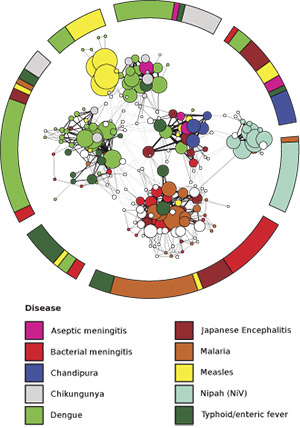
The network of diagnosed outbreaks of diseases with the potential to cause encephalitis (colored) and outbreaks of encephalitis where the cause was removed (white). The inner network describes the strength and relationship of individual outbreaks to each other. The outer ring gives the composition of the 7 communities of disease that were found by the detection algorithm. Each circle represents one outbreak report. Lines connecting two nodes indicate shared traits between two reports.
FBI and CIA Documents claim: Israel has achieved the ability to produce a nuclear bomb after receiving approximately 260 kilograms of enriched uranium from the NUMEC plants, owned by the Jewish-American Zalman Shapiro. According to his testimony in 1981, Karl Dukat, who was Deputy Director of the Central Intelligence Agency stated: “when Richard Helms, CIA director, passed on the evaluation of this important intelligence to President Lyndon Johnson, the President told Helms: Do not tell anyone what you reported to me, not to Dean Rusk (then Secretary of State) or Bob McNamara (then Secretary of Defense). Contacts at NUMEC at the time were Rafi Eitan (then head of the Bureau of Scientific Relations) and Avraham Shalom Bendor, later head of the Shin Bet.”
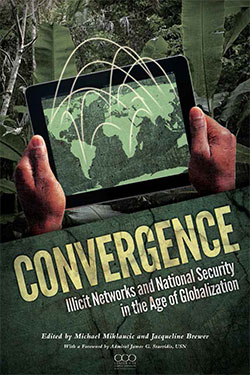
The Center for Complex Operations (CCO) has produced this edited volume, Convergence: Illicit Networks and National Security in the Age of Globalization, that delves deeply into everything mentioned above and more. In a time when the threat is growing, this is a timely effort. CCO has gathered an impressive cadre of authors to illuminate the important aspects of transnational crime and other illicit networks. They describe the clear and present danger and the magnitude of the challenge of converging and connecting illicit networks; the ways and means used by transnational criminal networks and how illicit networks actually operate and interact; how the proliferation, convergence, and horizontal diversification of illicit networks challenge state sovereignty; and how different national and international organizations are fighting back. A deeper understanding of the problem will allow us to then develop a more comprehensive, more effective, and more enduring solution.
I have reached a point where I have been forced to conclude that Monsanto is an evil corporation, as I understand that word. I know, from what you have written me that many of you, as have I and Ronlyn, have signed petitions against Monsanto. Now take the next step. Stop buying their products. Here is a URL where you will find the list of the companies Monsanto owns.
WARNING NOTICE: The list is not accurate and has been removed from Phi Beta Iota. The concept remains valid, but the public must first properly identify all Monsanto companies. We continue to wonder why farmers are not suing Monsanto for willful trespass, unlawful deprivation of property use, and health violations related to the toxicity and third generation infertility that are associated with Monsanto's GMO offerings.
Government officials and their families and associates in Azerbaijan, Russia, Canada, Pakistan, the Philippines, Thailand, Mongolia and other countries have embraced the use of covert companies and bank accounts.
The mega-rich use complex offshore structures to own mansions, yachts, art masterpieces and other assets, gaining tax advantages and anonymity not available to average people.
Click on Image to Enlarge
Many of the world’s top’s banks – including UBS, Clariden and Deutsche Bank – have aggressively worked to provide their customers with secrecy-cloaked companies in the British Virgin Islands and other offshore hideaways.
A well-paid industry of accountants, middlemen and other operatives has helped offshore patrons shroud their identities and business interests, providing shelter in many cases to money laundering or other misconduct.
Ponzi schemers and other large-scale fraudsters routinely use offshore havens to pull off their shell games and move their ill-gotten gains.
EXTRACT
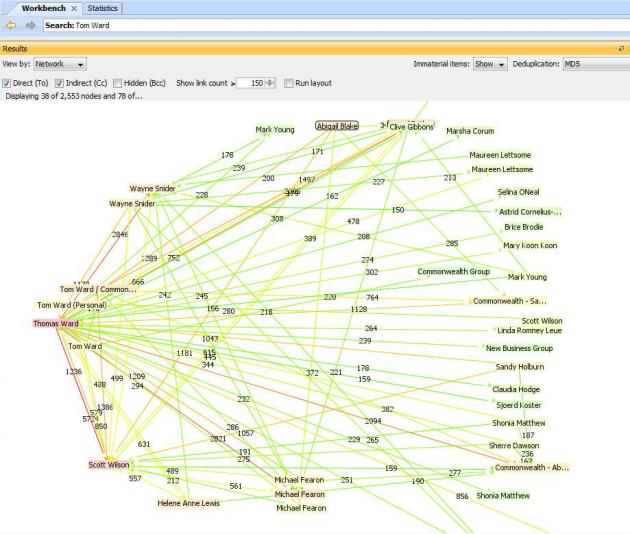
The major software tools used for the Offshore Project were NUIX of Sydney, Australia, and dtSearch of Bethesda, Md. NUIX Pty Ltd provided ICIJ with a limited number of licenses to use its fully featured high-end e-discovery software, free of charge. The listed cost for the NUIX software was higher than a non-profit organization like the ICIJ could afford, if the software had not been donated.