President Obama’s response to Mitt Romney comments on the size of the U.S. Navy during Monday’s debate did not “play well” with American voters, former CIA Director Michael Hayden tells Newsmax.
Romney complained that the Navy is “smaller now than any time since 1917.”
Obama responded: “We also have fewer horses and bayonets, because the nature of our military has changed.”
He added sarcastically: “We have these things called aircraft carriers, where planes land on them. We have these ships that go under water, nuclear submarines.” The issue, he said, “is not a game of Battleship, where we are counting ships.”
Earth Economics is a non-profit located in Tacoma, Washington, dedicated to researching and applying the economic solutions of tomorrow, today.
Earth Economics provides robust, science-based, ecologically sound economic analysis, policy recommendations and tools to positively transform regional, national and international economics, and asset accounting systems.
Working with leading ecologists, economists and modelers, we serve a large circle of businesses, non-profits, government agencies, policy makers and media channels with research, reports, presentations, workshops and investigations.
In the world of security clearances for access to classified information, the term “reciprocity” is used to indicate that one executive branch agency should ordinarily recognize and accept a security clearance that has been granted by another executive branch agency.
This is not just a nice, cost-efficient thing to do, it is actually a requirement of law. Under the 2004 intelligence reform law, “all security clearance background investigations and determinations… shall be accepted by all agencies.”
This requirement for mutual recognition and acceptance applies equally to the higher order clearances of the intelligence community, where reciprocity is intended to promote employee “mobility” throughout the intelligence system, according to the 2009 Intelligence Community Directive 709.
So possessing a clearance from one agency should simplify the process of access approval at another agency. But the opposite is not supposed to be true. If an agency refuses for some reason to recognize the clearance granted by another agency, that refusal is not supposed to incur loss of clearance in the original agency.
Officially, such “negative reciprocity” is not an authorized, legitimate security clearance practice. And yet there are signs that it is being adopted within the Department of Defense Office of Hearings and Appeals (DOHA), which rules on contested security clearance cases.
A new paper by attorney Sheldon I. Cohen describes a series of DOHA rulings in which a perverse form of negative reciprocity has been used to justify the denial or revocation of a security clearance, to the obvious detriment of due process.
“While the burden of proof has always been placed on the employee by the DOHA Appeal Board to show why he or she should be granted a security clearance, until now there was a modicum of a right to confrontation, and a right to challenge the evidence presented by the government,” Mr. Cohen wrote.
But in a ruling he describes, “anonymous redacted reports and other agency's decision are enough to deny or revoke a DoD clearance regardless of contrary evidence.”
Can ICT redefine the way we learn in the Networked Society? Technology has enabled us to interact, innovate and share in whole new ways. This dynamic shift in mindset is creating profound change throughout our society. The Future of Learning looks at one part of that change, the potential to redefine how we learn and educate. Watch as we talk with world renowned experts and educators about its potential to shift away from traditional methods of learning based on memorization and repetition to more holistic approaches that focus on individual students' needs and self expression.
Farmers drilling ever deeper wells over decades to water their crops likely contributed to a deadly earthquake in southern Spain last year, a new study suggests. The findings may add to concerns about the effects of new energy extraction and waste disposal technologies.
An Italian court sentenced scientists to jail time for not having a functioning crystal ball ahead of the 2009 earthquake in L'Aquila. The arguments of science and reason fell on deaf ears.
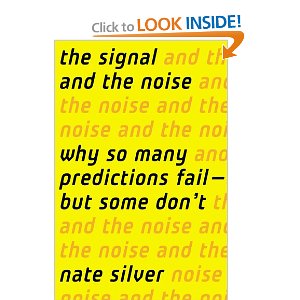
Two new books argue that algorithms can't fully replace human judgment. A review of Samuel Arbesman's The Half-Life of Facts and Nate Silver's The Signal and The Noise.
EXTRACT:
The ironic takeaway from both these fine books, however, is that the more data and facts one has, and the more predictions matter, the more important human judgment becomes. The co-evolution of human beings, datasets, and algorithms will ultimately determine whether Big Data creates new wealth or destroys old value.
But it turns out there’s an order to the state of knowledge, an explanation for how we know what we know. Samuel Arbesman is an expert in the field of scientometrics—literally the science of science. Knowledge in most fields evolves systematically and predictably, and this evolution unfolds in a fascinating way that can have a powerful impact on our lives.
Doctors with a rough idea of when their knowledge is likely to expire can be better equipped to keep up with the latest research. Companies and governments that understand how long new discoveries take to develop can improve decisions about allocating resources. And by tracing how and when language changes, each of us can better bridge generational gaps in slang and dialect.
Drawing on his own groundbreaking work, Silver examines the world of prediction, investigating how we can distinguish a true signal from a universe of noisy data. Most predictions fail, often at great cost to society, because most of us have a poor understanding of probability and uncertainty. Both experts and laypeople mistake more confident predictions for more accurate ones. But overconfidence is often the reason for failure. If our appreciation of uncertainty improves, our predictions can get better too. This is the “prediction paradox”: The more humility we have about our ability to make predictions, the more successful we can be in planning for the future.