Simplicity rules on WordPress. Every extra word REDUCES your changes of a hit.
What you were looking for is produced by this search: <ted data dirt>

The truth at any cost lowers all other costs — curated by former US spy Robert David Steele.
Simplicity rules on WordPress. Every extra word REDUCES your changes of a hit.
What you were looking for is produced by this search: <ted data dirt>
Free full length video (1 hour 44 min)
Global poverty did not just happen. It began with military conquest, slavery and colonization that resulted in the seizure of land, minerals and forced labor. Today, the problem persists because of unfair debt, trade and tax policies — in other words, wealthy countries taking advantage of poor, developing countries. Renowned actor and activist, Martin Sheen, narrates THE END OF POVERTY?, a feature-length documentary directed by award-winning director, Philippe Diaz, which explains how today's financial crisis is a direct consequence of these unchallenged policies that have lasted centuries. Consider that 20% of the planet's population uses 80% of its resources and consumes 30% more than the planet can regenerate. At this rate, to maintain our lifestyle means more and more people will sink below the poverty line. Filmed in the slums of Africa and the barrios of Latin America, THE END OF POVERTY? features expert insights from: Nobel prize winners in Economics, Amartya Sen and Joseph Stiglitz; acclaimed authors Susan George, Eric Toussaint, John Perkins, Chalmers Johnson; university professors William Easterly and Michael Watts; government ministers such as Bolivia's Vice President Alvaro Garcia Linera and the leaders of social movements in Brazil, Venezuela, Kenya and Tanzania.

By IAN MacDOUGALL, Associated Press – 34 minutes ago
OSLO, Norway (AP) — Anders Behring Breivik said he was a boy when his life's path began to turn. It was during the first Gulf War, when a Muslim friend cheered at reports of missile attacks against American forces.
“I was completely ignorant at the time and apolitical but his total lack of respect for my culture (and Western culture in general) actually sparked by interest and passion for it,” the suspect in Norway's bombing and mass shooting wrote in his 1,500-page manifesto.
The 32-year-old Norwegian said it was the NATO bombing of Serbia in 1999 that “tipped the scales” for him because he sympathized with Serbia's crackdown on ethnic Albanian Muslims in Kosovo. A year later he said he realized that what he called the “Islamization of Europe” couldn't be stopped by peaceful means.
Phi Beta Iota: There has been ample warning of the growing anger of European and North American populations over the Muslimization of their countries. The Muslims are more devout/radical than the Catholics, who have lost a great deal of faith in the Church's stance against birth control–the failure of all Western governments is complex–on the one hand, they have failed to be intelligent or retain their integrity about domestic population policies; and on the other, they have perpetuated virtual colonialism, unilateral militarism (Libya being the latest example), and predatory capitalism (Goldman Sachs being the most outrageous, hurting its own as well as all others). The gap between the “elites” and the general public is catastrophically wide. The corruption of the West is its own demise.
See Also:
Continue reading “Koko: When Governments Fail, Humans Explode”

How Do You Change An Organizational Culture?
EXTRACT
Changing a culture is a large-scale undertaking, and eventually all of the organizational tools for changing minds will need to be put in play. However the order in which they deployed has a critical impact on the likelihood of success.
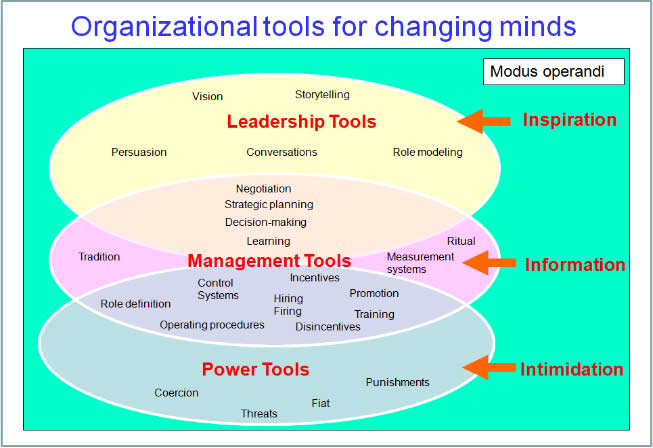
In general, the most fruitful success strategy is to begin with leadership tools, including a vision or story of the future, cement the change in place with management tools, such as role definitions, measurement and control systems, and use the pure power tools of coercion and punishments as a last resort, when all else fails.
Phi Beta Iota: Missing from this depiction is education, and the 21st Century role of leaders in eliciting and facilitating bottom-up co-creation.
Zero Carbon Cloud is looming….exciting developments, from self-contained farm units to far-flung remote energy sources that could ultimately be free.

Microsoft’s Online Business For The Year: Over $2.5 Billion …Lost
By TechCrunch.com, Published: July 23
EXTRACT
Reading Microsoft’s press release on their earnings, you’d think everything is fantastic in the division. “Online Services Division revenue grew 17% for the fourth quarter and 15% for the full year, primarily driven by increases in search revenue.” Big growth! Awesome!
Wait a minute…
What Microsoft once again conveniently left out is any talk of how profitable the division is. That’s because it’s not profitable. Oh boy is it ever not profitable. The division lost $728 million for quarter. Remarkably, that’s the second-worst loss they’ve ever reported — only $4 million shy of the record $732 million loss in Q4 2009.
