QUOTE: No country in the world pays less for food and more for medicine than the USA.
Phi Beta Iota: Phenomenal. Trailer for a larger “must see” movie. A potential salvation for America built around agriculture, family, food, health, and water.
Bruce Sterling and I are well into our annual State of the World conversation over on the WELL. Bruce, who’s traveled the world all his life and has been in unique situations (like his travels through Russia and Eastern Europe after the fall of the Iron Curtain), truly thinks globally, whereas I’m virtually global (via the Internet) though not as well-traveled. I tend to write from a U.S. perspective, which means less these days… sez Bruce,
Back in the 90s, when I was travelling in Europe, I used to get a lot of eager queries about the USA. What’s new over there, what are you doing with your lives and your riches and your technology, why is your government like that? This was considered a matter of urgency, and most Europeans I met, who were naturally from techie, artsy and literary circles, held views of America that were surprisingly like contemporary paranoid Tea Party views. They had interestingly wacky private theologies about the Pentagon, the CIA, Wall Street, the malignant military-industrial complex and so forth… Not that they ever bothered to find out much about the factual operation of these bodies. Stilll, they were sure that the USA really mattered.
Nowadays, the Europeans are just not all that concerned about Yankees. They don’t ask; they’re incurious about America, they are blase’. Being an American in Europe now is rather like being a Canadian, and it’s trending toward being a Brazilian.
…
American soft power is vanishing. Foreigners are much less interested in American television, movies, pop music… America once had a tremendous hammerlock on those expensive channels of distribution, but those old analog megaphones don’t matter half as much in today’s network society.
The USA has become a big banana republic; in other words, it’s come to behave like other countries quite normally behave. The upside is that we don’t get blamed for what happens; the downside is, nothing much happens. Decay and denial. Gothic High Tech.
Phi Beta Iota: the below comment in the larger dialog was especially interesting–the world is giving up on governments, the era of global hybrid networks that are evidenc-driven and amass more spending power than governments and corporations is nearing. Religions might–but with grave doubts–be a starting point, but only if they accept evidence-based sense-making in support of faith-based truth and reconciliation.
inkwell.vue.400 : State of the World 2011: Bruce Sterling and Jon Lebkowsky permalink #16 of 73: gmoke (gmokecamb) Mon 3 Jan 11 18:19
One thing I see on the horizon and which I think will be the next step for 350.org is a kind of ongoing global brainstorm on local, practical solutions and adaptations to climate change. Since the international diplomats aren't going to do anything until 2020 and the incoming US Congress refuses to do anything constructive, those who want to address climate change will have to do it themselves. Online repositories of information where people can share what works where and what doesn't will help speed our climbing the collective learning curve and the replication of successful experiments.
There are some groups online which are trying to pull together parts of this puzzle but no central nexus that I know of. Yet.
One can spend a lot of time defining a medium in terms of how it looks, what it transmits, wavelengths used, typographic choices made, bandwidth available. I like to think about media in terms of questions answered.
. . . . . . .
But the web is not just some kind of magic all-absorbing meta-medium. It's its own thing. And like other media it has a question that it answers better than any other. That question is:
Why wasn't I consulted?
Why Wasn't I Consulted?
“Why wasn't I consulted,” which I abbreviate as WWIC, is the fundamental question of the web. It is the rule from which other rules are derived. Humans have a fundamental need to be consulted, engaged, to exercise their knowledge (and thus power), and no other medium that came before has been able to tap into that as effectively.
Brace yourself for the initial angry wave of criticism: How dare you, I hate it, it's ugly, you're stupid. The Internet runs on knee-jerk reactions. People will test your work against their pet theories: It is not free, and thus has no value; it lacks community features; I can't believe you don't use dotcaps, lampsheets, or pixel scrims; it is not written in Rusp or Erskell; my cat is displeased. The ultimate question lurks beneath these curses: why wasn't I consulted?
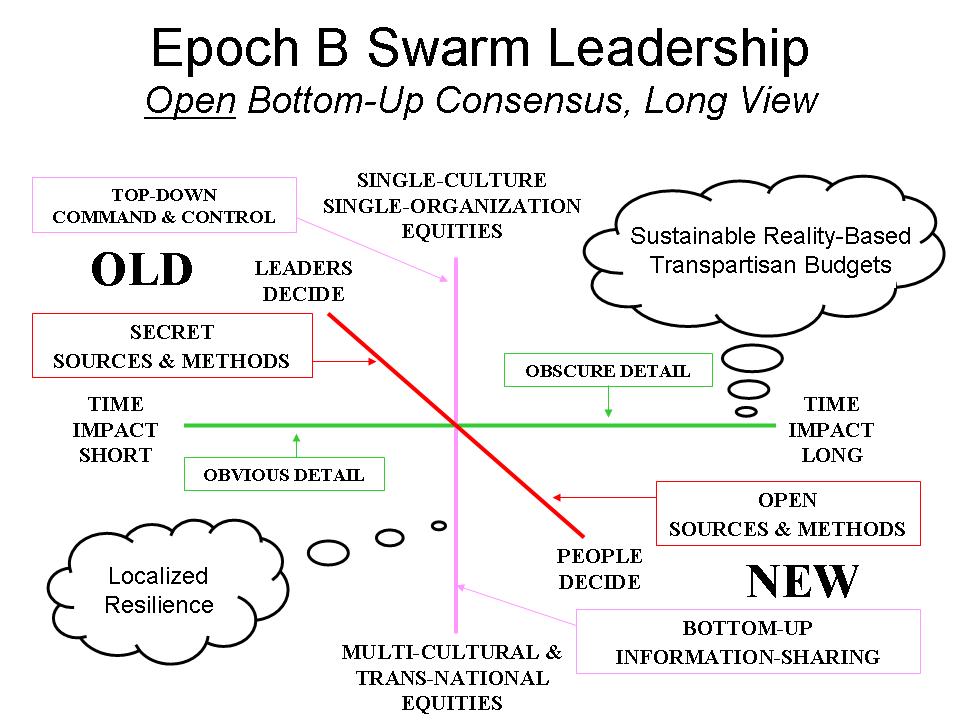
Phi Beta Iota: This is Epoch B leadership emergent. Smart phones are stupid–they are walled gardens. The Industrial Era “owners” including Microsoft are having real difficulty understanding that the information commons is now outside the wall, and cannot be owned or controlled, only shared and made sense-of. The cloud is stupid as well–until someone “gets” the concept of call centers empowering the poor free, one cell call at a time, while harvesting the questions–Hackers in Silicon Valley understood this in 1994, but Silicon Valley–notably Oracle and Microsoft–are still focused on walled gardens. 5 billion poor, four times the annual economy of the one billion rich–really does not seem that complikcated, but evidently it is.
1. Throwing is more important than catching. If you're good at throwing, the catching takes care of itself. Emergency response is overrated compared to emergency avoidance.
2. Juggling is about dropping. The entire magic of witnessing a juggler has to do with the risk of something being dropped. If there is no risk of dropping, juggling is actually sort of boring. Perfection is overrated, particularly if it keeps you from trying things that are interesting.
Hence the tricky part–you want to ship in a way that (as much as you can) avoids failure, but when failure comes, moving forward is more effective than panic or blame.
Search Engines
Meta & Mega Search Tools
People and Company Finders
Social Media and Real-Time Search and Collaboration Tools
Kid Friendly and Educational Search Engines
Video/Multimedia
Specialty Search Tools
Username Search
Maps/Geographic
Useful Web Sites, Tools and Documents
Proxy Servers and Online Privacy Tools
News
Image Search
Online Communities
Whois, IP Lookups and Web Site Analysis
Reference Sites
Language Tools
Phi Beta Iota: Added permanently to Professional Sites.
EXTRACT: Many people claim Stoneleigh and I must be crazy, and doomers and all that, for predicting an 80%+ drop in real estate values, but we in turn can't seem to understand why home prices would fall “only” 20% from here, or why they would fall “just” 40%, as Mish suggested for instance. We think that more than 20% is in the cards just because of the bubble coming back to earth; we think 40% is certain because of the bubble bursting, and we think 80%+ will then happen because the bursting bubble will take the entire financial system down with it. Pretty simple really.g, and it is worth reading….every single word of it.
EXTRACT: According to L. Randall Wray, lenders may have the right to collect debt on certain loans, if they can prove ownership of the loan, but they can't foreclose unless and until they have a clear record (chain) of all transactions the loans went through, through their entire existence. And MERS effectively killed that chain.
EXTRACT: The entire US housing system, lenders, builders, borrowers, the whole thing, is in grave danger, and that means both the financial system and the economy at large are as well. We're looking at not just one or two, but a whole series of reinforcing feedback loops. Which neither Obama nor Geithner nor Bernanke have any control over, other than fleetingly and temporarily. And that will be the story of 2011. Well, that and, of course, the euro crumbling, Japan deflating, China inflating, cities, counties and states defaulting, violent street protests, millions more Americans sinking into abject poverty, misery and hardship, and so on.
Read every word…. Phi Beta Iota: This is the best review we have found and it is chillingly credible. In our view, the Secretary of the Treasury means well but has absolutely no clue how to actually manage the US economy back to a more stable ethical state.