How Leaky is your country? : A Visualisation of Wikileaks


The truth at any cost lowers all other costs — curated by former US spy Robert David Steele.
Published online 21 July 2010 | Nature 466, 432-434 (2010)
Eradicating any organism would have serious consequences for ecosystems — wouldn't it? Not when it comes to mosquitoes, finds Janet Fang.
(download pdf version)
Every day, Jittawadee Murphy unlocks a hot, padlocked room at the Walter Reed Army Institute of Research in Silver Spring, Maryland, to a swarm of malaria-carrying mosquitoes (Anopheles stephensi). She gives millions of larvae a diet of ground-up fish food, and offers the gravid females blood to suck from the bellies of unconscious mice — they drain 24 of the rodents a month. Murphy has been studying mosquitoes for 20 years, working on ways to limit the spread of the parasites they carry. Still, she says, she would rather they were wiped off the Earth.
That sentiment is widely shared. Malaria infects some 247 million people worldwide each year, and kills nearly one million. Mosquitoes cause a huge further medical and financial burden by spreading yellow fever, dengue fever, Japanese encephalitis, Rift Valley fever, Chikungunya virus and West Nile virus. Then there's the pest factor: they form swarms thick enough to asphyxiate caribou in Alaska and now, as their numbers reach a seasonal peak, their proboscises are plunged into human flesh across the Northern Hemisphere.
So what would happen if there were none? Would anyone or anything miss them? Nature put this question to scientists who explore aspects of mosquito biology and ecology, and unearthed some surprising answers.
Continue reading “Nature Tries to Imagine a World Without Mosquitoes/Malaria”
BEHIND THE CENSORSHIP OF OPERATION DARK HEART
By censoring Anthony Shaffer's new book “Operation Dark Heart” even though uncensored review copies are already available in the public domain, the Department of Defense has produced a genuinely unique product: a revealing snapshot of the way that the Obama Administration classifies national security information in 2010.
With both versions before them (excerpts), readers can see for themselves exactly what the Pentagon classifiers wanted to withhold, and can judge for themselves whether the secrecy they tried to impose can be justified on valid national security grounds. In the majority of instances, the results of such an inspection seem disappointing, if not very surprising, and they tend to confirm the most skeptical view of the operation of the classification system.
The most commonly repeated “redaction” in Operation Dark Heart is the author's cover name, “Christopher Stryker,” that he used while serving in Afghanistan. Probably the second most common redactions are references to the National Security Agency, its heaquarters location at Fort Meade, Maryland, the familiar abbreviation SIGINT (referring to “signals intelligence”), and offhand remarks like “Guys on phones were always great sources of intel,” which is blacked out on the bottom of page 56.
Also frequently redacted are mentions of the term TAREX or “Target Exploitation,” referring to intelligence collection gathered at a sensitive site, and all references to low-profile organizations such as the Air Force Special Activities Center and the Joint Special Operations Command, as well as to foreign intelligence partners such as New Zealand. Task Force 121 gets renamed Task Force 1099. The code name Copper Green, referring to an “enhanced” interrogation program, is deleted.
Perhaps 10% of the redacted passages do have some conceivable security sensitivity, including the identity of the CIA chief of station in Kabul, who has been renamed “Jacob Walker” in the new version, and a physical description of the location and appearance of the CIA station itself, which has been censored.
Many other redactions are extremely tenuous. The name of character actor Ned Beatty is not properly classified in any known universe, yet it has been blacked out on page 15 of the book. (It still appears intact in the Index.)
In short, the book embodies the practice of national security classification as it exists in the United States today. It does not exactly command respect.
A few selected pages from the original and the censored versions of Operation Dark Heart have been posted side-by-side for easy comparison here (pdf).
The New York Times reported on the Pentagon's dubious handling of the book in “Secrets in Plain Sight in Censored Book's Reprint” by Scott Shane, September 18.
** INSPECTORS GENERAL TO HELP OVERSEE CLASSIFICATION
** GAO GAINS A FOOTHOLD IN INTELLIGENCE OVERSIGHT
See Also:

Tip of the Hat to Stan Garfield at LinkedIn.

Recovering spy, serial pioneer for open and public intelligence
I held a bi-partisan vote today, with me representing the Democratic Party while I represented the Republican Party. Strict ballot access controls ensured a unanimous outcome — the new Virtual President of the United States of America is Robert David Steele, or for Latinos, Roberto David de Steele y Vivas.
Over the next 45 days, on Tuesdays and Thursdays I will announce one critical policy decision, always in the context of a balanced budget and always with the public interest in mind — this is not going to be pretty, but 45 days from today, every American will be able to compare my virtual track record with the actual track record of those seeking re-election, or in the case of a tiny handful that overcame enormous obstacles, those seeking election for the first time.
Thursday: Virtual Sunshine Cabinet Named
Phi Beta Iota: Steele's posts will be buried among 5,999 other bloggers posting twice weekly. The search bar at Huffington Post works well. You can also, if you wish, click on the fan logo at this first point, to automatically receive an email alert with the exact URL for each additional post as it appears.
 Green Meetings Prime Source Page
Includes Basic Information, Planning Tool, Targeted Roles & Tasks
Also Initiatives Guide, Links & Resources
 Green Meetings
A one-stop information source about green meetings.
 CHOOSE A “GREEN HOTEL” WHENEVER YOU TRAVEL
Learn more about green hotels and how to be a green guest by visiting Green Hotels Association, Zero Waste Alliance, and CERES Green Hotel Initiative. Go green on your next hotel stay and make a difference for the environment.
 Green meetings checklist
Portland, Oregon; Vermont; Great Barrier Reef; Dominica; New Forest National Park, England; Aspen, Colorado; Norwegian Fjords; San Francisco, California; Greenbox, Ireland; Sydney, Australia
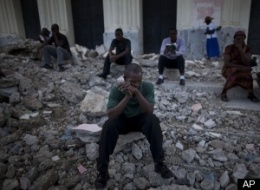
Haiti Still Waiting For Pledged U.S. Aid
The Huffington Post
JONATHAN M. KATZ and MARTHA MENDOZA | 09/29/10
PORT-AU-PRINCE, Haiti — Nearly nine months after the earthquake, more than a million Haitians still live on the streets between piles of rubble. One reason: Not a cent of the $1.15 billion the U.S. promised for rebuilding has arrived.
The money was pledged by Secretary of State Hillary Rodham Clinton in March for use this year in rebuilding. The U.S. has already spent more than $1.1 billion on post-quake relief, but without long-term funds, the reconstruction of the wrecked capital cannot begin.
With just a week to go before fiscal 2010 ends, the money is still tied up in Washington. At fault: bureaucracy, disorganization and a lack of urgency, The Associated Press learned in interviews with officials in the State Department, the Senate Foreign Relations Committee, the White House and the U.N. Office of the Special Envoy. One senator has held up a key authorization bill because of a $5 million provision he says will be wasteful.
Meanwhile, deaths in Port-au-Prince are mounting, as quake survivors scramble to live without shelter or food.