Infographic: The Effects of Coal on Water in the US

03 Environmental Degradation, 05 Energy, 12 Water, info-graphics/data-visualization, True Cost, True Cost

See the article from CircleofBlue.com

August 16, 2010

The contest between coal-fired energy production and water demand is a mismatch. Mining and burning coal accounts for half of all water withdrawals in the United States, which is the same amount of water that pours over Niagara Falls in five months. Burning coal in power plants also is the source of more climate-changing carbon emissions than any other industrial sector. Here’s a look at the economically essential and ecologically damaging accord between coal and water.

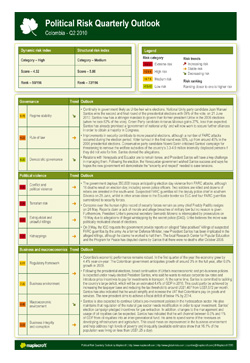
Worth a Look: New Political Risk Quarterly

Commercial Intelligence, Worth A Look
Home Page

RISK AREAS

Governance risks

  • Regime stability
  • Rule of law
  • Democratic governance

Political violence risk

  • Conflict and political violence
  • Terrorism risk
  • Extrajudicial and unlawful killings
  • Kidnappings

Business and macroeconomic risk

  • Regulatory Framework
  • Business environment
  • Macroeconomic environment
  • Business integrity and corruption

Phi Beta Iota: All well and good, but nothing here about whether the government has a holistic strategy, adequate decision support, Whole of Government planning and programming, and so on.  This is a good start that could be made vastly better by embracing the larger contruct of political-legal, socio-economic, ideo-cultural, techno-demographic, and natural-geographic.

Worth a Look: SciVal from Elsevier

Analysis, Collective Intelligence, Maps, Politics of Science & Science of Politics, Research resources, Tools, Worth A Look

SciVal Home

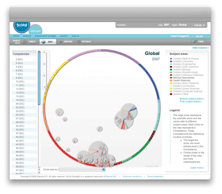
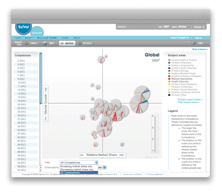
We have in the past highlighted the work of Dick Klavans, who along with Brad Ashton is one of our foremost Scientific & Technical Intelligence (S&TI) colleagues.  Apart from his book with Brad, Keeping Abreast of Science and Technology: Technical Intelligence for Business and his new web site, Maps of Science, see also on this site: 2002 Klavans (US) Technology Mapping: A Workshop on (Open) Sources & Methods for Identifying Commercial Opportunities in Technology and 2002 Klavans (US) Tomorrow’s Hotspots: Identifying Commercial Opportunities from Science.

SciVal Home

Elsevier is now commercializing what Dick has been doing for the last twenty years in one-of productions, and we believe this capability will be extraordinary, not only in performance measurement and performance enhancement for specific disciplinary units, but in demanding that inter-disciplinary and integrative problem-finding and solving come back into being.

Code for America

Civil Society, Collective Intelligence, Government, Open Government, Technologies

Code for America was founded to help the brightest minds of the Web 2.0 generation transform city governments. Cities are under greater pressure than ever, struggling with budget cuts and outdated technology. What if, instead of cutting services or raising taxes, cities could leverage the power of the web to become more efficient, transparent, and participatory?

Friends of Code for America

The Case Foundation | CityCamp | GOOD | GovFresh | GovLoop | Omidyar Network | Open311 | OpenMuni | OpenPlans | O'Reilly Media | Stamen Design | The Sunlight Foundation

Banking with “Enemies”

Commerce, Corruption, Money, Banks & Concentrated Wealth

According to court documents, from as early as the mid-1990s until September 2006, Barclays knowingly and willfully moved or permitted to be moved hundreds of millions of dollars through the U.S. financial system on behalf of banks from Cuba, Iran, Libya, Sudan and Burma, and persons listed as parties or jurisdictions sanctioned by OFAC in violation of U.S. economic sanctions.

Department of Justice Office of Public Affairs, Wednesday, August 18, 2010

Barclays Bank PLC Agrees to Forfeit $298 Million in Connection with Violations of the International Emergency Economic Powers Act and the Trading with the Enemy Act

WASHINGTON – Barclays Bank PLC, a United Kingdom corporation headquartered in London, has agreed to forfeit $298 million to the United States and to the New York County District Attorney’s Office in connection with violations of the International Emergency Economic Powers Act (IEEPA) and the Trading with the Enemy Act (TWEA), announced Assistant Attorney General Lanny A. Breuer of the Criminal Division and District Attorney Cyrus R. Vance Jr., of the New York County District Attorney’s Office. The violations relate to transactions Barclays illegally conducted on behalf of customers from Cuba, Iran, Sudan and other countries sanctioned in programs administered by the Office of Foreign Assets Control (OFAC).

Opening Beijing’s Seven Secrets

02 China, 07 Other Atrocities, Counter-Oppression/Counter-Dictatorship Practices, Open Government, Secrecy & Politics of Secrecy

Waiting for Wikileaks: Beijing's Seven Secrets

by Perry Link (Aug 18, 2010)

While people in the US and elsewhere have been reacting to the release by Wikileaks of classified US documents on the Afghan War, Chinese bloggers have been discussing the event in parallel with another in their own country. On July 21 in Beijing, four days before Wikileaks published its documents, Chinese President Hu Jintao convened a high-level meeting to discuss ways to prevent leaks from the archives of the Communist Party of China.

In emails, tweets, and web postings, Chinese bloggers, both inside China and overseas, began listing key episodes in recent Chinese history that have remained shrouded in mystery and for which they would love to see archives opened:

1. The famine during the Great Leap Forward in 1959-62. Somewhere between 20 and 50 million people died because of bad policy, not “bad weather.” What exactly happened? What policies caused the famine and what policies suppressed information on it? How much grain was in state granaries while people starved? Is it true that Mao sold grain to the Soviet Union during those years in order to buy nuclear weapons?

Continue reading “Opening Beijing's Seven Secrets”

NIGHTWATCH Extract: Colombian Constitution vs. US

Analysis, Corruption, Cultural Intelligence, Multinational Plus, Threats, Tribes

Colombia: The Constitutional Court yesterday declared an agreement granting US military access to Colombian bases unconstitutional on procedural grounds. La Patilla reported the vote was 6-3 against the agreement, and Semana reported the court would soon give a press conference to explain the details. The constitutional court ruled the 2009 accord should be redrafted as an international treaty and sent to Colombia's Congress for approval.

The agreement would have allowed US forces to have access to seven Colombian bases that help support operations against drug trafficking and terrorism. This is the draft legislation that other Latin American leaders criticized lat year because it abetted a rise in US regional influence.

The deal agreed by former President Alvaro Uribe in October 2009 gave the US access to the bases for 10 years and would see a maximum of 800 US military personnel and 600 civilian defense contractors based in Colombia.

The court's chief justice Mauricio Gonzalez said the deal was “an arrangement which requires the State to take on new obligations as well as an extension of previous ones.” He said that as such, it should be “handled as an international treaty, that is, subject to congressional approval”. The court did not rule on the legitimacy of the agreement itself and the ruling does not mean the US has to leave the country altogether.

NIGHTWATCH Comment: President Juan Manuel Santos said the court ruling will have little impact on U.S. military help fighting rebels and will not affect the operations of U.S. troops and contractors working with Colombia's military, The Associated Press reported 18 August.  The ruling is primarily procedural not substantive. Nonetheless, it will be an inconvenience.

NIGHTWATCH KGS Home
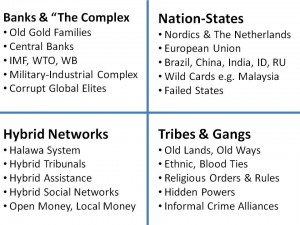
Phi Beta Iota: Here is a rough graphic showing the four spheres of influence that are fighting World War III.  Nations are flexing their Constitutional muscles against US and external incursions, while at the same time, hybrid organizations and “hidden powers” are fighting in the shadows.  Most Nation-States are no longer central because they have lost its legitimacy from a mix of internal corruption and external misadventure.

It is neither possible nor desireable to “fight” the established powers–Non-Zero Strategy requires a focus on the five billion and the creation of infinite wealth with social capitalism and Information Communication Technologies (ICT) as well as energy, food, and other innovations.  Non-violent innovation is the only viable winning strategy.

See Also:

Graphic: Four Threat Classes

Search: world map with 8 conflicts

Search: Africa Graphic and Four Threat Classes

Search: five front war the better way to fight

noble gold