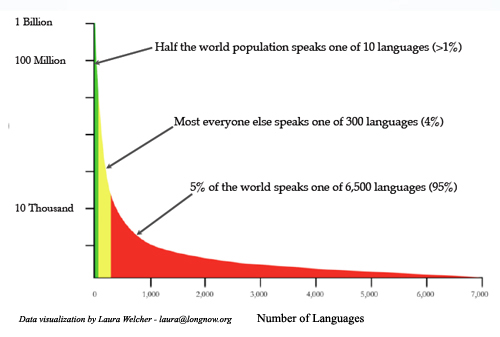
The Rosetta Project is pleased to announce the Parallel Speech Corpus Project, a year-long volunteer-based effort to collect parallel recordings in languages representing at least 95% of the world’s speakers. The resulting corpus will include audio recordings in hundreds of languages of the same set of texts, each accompanied by a transcription. This will provide a platform for creating new educational and preservation-oriented tools as well as technologies that may one day allow artificial systems to comprehend, translate, and generate them.
The Long Commission Report was very closely held, at the time only five people including John Guenther and Robert Steele, had access to the entire report. Here's the bottom line:
1) The threat changed and no one noticed. The battalion commander, who had previously served as the senior Marine in the CIA's Special Operations Group (SOG), was told he was in a benign threat environment in which casual shrapnel was the highest threat to his troops, and it therefore made sense, if they were to be billeted ashore (Navy cannot stand dust and bootmarks on its lily decks), to put them in a solid building.
2) Policy-makers had no clue about the connection between their behavior and the threat. They thought lobbing in battleship shells the size of small cars would “send a message” without realizing that a) this changed the Marine Corps role from peace-keeper to belligerent; and b) they might inspire a message back.
Play becomes work with playpump + eventually no water, no maintenance, and elder women can't use it. See synopsis and watch the Frontline video here
(clips from the synopsis about the Frontline video documentary)
Five years ago, Amy Costello reported a story for FRONTLINE/World. It was about the challenges of getting water in Africa, and a promising new technology called the PlayPump.
After years of covering “bad news” in Africa, she was happy to report a story that seemed to offer something to cheer about. Her story showed how simple it might be for children to pump fresh water just by playing. Behind it all, a South African entrepreneur named Trevor Field.
“A report commissioned by the Mozambique government on the PlayPump that was never released, cited problems with the pumps – women finding it difficult to operate; pumps out of commission for up to 17 months; children not playing as expected on the merry-go-rounds, and maintenance, “a real disaster,” the report said. “
Field had made his career in advertising, but when he heard about this new device, he formed a company and started making PlayPumps himself.
To cover maintenance costs, he proposed selling ads on the sides of the water tower. He said the PlayPump model would be a big improvement over the hand pumps that Africans have struggled with for years.
While the US watches another CNN story on rape, Latin America has been watching CNN Espanol where the Ambassador of Venezuela to the Organization of American States (OAS), has just delivered a phenomenally detailed, articulate, and persuasive denunciation of the US and its regional allies, particularly Colombia.
Hugo Chavez has then come out, breaking relations with Colombia (with great sadness), while offering Guyana the oil it needs, and calling again for a regional organization, the only thing “missing” in t he Bolivarian reconstitution. He anticipates that the incoming government of Colombia will restore rational and reasonable relations.
Off to the side, Cuba is re-presenting its proposal for an OAS without the US and Canada–a regional organization that goes beyond UNASUR (Union of South American Nations) to include the Carribean and Central America.
What one notices from the South is that nothing has changed in the US between the Bush and Obama Administrations. The Ambassadors are the same, the policies (if they can be called policies) are the same, the military mumblings about Hugo Chavez are the same.
See article showing politics versus public interest
By TED BRIDIS (AP) – July 21, 2010
WASHINGTON — For at least a year, the Homeland Security Department detoured hundreds of requests for federal records to senior political advisers for highly unusual scrutiny, probing for information about the requesters and delaying disclosures deemed too politically sensitive, according to nearly 1,000 pages of internal e-mails obtained by The Associated Press.
The department abandoned the practice after AP investigated. Inspectors from the department's Office of Inspector General quietly conducted interviews last week to determine whether political advisers acted improperly.
The Freedom of Information Act, the main tool forcing the government to be more open, is designed to be insulated from political considerations. Anyone who seeks information through the law is supposed to get it unless disclosure would hurt national security, violate personal privacy or expose confidential decision-making in certain areas.