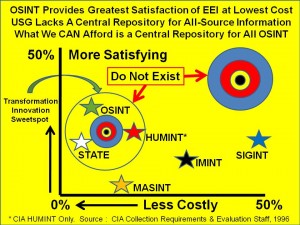
Open Source Intelligence (OSINT) is the only discipline that could possibly create, in the near-term, a foundation for Multinational Engagement. It is immediately applicable to disasters verging on catastrophes such as Haiti, and can be a trust builder toward shared classified processing across the others disciplines, among 90 plus nations.
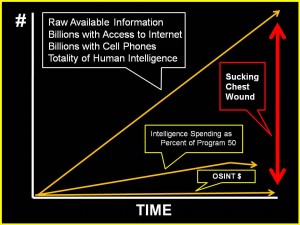
Originally created by Dr. Mark Lowenthal, then with OSS.Net, Inc. and since modified, this slide, combined with Graphic: OSINT and Missing Information, depicts the challenge. What most do not understand is these two facts:
1. Open Source Information (OSIF) is not the same as Open Source Intelligence (OSINT). The latter is deliberately discovered, discriminated, distilled, and delivered decision-support tailored to a specific decision. No does this now in the IC that we know of.
2. Humans and Human Minds, not vast unaffordable non-interoperable technical processing farms, are how we cut to the chase. The magic of OSINT, as Dr. Stevan Dedijer stated so clearly in 1992, is to “know who knows,” so as to connect, as Robert Steele stated in Canada in 1994, the source with the consumer. This can only be done with Multinational Engagement, it absolutely will never happen if we continue to insist on US citizens with clearances as the heart of “national intelligence.”
US Army Human Terrain System (HTS) principals recently produced a number of briefings adding up to a total of 133-pages of MS PowerPoint slides. For convenience sake here, we'll use the title of the first presentation titled The Future: Training Directorate Executive Overview, 08 January 2010 (The Future)1 as the overall title for the series. The presentations contain a dizzying array of information, mostly in living color.
They are audacious and excellent documents whose purpose seems to be to convince command and funding sources that HTS principals have been working since at least 2008 to improve recruiting practices (rigid check of qualifications), training methodologies (going Socratic, modular and phased) and logistics practices (housing, deployment, transport, move to Kansas City).
Once past the hypnotic affects of the 133 slides that induce a “this is great” feeling, the realization comes that the same people who destroyed the US Army program concept in the first place are the same ones that now claim they can reconstruct it and expand HTS operations to all combatant commands.
Montgomery Clough and Steve Fondacaro still remain at the program's helm in spite of two year's worth of allegations–from former and current HTS employees–that fraud, waste and abuse have been common place throughout the life of the HTS. Further, the substance of The Future is early-collegiate, not professional military/academic pedagogy. Financial figures are presented with no work breakdown structure/allocation. And worse, there is no mention of any academic/university review of the social science effort. This is troublesome given that management's experience in the field is limited. In short, the effort seems somewhat disingenuous.
Amazon Page
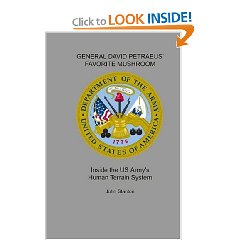
John Stanton is a Virginia-based writer specializing in national security and political matters. His book on the Human Terrain System (entitled General David Petraeus' Favorite Mushroom is available at Amazon and Wiseman Publishing. Reach him at cioran123[at]yahoo.com.
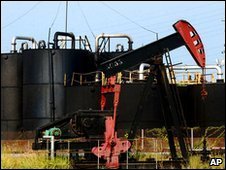
A new US assessment of Venezuela's oil reserves could give the country double the supplies of Saudi Arabia.
Scientists working for the US Geological Survey say Venezuela's Orinoco belt region holds twice as much petroleum as previously thought.
The geologists estimate the area could yield more than 500bn barrels of crude oil.
Phi Beta Iota: This is consistent with both the Brazilian discoveries and the rare nature of the Amazon region. All signs point to a re-emergence of the United Nations of South America (UNASUR) as a major political, socio-eceonomic, ideo-cultural, and techno-demographic “bloc” in the next quarter century. If they create their own Multinational Engagement network for regional information-sharing and sense-making, with a model that can be ported to South Africa for extension into that continent, and to the Indonesia-Malaysia axis with Singapore as a central hub for Chinese diaspora influence, the balance of power in the world will change dramatically. The “closed model” of top down command and control has faded, the “open model” of networks is emergent. Latin American populism is a force that cannot be repressed, it can only be respected.
Now that the mega banks have been bailed out, there is growing pressure in the US and the EU to cut back on state deficits. In the US, which is now under the constraints of of it highest burden private debt burden in recorded economic debt burden (i.e., level of debt related to size of GDP), a reduction in government spending runs a clear risk of a debt deflation — where the economy shrinks because consumers and businesses cut back of spending to reduce their debts. In theory, if the government retrenched and triggered a debt deflation, the US government could reverse course and return to a policy of fiscal stimulus, in part because it has a sovereign economy with its own currency.
The situation is very different in the EU, were the burdens of private debt are lower but burdens of public debt are higher. Moreover, as my friend Marshall Auerback argues below, the economic situation is fundamentally different for each nation in the European Union, because the common currency, together with the accompanying centralized bureaucracy, which is necessary to manage that currency, constrains the ability of individual state governments, like that of Spain, to respond to their own peculiar conditions.
I find Auerback's analysis to be deeply troubling, because it makes sense. I have viewed the EU from the other end of the telescope since 2005, and my greatest impression has been one of its economic benefits — I have seen at the local level in rich and poor countries alike how a rising tide was lifting all boats. To be sure there were inefficiencies and waste, like excessive and shoddy construction in Spain and unfinished projects in Greece, and chaos in Italy, but all in all, what has impressed me the most was level of positive atmosphere in all the EU countries I have visited and lived in. When the EU is growing, the system of open borders; free movement of labour and capital, and a common currency works like oil in an economic engine; rich countries, like the Netherlands, can transfer funds to poorer countries, like Greece. Smaller economies can run big deficits without worrying about the value of their currency.
But, if Auerback is right, when overall growth slows or reverses, the EU engine gets sand in its gears, and as its internal friction increases, it slows down even more. Moreover, the EU's complex centrally controlled nature naturally makes the engine less adaptable to changing conditions. If he is right, this could spell real trouble.
Phi Beta Iota: The world and its populations are trapped right between an Industrial Era “too big to fail” set of governments and corporations and central banks, and a fragmenting complexity and speed of decomposition local landscape that begs for adaptive localized decision-making. We are in an interruggum between the collapse of the old systems of governance and the emergence of new bottom-up networks that would include Open Money and dismiss the fraudulent scarcity and hoarding characteristic of traditional money.
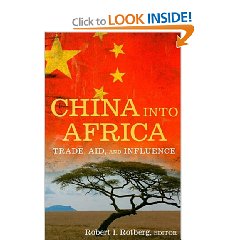
Africa and China are now immersed in their third and most transformative era of heavy engagement, one that promises to do more for economic growth and poverty alleviation than anything attempted by Western colonialism or international aid programs.Robert Rotberg and his Chinese, African, and other colleagues discuss this important trend and specify its likely implications. Among the specific topics tackled here are China's interest in African oil; military and security relations; the influx and goals of Chinese aid to sub-Saharan Africa; human rights issues; and China's overall strategy in the region. China's insatiable demand for energy and raw materials responds to sub-Saharan Africa's relatively abundant supplies of unprocessed metals, diamonds, and gold, while offering a growing market for Africa's agriculture and light manufactures.As this book illustrates, this evolving symbiosis could be the making of Africa, the poorest and most troubled continent, while it further powers China's expansive economic machine.
Amazon Page
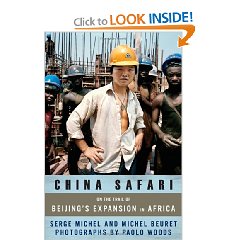
One of the most worrying elements to emerge from these pages is a consistent lack of transparency in all these Chinese ventures. “Not a single Chinese official in the region would agree to meet us,” the authors write. Their requests for interviews with African officials and Chinese managers were routinely ignored, access to work sites barred and information on contractual terms withheld. Domestic parliamentarians have been similarly stymied, unable to uncover even basic details of projects they were promised would transform their countries. None of this bodes well on a continent where top-level sleaze and capital flight have already leached away billions of dollars earmarked for development. Opaque, unscrutinized contracts threaten more of the same. Michel and Beuret are admirably even-handed, unsparing in their attacks on the cynical agendas and sad outcomes of past French, British and U.S. intervention.
Phi Beta Iota: Above two on order and will be reviewed soon.
Amazon Page
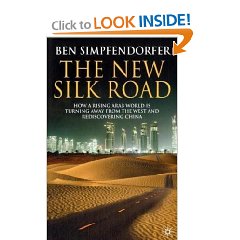
“As the chief China economist for Royal Bank of Scotland in Hong Kong and a former resident of both Beirut and Damascus, Mr Simpfendorfer is well placed to tackle the subject. But although he is a professional economist, what sets Mr Simpfendorfer's book aside from the usual run of publications about the mainland's rise is not his command of macroeconomic statistics, but his grasp of how the expanding relationship between China and the Arab world works at the personal level.” – Tom Holland, South China Morning Post
“Despite the global economic crisis, the trajectory of the Arab and Chinese economies still match the soaring skylines of Dubai and Shanghai. Furthermore, as Ben Simpfendorfer bracingly illustrates, these are not isolated events but rather the resurrection of a Silk Road symbiosis. For all the region's troubles, this book places the Persian Gulf back where it geographically belongs: at the center of Eurasia and bending towards the overwhelming gravity of China.” – Parag Khanna, author of The Second World–Empires and Influence in the New Global Order and Senior Research Fellow at the New America Foundation
Amazon Page
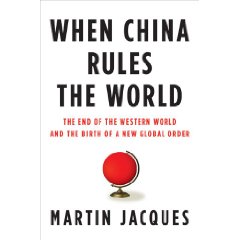
A convincing economic, political and cultural analysis of waning Western dominance and the rise of China and a new paradigm of modernity. Jacques (The Politics of Thatcherism) takes the pulse of the nation poised to become, by virtue of its scale and staggering rate of growth, the biggest market in the world. Jacques points to the decline of American hegemony and outlines specific elements of China's rising global power and how these are likely to influence international relations in the future. He imagines a world where China's distinct brand of modernity, rooted firmly in its ancient culture and traditions, will have a profound influence on attitudes toward work, family and even politics that will become a counterbalance to and eventually reverse the one-way flow of Westernization. He suggests that while China's economic prosperity may not necessarily translate into democracy, China's increased self-confidence is allowing it to project its political and cultural identity ever more widely as time goes on. As comprehensive as it is compelling, this brilliant book is crucial reading for anyone interested in understanding where the we are and where we are going. Publishers Weekly
For the better part of 15 years, with one tragic interruption, he dug and dug and then transformed his scholarly spadework into accessible, inviting prose. The result is “When China Rules the World,” a compelling and thought-provoking analysis of global trends that defies the common Western assumption that, to be fully modern, a nation must become democratic, financially transparent and legally accountable. Jacques argues persuasively that China is on track to take over as the world's dominant power and that, when it does, it will make the rules, on its own terms, with little regard for what came before. Washington Post
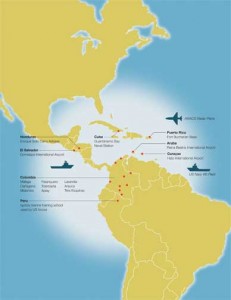
Muscling Latin America: The Pentagon has a new Monroe Doctrine (The Nation)
In September Ecuador's president, Rafael Correa, delivered on an electoral promise and refused to renew Washington's decade-old, rent-free lease on an air base outside the Pacific coast town of Manta, which for the past ten years has served as the Pentagon's main South American outpost. The eviction was a serious effort to fulfill the call of Ecuador's new Constitution to promote “universal disarmament” and oppose the “imposition” of military bases of “some states in the territory of others.” It was also one of the most important victories for the global demilitarization movement, loosely organized around the International Network for the Abolition of Foreign Military Bases, since protests forced the US Navy to withdraw from Vieques, Puerto Rico, in 2003. Correa, though, couldn't resist an easy joke. “We'll renew the lease,” he quipped, “if the US lets us set up a base in Miami.”
Funny. Then Washington answered with a show of force: take away one, we'll grab seven. In late October the United States and Colombia signed an agreement granting the Pentagon use of seven military bases, along with an unlimited number of as yet unspecified “facilities and locations.”
Connect these dots: In Nigeria this week, Muslim youths set fire to a church, killing more than two dozen Christian worshippers. In Egypt, Coptic Christians have been suffering increased persecution including, this month, a drive-by shooting outside a church in which seven people were murdered. In Pakistan, Christian churches were bombed over Christmas. In Turkey, authorities have been closing Christian churches, monasteries and schools. Recently, churches in Malaysia have been attacked, too, provoked by this grievance: Christians inside the churches were referring to God as “Allah.” How dare infidels use the same name for the Almighty as do Muslims!