Journal: Insurgents Hack U.S. Drones

04 Inter-State Conflict, 05 Civil War, 08 Wild Cards, 10 Security, Commerce, Commercial Intelligence, Ethics, Military, Mobile, Peace Intelligence, Real Time

Full Story Online
Full Story Online

Insurgents Hack U.S. Drones

$26 Software Is Used to Breach Key Weapons in Iraq; Iranian Backing Suspected

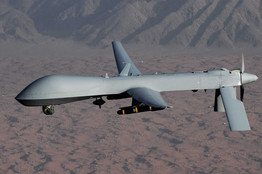
WASHINGTON — Militants in Iraq have used $26 off-the-shelf software to intercept live video feeds from U.S. Predator drones, potentially providing them with information they need to evade or monitor U.S. military operations.

Senior defense and intelligence officials said Iranian-backed insurgents intercepted the video feeds by taking advantage of an unprotected communications link in some of the remotely flown planes' systems. Shiite fighters in Iraq used software programs such as SkyGrabber — available for as little as $25.95 on the Internet — to regularly capture drone video feeds, according to a person familiar with reports on the matter.

Today, the Air Force is buying hundreds of Reaper drones, a newer model, whose video feeds could be intercepted in much the same way as with the Predators, according to people familiar with the matter. A Reaper costs between $10 million and $12 million each and is faster and better armed than the Predator. General Atomics expects the Air Force to buy as many as 375 Reapers.

logo cbs news
Full Story Online

Additional Insights from CBS News Beyond Wall Street Journal

The implications of the Predator's unencrypted transmissions have been known in military circles for a long time. An October 1999 presentation given at the Air Force's School of Advanced Airpower Studies in Alabama noted “the Predator UAV is designed to operate with unencrypted data links.”

A 1996 briefing by Paul Kaminski, an undersecretary of defense for acquisition and technology, may offer a hint about how the Iraqi's interception was done. Kaminski said that the military had turned to commercial satellites – “Hughes is the primary provider of direct (satellite) TV that you can buy in the United States, and that's the technology we're leveraging off of” – to share feeds from Predator drones.

Continue reading “Journal: Insurgents Hack U.S. Drones”

Journal: Stabilization & Reconstructions Hot Spots

Peace Intelligence

Phi Beta Iota: We thought we would look at one month's English-language news reporting on the term <stabilization and reconstruction> in relation to top countries of concern to the USA.  Here is what we found.  Our general conclusion: the US is doing all it can in Afghanistan; the Strategic Communication in Iraq is totally hosed, no one knows how to get the word out on all the good things being done as we transition from advise & assist to exit; and we are totally out to lunch on Somalia, Sudan, and Yemen.  As is its custom, the US Government is waiting for those three places to explode into a fiery inferno rather than ramping up what General Al Gray, USMC, then Commandant of the Marine Corps, called “peaceful and preventive measures.”

Afghanistan

AFG IJC Op's Update, Dec. 1: Reconstruction in Zabul Province; Casualty Update

Afghanistan and Pakistan: Anatomy of a Proxy War

Afghanistan stabilization may depend on Indo-Pakistani reconciliation

Afghans Assess Roles for NATO, U.N., Regional Actors

Agencies sending more civilians to Afghanistan

Canada must keep up aid after leaving Afghanistan, say locals

Contractors Watching Contractors

‘Germany Is Not Armed for War'

Indo-Pak-Afghan knot: threat to region’s stability?

Korea refutes Taliban statement

Lithuania will continue working towards stability in Afghanistan

Local shuras, jirgas and local community efforts in Afghanistan

Nation-Building in Afghanistan

On Afghanistan, Obama finds friend in India

Predoiu: Romania to increase number of troops in Afghanistan by 100

Provincial reconstruction team builds up Zabul to benefit Afghans, future generations

Remarks at the American Enterprise Institute

The Regional Alternative to Escalation in Afghanistan

Top UN official: Civil effort needs restructuring

Turkey not to send troops to Afghanistan

U.S. asks Gulf states for help in Afghanistan

US envoy says China can help Afghans

When bricks trump bullets

Iraq

Blair adviser: US did not expect to stabilize Iraq

Inherited wars, inherited corruption

Iraq hopes Babylon ruins translate into tourist dollars

Rethinking the American Way of War

U.S. and Iraq become partners in education

U.S. Brigade Makes Steady Reconstruction Progress in Iraq

Somalia

No articles with term “stabilization and reconstruction”

Sudan

Testimony by John Prendergast at the Review of the U.S.-Sudan Policy Hearing

Yemen

UAE to give Yemen Dh2.4b development grant

Journal: Straight Talk From Haider Mullick on AF-PK

04 Inter-State Conflict, 05 Civil War, 08 Wild Cards, Cultural Intelligence, Government, Media, Military, Peace Intelligence
Haider Mullick Home Page

Haider Mullick is a Senior Fellow at the US Joint Special Operations University and a research fellow at the Institute for Social Policy and Understanding.

The Diplomat speaks with South Asia analyst Haider Mullick about Pakistan’s counter-insurgency efforts, conspiracy theories and the prospects for stability in Afghanistan.

The Questions (Click Here for the Answers)

You’ve recently returned from a trip to India and Pakistan. How have perceptions of the United States settled since US Secretary of State Hillary Clinton visited?

You’ve written recently about how the US needs to market itself in Pakistan. In a nutshell, what does it need to be doing differently?

Clinton was critical of Pakistan’s failure to capture top al-Qaeda leaders. Broadly speaking, how do you rate Pakistan’s counter-insurgency efforts?

How effective has the Pakistani leadership been in rallying public support for its counter-insurgency efforts?

Looking across the border at Afghanistan, what do you make of the recent US announcement to send 30,000 more troops. Was President Barack Obama right to set out a timeline for withdrawal?

Are you optimistic about the prospects for long-term stability in Afghanistan?

Journal: Highlights from the East West Institute

Peace Intelligence
Berto Jongman Recommends...

Al Qaeda Hierarchy in a Pocket? (30 Nov 09)

Ikram Sehgal suggests that Pakistan’s offensive in South Waziristan has cornered Al Qaeda and urges the Pakistani military to capitalize on this opportunity to disrupt the network’s leadership.

U.S. Policymakers Discuss Measures to Reduce Readiness of Nuclear Weapons (30 Nov 09)

On November 18, 2009, H.E. Urs Ziswiler, Swiss Ambassador to the United States, organized a working lunch in partnership with the EastWest Institute to discuss the recommendations of the EWI report “Reframing Nuclear De-alert: Decreasing the Operational Readiness of U.S. and Russian Nuclear Arsenals” with U.S. policymakers.

Climate Terrorists: They Will Come (25 Oct 09)

Three facts are staring us in the face about certain communities around the world: more people in poverty; rising and large numbers of unemployed youth; and an increasing absolute population (increasing the demand for resources). This is a recipe for violent unrest even in ordinary times.

Groundbreaking U.S.-Russia Joint Threat Assessment on Iran (19 May 09)

A confluence of events has presented the Russian Federation and the United States with an unusual opportunity to transform their relationship.

U.S.-Russia Joint Threat Assessment on Iran's nuclear and missile potential

Reactions to the joint threat assessment

The unfortunate reality is that trust is at an exceedingly low level between the elites and publics of both nations. Building that trust requires a leap of faith that they can work together on the most difficult issues.

Journal: Dean Breaks with Obama, Third Party Rumbles

07 Health, Collective Intelligence, Collective Intelligence, Cultural Intelligence, Open Government

Full Story Online
Full Story Online

Dean says kill the Senate health bill: report

Dean tells Good Morning America that he thinks health bill should be scrapped: Video at bottom

WASHINGTON — Following the jettisoning of both the public option and the Medicare buy-in provision, one of the nation's leading progressive voices on health care reportedly said Tuesday that the Senate bill is no longer worth supporting.

Phi Beta Iota: Buried within the comments “Howard Dean with Cynthia mckinney, Dennis Kucinich and Ralph Nader would be a good group to get a real third party going. ”  We add as a non-partisan observation that the principal figures representing the 70% of America that did not vote for the current Administration have failed to come together.  Between Howard Dean and Joe Lieberman the Progressive wing of the Democratic Party may be finding that Sarah Palin and Ron Paul are looking a lot more reasonable.  Ralph Nader, Cynthia McKinney, and Jackie Salit have the power–not yet exercised–to bring America together on the ONE THING we can all agree on: the Electoral Reform Act of 2010.

Journal: ClimateGate 16 December 2009 Afternoon

Earth Intelligence
ClimateGate Rolling Update

Wary Nations Face Cultural Divide on Climate Treaty's ‘Transparency

COPENHAGEN — Trust between nations is in short supply at the U.N. climate talks. Dealing with it has emerged as the linchpin in the negotiations of a new global warming treaty.

Global warming reporters left out in the cold

The organizers of that global warming conference believe they’re smart enough to run the planet. But evidently, they couldn’t “even figure out that 45,000 people won’t into a 15,000 person building.”

Copenhagen: Al Gore ‘ing the Truth on Climate Change

This is an Orwellian example of what to expect from the so-called “man-made” global warming crowd if they get their desired power to govern every aspect of our lives. These unelected “world government” bureaucrats in Copenhagen, who pontificate a totalitarian system of UN World “governance” over all nations, including the United States, in order to “save the planet” from “human destruction,” really desire nothing more than being in control of everyone else.

IO Newsletter Volume 10 Number 4

IO Newsletter
IO Newsletter V 10 N 04

Articles in this issue

1.         How Team of Geeks Cracked Spy Trade

2.         Civilization's High Stakes Cyber-Struggle: Q&A Gen. Wesley Clark (ret.)

3.         Academy Explores Expanding Cyberwarfare Training

4.         Directive Number 9

5.         YouTube War: Fighting in a World of Cameras in Every Cell Phone and Photoshop on Every Computer

6.         Air Force ISR, EW To Stay Independent

7.         China’s military says website had 2.3 million attacks

8.         Intelligence Ops Greatest Chinese Threat to U.S.

9.         Congressional commission focuses on China's cyberwar capability

10.       NSA Iraqi Computer Attacks and U.S. Defense

11.       South Korean Military Cyber Command Announced

12.       As Smart Grid Expands, So Does Vulnerability to Cyber Attacks

13.       Recent Air Force Law Review Discusses Cyberlaw

14.       Taliban Out-Surging Us in Information War

15.       NK Developing Another Deadly Weapon: Hackers

16.       Secret agents fight a cyber attack on Britain every day

17.       Lessons from the Estonian cyber-attacks

18.       War From Cyberspace

19.       On the imminent Cyber Warfare, what’s Ghana’s preparedness?

noble gold