Barack Obama is daring the terrorists. He's standing in their front yard. He's calling them out.
Of course, that's not how it's reported. “U.S. ‘nowhere near' decision to pull all troops out of Afghanistan,” was the understated Reuters headline. Under negotiation is an agreement keeping 8,000 to 10,000 American troops in Afghanistan “through 2024 and beyond.” Also on the table are night raids and drone strikes that Afghan President Hamid Karzai refuses to allow.
Given the amount of confusion that has existed about the role of external actors in Venezuela, the article seeks to present the key facts and data regarding Chinese loans, oil investment and other support to the Venezuelan petroleum sector, in the context of Indian and Russian activities in the sector as well. I would like to offer my sincere thanks to a number of experts in the Venezuelan petroleum, financial, and other sectors who shared their knowledge and dedicated the time so that I could get the story right.
Dr. Evan Ellis is a professor of national security studies, modeling, gaming and simulation with the Center for Hemispheric Defense Studies at the National Defense University, with a research focus on Latin America's relationships with external actors, including China, Russia and Iran, as well as work on populism in the Andes, transnational criminal organizations and gangs in Mexico and Central America, energy security, and non-traditional national security topics. Dr. Ellis has published over 50 works, including the 2009 book China in Latin America: The Whats and Wherefores, as well as articles in national security, finance, and technical journals.
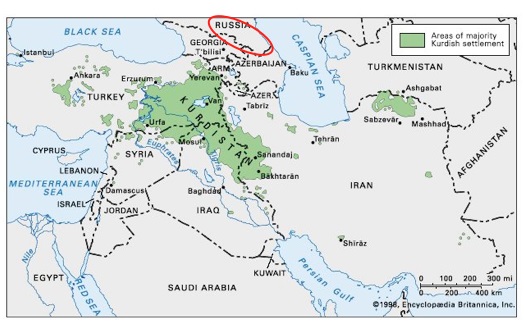
The Kurds are the world’s largest ethnic group (25-35 million) without a nation. As the graphic below shows, Kurds are widely distributed throughout the turbulent regions of Middle East and Central Asia. The green areas are the major areas of heavy Kurdish concentration — but small enclaves exist in areas not marked. (For example, I met many Kurdish Turks in western Anatolia in 2008-9 — my impression was that these urban Kurds were well integrated into Turkish society, unlike their brethren in the East.)
Click on Image to Enlarge
Below is a report analyzing a little known dimension to the Kurdish Question in the turbulent North Caucasus (i.e. the area of red ellipse), where a relatively small number (approximately 64,000) people of Kurdish origin now reside.
The author argues that Russia’s Kurds are sending humanitarian aid to anti-Jihadi Kurds in Syria while Jihadis from Russian Republics of Chechnya and Dagestan (also in the North Caucasus) are flowing into Syria, possibly setting the stage from some kind of blowback in the North Caucasus. (I have no idea of how accurate this report is — and can not vouch for it.)
But if true, Russia’s emerging Kurdish Question could be exceedingly complex, involving internal relations with its turbulent Caucasus Republics and external relations with Turkey, Syria, Azerbaijan, and possibly Iran, among others. These problems may have had something to do with Putin’s tamping down of Obama’s ill-considered efforts to intervene in the Syrian Civil war last August and September — an intervention that would have effectively placed the US on the side of Jihadis we claim to be fighting in the so-called Global War on Terror (GWOT) — and are enemies of the Russians as well.
Maxim A. Suchkov, Ph.D., a former Fulbright visiting fellow at Georgetown University (2010-11), is currently a fellow at the Institute for Strategic Studies at the North Caucasian city of Pyatigorsk, Russia and is a contributor to the Central Eurasian Studies Society Blog.
Syria: Syrian TV reported that on 9 December the Syrian army captured the town of al-Nabk in west-central Syria after days of fighting. This town was the last rebel strong point on the road that links Damascus to Homs and the coast.
Remember the thumping of Obama’s war drums for a US attack on Syria last August and September, including his spokesmen’s absurd invocations of Kosovo as a precedent for a limited cruise missile strike on Syria? The trigger for hyping that war fever was a sarin gas attack in Eastern Ghouta, a Damascus suburb, on August 21. Obama was quick to blame Syrian President Bashar al-Assad for crossing Obama’s bizarre Netanyahu-esque “red line.”
Donors in Saudi Arabia have notoriously played a pivotal role in creating and maintaining Sunni jihadist groups over the past 30 years. But, for all the supposed determination of the United States and its allies since 9/11 to fight “the war on terror”, they have showed astonishing restraint when it comes to pressuring Saudi Arabia and the Gulf monarchies to turn off the financial tap that keeps the jihadists in business.