Jackie Salit, who helped Mike Bloomberg get elected the first time around, appears to have sold out the Independent franchise. Below the line is a complete posting from their website preserved for the record…just in case they are tempted to rescript the history. They tipped their hand. NO LABELS is a fraud, and this makes Jackie Salit a fraud. For more on NO LABELS as “four more years” for Wall Street, see the links at the end of this posting.
“No Labels” connects to Independent Voters
Concern about the negative effects of partisanship is growing as evidenced by two high-powered political operatives—one a Democrat, the other a Republican—coming together to create the newly formed No Labels organization. Independent student leader Nolan DiFrancesco, founder of College Independents and an activist in IndependentVoting.org’s network, attended a No Labels meeting and paved the way for a meeting between our president Jackie Salit and No Labels founder Nancy Jacobson in July.
The documentary film “Inside Job” makes it perfectly clear that there is only one party in DC: The Wall Street Party. With five Wall Street minders for every elected official in DC, why are we surprised? There are of course a few exceptions, but their legislative record suggest they are essentially ineffective.
The Wall Street Party has constructed a circular tautology that incorporates 1] Wall Street; 2] Government; 3] Academia, and 4] The Press — the American Gang of Four.
It is no surprise that the Wall Street Party has a principle goal of privatizing wealth via tax cuts for themselves, while socializing the pain and suffering by slashing public spending for security in employment, health and education.
Tautologies, such as the ones that prop up the Wall Street Party, are constructed for the sole purpose of being unarguably true and are by design incapable of disproof. A prime example of the Wall Street Party's abuse of reality is their hijacking and distortion of the works of Adam Smith.
Of course tautologies are false reality distortion bubbles. They can only paper over the diversion from reality just so long. Then they fail in a big way. A prime example of this would be the former USSR.
The best way to deal with this is most likely an open source refutation [refudiation?] of the claims of the Wall Street Party.
Welfare states around the world will be forced by hard budgetary constraints to reconsider their current model of provision. The state needs to redefine its relationship with individuals and, crucially, with communities. It must find a way of re-endowing communities with independence and self-sufficiency, of giving them the wherewithal to transform themselves and their neighborhoods. The starting point is rethinking how it can leverage and direct not only its revenue budgets but – as this paper will discuss in detail – also its capital assets in a way that broadens and deepens social action and civic participation.
The opportunity for this new relationship in the UK has arrived sooner than expected or hoped. Given the extent of budgetary cuts, a large proportion of the public estate is no longer sustainable in its current form. We now face an unprecedented mass divestment of state assets, which among other things is likely to include: • Libraries. • Swimming pools. • Community centres. • Public spaces. • Council offices. • Courts. • Police stations. • Prison buildings. • The road network. • British Waterways. • RDA, MoD and Whitehall assets. • Ports.
In the years to come, a huge amount of this wealth will suddenly cease to be public and there is a real risk that such assets will not only be privatised (as during the 1980s) but privatised in such a way as to reinforce existing inequalities of wealth. There is a danger that the net result will be a rent seekers’ paradise, where vested interests triumph over communal need and wealth flows backwards to the already established and upwards to the already wealthy.
We believe that the opposite is possible. Public assets can – and, wherever desirable, should – become community assets, owned mutually or by individual shareholders or stakeholders in association with communities. These public goods can, if properly directed and organised, capitalise both civil society and the bottom 10 per cent of society which currently has negative net wealth.
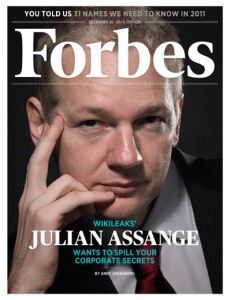
Fascinating article, including leaks in the pipeline (banks), whistleblowers, censorship, his story, trying to stop leaks, spying, untrustful competitors, secrecy, war, field of intelligence, etc. … “our primary defense isn’t law, but technology…courage is contagious” (p.8) — JAS
Following is an excerpt from page 5 regarding moving in the direction of ethical business — JAS
Forbes Cover Story
What do you think WikiLeaks mean for business? How do businesses need to adjust to a world where WikiLeaks exists?
WikiLeaks means it’s easier to run a good business and harder to run a bad business, and all CEOs should be encouraged by this. I think about the case in China where milk powder companies started cutting the protein in milk powder with plastics. That happened at a number of separate manufacturers.
Let’s say you want to run a good company. It’s nice to have an ethical workplace. Your employees are much less likely to screw you over if they’re not screwing other people over.
Then one company starts cutting their milk powder with melamine, and becomes more profitable. You can follow suit, or slowly go bankrupt and the one that’s cutting its milk powder will take you over. That’s the worst of all possible outcomes.
The other possibility is that the first one to cut its milk powder is exposed. Then you don’t have to cut your milk powder. There’s a threat of regulation that produces self-regulation.
It just means that it’s easier for honest CEOs to run an honest business, if the dishonest businesses are more effected negatively by leaks than honest businesses. That’s the whole idea. In the struggle between open and honest companies and dishonest and closed companies, we’re creating a tremendous reputational tax on the unethical companies.
No one wants to have their own things leaked. It pains us when we have internal leaks. But across any given industry, it is both good for the whole industry to have those leaks and it’s especially good for the good players.
But aside from the market as a whole, how should companies change their behavior understanding that leaks will increase?
Do things to encourage leaks from dishonest competitors. Be as open and honest as possible. Treat your employees well.
I think it’s extremely positive. You end up with a situation where honest companies producing quality products are more competitive than dishonest companies producing bad products. And companies that treat their employees well do better than those that treat them badly.
Would you call yourself a free market proponent?
Absolutely. I have mixed attitudes towards capitalism, but I love markets. Having lived and worked in many countries, I can see the tremendous vibrancy in, say, the Malaysian telecom sector compared to U.S. sector. In the U.S. everything is vertically integrated and sewn up, so you don’t have a free market. In Malaysia, you have a broad spectrum of players, and you can see the benefits for all as a result.
How do your leaks fit into that?
To put it simply, in order for there to be a market, there has to be information. A perfect market requires perfect information.
There’s the famous lemon example in the used car market. It’s hard for buyers to tell lemons from good cars, and sellers can’t get a good price, even when they have a good car.
By making it easier to see where the problems are inside of companies, we identify the lemons. That means there’s a better market for good companies. For a market to be free, people have to know who they’re dealing with.
You’ve developed a reputation as anti-establishment and anti-institution.
Not at all. Creating a well-run establishment is a difficult thing to do, and I’ve been in countries where institutions are in a state of collapse, so I understand the difficulty of running a company. Institutions don’t come from nowhere.
It’s not correct to put me in any one philosophical or economic camp, because I’ve learned from many. But one is American libertarianism, market libertarianism. So as far as markets are concerned I’m a libertarian, but I have enough expertise in politics and history to understand that a free market ends up as monopoly unless you force them to be free.
WikiLeaks is designed to make capitalism more free and ethical.
But in the meantime, there could be a lot of pain from these scandals, obviously.
Pain for the guilty.
Do you derive pleasure from these scandals that you expose and the companies you shame?
It’s tremendously satisfying work to see reforms being engaged in and stimulating those reforms. To see opportunists and abusers brought to account.
Phi Beta Iota: Our hope for the round after banks would be massive leakage from the Republican National Committee and the Democratic National Committee. This “open everything” meme is way cool. Think of it as tough love.
Facebook Question and Answer
Jonathan Kan So, do WikiLeaks make your Open Source Intelligence dream comes true?
The short answer is no–WikiLeaks is the lowest form of open source raw sewage–BUT WikiLeaks is serving an enormous purpose in demonstrating without equivocation that “rule by secrecy” is unethical, inept, and not in the public interest. It is a catalyst for change, not change itself. For change the game, see Tom Atlee on politics (search Tom Atlee Change the Game) and for substance see my M4IS2 Briefing to South America, at www.tinyurl.com/SteeleCHILE. Pass it on. The revolution has started without a single politician being involved.
Phi Beta Iota: More than six minutes–a special with decisive commentary on the government's failure to save the economy, choosing instead to save the financial super-parasites that fund the campaigns of the political parasites. Junk math, junk derivatives, junk politics…. Defense Budget & the Deficit: A Comparison of Reduction Scenarios
Several plans for cutting back the defense budget are floating around Versailles on the Potomac. These have taken the form of unsolicited proposals made to the Simpson-Bowles deficit commission. In this important CP report, Winslow Wheeler, a former staffer on the Senate Budget Committee cuts through the rhetoric surrounding these plans and places their budget scenarios in an apples versus apples comparison. Chuck
In some respects, the anguish exhibited by Ahmed Rashid in the attached report (Rashid is a supporter of the Afghan intervention) suggests that the situation in Afghanistan is beginning to look a little like Vietnam in 1963 before the assassination of Diem. We are faced with an escalating rural guerrilla war, where the guerrillas have the initiative. Our strategy to regain the initiative by winning the hearts and minds of a disaffected predominantly rural population focuses again on controlling urban areas. In a xenophobic society that traditionally picks its leaders and evolves its patterns of governance from the bottom up, we have maneuvered ourselves into a position of outsiders trying to redesign that traditional society from the top down by imposing our choices for leaders and our visions for building “democratic” institutions. Metrics of success in this kind of conflicted effort, naturally, devolve into a reflection of the lack of success in overcoming the insurmountable contradiction.
Inevitably, once again, we focus on our inputs rather that outputs — as can be seen in an increasing reliance on Taliban body counts, the number of Afghan troops we have trained, the size of the “surge,” etc.
Local security forces are corrupt and incompetent, and they are led by rapacious leaders and warlords more interested in feathering their own nests than in building a viable nation. Violence is escalating almost everywhere, yet that violence is itself being being touted as a sign of progress. In short, like Vietnam, the tunnel of Afghanistan is getting longer and darker. Like Vietnam, the political urge to find a neat, clean solution to an intractable problem made worse by the arrogance of our ignorance is increasing.
It is against this backdrop that political pressures are building to dump the corrupt stooge we put into place and replace him with a more pliable corrupt stooge, if only to justify a the war's continuation by providing a patina of progress to an increasingly war-weary Americans on the home front.
So, we face the same question we faced in Vietnam in the fall of 1963: If we dump our stooge because he is becoming uncooperative, who do we put in his place? The only comfortable options for our political leaders are once again the leaders (warlords) of the corrupt and rapacious groups we have promoted. Rashid ends his essay by saying that the US and Karzai will not not part ways. I am not so sure. But whatever the case, the name of the game is to buy time in a guerrilla war where time is on the side of the guerrilla. Like Sir Douglas Haig's decision to pour in reinforcements and continue the battle of the Somme for four months after taking 60,000 casualties the first day, a strategy to buy time by promoting more of the same is a strategy to reinforce failure that will eventually sputter out ineffectually at very high cost. Chuck