Journal: Resources on Terrorism and Jihad

08 Wild Cards, 09 Terrorism, 10 Security, Analysis, Communities of Practice, Cultural Intelligence
Berto Jongman Recommends...

A 9/11 in Indonesia: JI's planned aviation attack: info Noordin Top's laptop

Countering terrorist ideology: the ideological response unit (Singapore)

Global (Terrorism) Pathfinder (Singapore)

The ICPVTR Terrorism Database – Global Pathfinder – is a one-stop repository for information on the current and emerging terrorist threat. The database focuses on terrorism and political violence in the Asia-Pacific region – comprising of Southeast Asia, North Asia, South Asia, Central Asia and Oceania.

In addition to providing the latest information on terrorist attacks and pronouncements, Global Pathfinder also includes over a hundred terrorist training manuals, counter terrorism legislations and conventions, analytical papers on terrorist ideologies, commentaries on terrorist trends and patterns, transcripts of landmark cases, interviews with terrorists as well as photographs from different conflict zones across the world. Further, Global Pathfinder also has a huge collection of jihadi websites, the contents of which are routinely translated and analysed by our analysts.

The Global Jihad Network: Why and How al–Qaeda UsesComputer Technology to Wage Jihad

One of the main architects of the new al-Qaeda is a man named Abu Musab al-Suri.  He put down his vision for the future of jihad in a book entitled Call for Worldwide Islamic Resistance, a one-thousand six-hundred page manifesto published on  the Internet in 2004.

…he sought “…to transfer the training to each house of each district in the village of every Muslim….making appropriate training materials available to more than a billion Muslims….

Systems Approach To Terrorism: Countering The Terrorist Training Subsystem

Celebi's thesis focuses on the use of the Internet both in general and in the case of the Kurdish group PKK. The work is strongest in its discussion of what the author calls the training subsystem, and in his explication of that system as involving more than tradecraft and being increasingly based online. This training subsystem is seen as having four core functions:

1. The training subsystem creates, intensifies and sustains the competence, commitment and the skills that the terrorists will apply to reach their goals.

2. The training subsystem not only teaches the ways and means, but also justifies them by means of intensive indoctrination.

3. The training subsystem establishes ties to the group and creates a sense of belonging.

4. The training subsystem enables knowledge to be stored inside the boundaries of the system, and facilitates its passing through generations.
Journal: Update on Combatting Global Terrorism

09 Terrorism, 10 Security, Government, Law Enforcement, Non-Governmental, Peace Intelligence
Berto Jongman Recommends...

Kudos should be given to the UN’s Counter Terrorism Committee Executive Directorate (CTED) for producing what is perhaps the most comprehensive and frank assessments to date of the international community’s implementation of Security Council Resolution 1373 and the measures adopted to combat international terrorism. Their report was presented to the Security Council by CTED Executive Director Mike Smith on December 16th and provides detailed information on what is actually being done, on the vulnerabilities, and on the technical assistance required. It provides a thematic overview of the laws and actions taken in the areas of enforcement, border control, countering the financing of terrorism, and international cooperation as well as a region by region assessment. Human rights considerations are also addressed.  The report should be read closely.

Journal: Pakistani Perspectives

08 Wild Cards, 10 Security, Cultural Intelligence, Peace Intelligence
Berto Jongman Recommends...

Taliban Insurgency in Pakistan: A Counterinsurgency Perspective

How counterinsurgents manipulate insurgents’ disadvantage in their own favor would ultimately prove crucial. The task requires vision, will and capacity, but so far the state seems to lack effective strategy on this tactical front. The Taliban insurgency in the tribal areas has regional dimensions as well, with regional and global actors trying to secure their own interests in the area. But ignoring Pakistan’s concerns and regional interests would frustrate the counterinsurgency effort. Pakistan cannot snuff out the insurgency alone.

Exploring the Mindset of the British-Pakistani Community: The Socio-cultural and Religious Context

The study finds that British-Pakistanis are almost all Muslims and have a mainly rural background. Their first generation in Britain was very conservative and did not let the next generation assimilate and become part of British society. There is lack of political, social and economic awareness among British-Pakistanis, many of whom are still confused and divided, not only physically but mentally as well, between their adopted and native countries. Moreover, there are some radical elements amongst this population also. The socio-cultural and religious identities of the British-Pakistani community may become more crucial in their potential to evolve parallel closed societies within the mainstream host society if not brought into the mainstream immediately

Pakistan Jihad: The Making of Religious Terrorism
Dr Eamon Murphy & Dr Ahmad Rashid Malik

Central Asia: Islamists in Prison

Anne Speckhard on delegitimizng terrorism

Impact of War in SWAT Valley on Farming Sector

Journal: $30B for Israel, 75% Earmarked for US KR

08 Wild Cards, 10 Security, Commerce, Government, Military, Peace Intelligence

Full Story Online
Full Story Online

Obama Approves $30 Billion in Military Aid to Israel Over Next Decade

$500 Million in Aid Also to Go to Palestinian Authority

by Jason Ditz, December 18, 2009

As the single largest expense of the 2010 foreign aid budget, President Obama approved $2.775 billion in military aid to Israel, the first payment in a decade-long commitment that will reach at least $30 billion.

Continue reading “Journal: $30B for Israel, 75% Earmarked for US KR”

Reference: Walter Dorn on UN Intelligence in Haiti

01 Poverty, 04 Inter-State Conflict, 05 Civil War, 08 Wild Cards, 09 Terrorism, 10 Security, 10 Transnational Crime, Academia, Analysis, Articles & Chapters, Civil Society, Ethics, Government, InfoOps (IO), Law Enforcement, Methods & Process, Military, Non-Governmental, Peace Intelligence, United Nations & NGOs
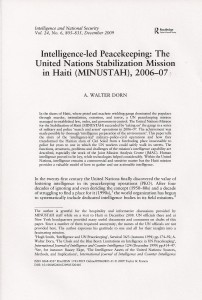
Walter Dorn on UN Intelligence in Haiti
Walter Dorn on UN Intelligence in Haiti (MINUSTAH U-2)

UPDATE:  Superceeded by final published version a tReference: Intelligence-Led Peacekeeping

Phi Beta Iota: Dr. Walter Dorn is one of a tiny handful of truly authoritative academic observers of UN intelligence, a pioneer in his own right, and perhaps the only person who has followed UN intelligence from the Congo in the 1960's to the creation of new capabilities in Haiti and elsewhere in the 21st Century.  He is the dean of UN intelligence authors.  See also Who’s Who in Peace Intelligence: Walter Dorn.

Journal: Contractors Out of Control, Money Wasted

04 Inter-State Conflict, 05 Civil War, 08 Wild Cards, 10 Security, 11 Society, Commerce, Commercial Intelligence, Ethics, Government, Military, Peace Intelligence
Chuck Spinney
Chuck Spinney

Published on Friday, December 18, 2009 by Rebel Reports

Stunning Statistics About the War Every American Should Know

Contrary to popular belief, the US actually has 189,000 personnel on the ground in Afghanistan right now—and that number is quickly rising.

by Jeremy Scahill

A hearing in Sen. Claire McCaskill's Contract Oversight subcommittee on contracting in Afghanistan has highlighted some important statistics that provide a window into the extent to which the Obama administration has picked up the Bush-era war privatization baton and sprinted with it. Overall, contractors now comprise a whopping 69% of the Department of Defense's total workforce, “the highest ratio of contractors to military personnel in US history.” That's not in one war zone-that's the Pentagon in its entirety.

In Afghanistan, the Obama administration blows the Bush administration out of the privatized water. According to a memo [PDF] released by McCaskill's staff, “From June 2009 to September 2009, there was a 40% increase in Defense Department contractors in Afghanistan. During the same period, the number of armed private security contractors working for the Defense Department in Afghanistan doubled, increasing from approximately 5,000 to more than 10,000.”

At present, there are 104,000 Department of Defense contractors in Afghanistan. According to a report this week from the Congressional Research Service, as a result of the coming surge of 30,000 troops in Afghanistan, there may be up to 56,000 additional contractors deployed. But here is another group of contractors that often goes unmentioned: 3,600 State Department contractors and 14,000 USAID contractors. That means that the current total US force in Afghanistan is approximately 189,000 personnel (68,000 US troops and 121,000 contractors). And remember, that's right now. And that, according to McCaskill, is a conservative estimate. A year from now, we will likely see more than 220,000 US-funded personnel on the ground in Afghanistan.

Continue reading “Journal: Contractors Out of Control, Money Wasted”

Journal: Insurgents Hack U.S. Drones

04 Inter-State Conflict, 05 Civil War, 08 Wild Cards, 10 Security, Commerce, Commercial Intelligence, Ethics, Military, Mobile, Peace Intelligence, Real Time

Full Story Online
Full Story Online

Insurgents Hack U.S. Drones

$26 Software Is Used to Breach Key Weapons in Iraq; Iranian Backing Suspected

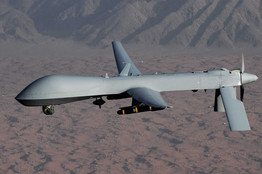
WASHINGTON — Militants in Iraq have used $26 off-the-shelf software to intercept live video feeds from U.S. Predator drones, potentially providing them with information they need to evade or monitor U.S. military operations.

Senior defense and intelligence officials said Iranian-backed insurgents intercepted the video feeds by taking advantage of an unprotected communications link in some of the remotely flown planes' systems. Shiite fighters in Iraq used software programs such as SkyGrabber — available for as little as $25.95 on the Internet — to regularly capture drone video feeds, according to a person familiar with reports on the matter.

Today, the Air Force is buying hundreds of Reaper drones, a newer model, whose video feeds could be intercepted in much the same way as with the Predators, according to people familiar with the matter. A Reaper costs between $10 million and $12 million each and is faster and better armed than the Predator. General Atomics expects the Air Force to buy as many as 375 Reapers.

logo cbs news
Full Story Online

Additional Insights from CBS News Beyond Wall Street Journal

The implications of the Predator's unencrypted transmissions have been known in military circles for a long time. An October 1999 presentation given at the Air Force's School of Advanced Airpower Studies in Alabama noted “the Predator UAV is designed to operate with unencrypted data links.”

A 1996 briefing by Paul Kaminski, an undersecretary of defense for acquisition and technology, may offer a hint about how the Iraqi's interception was done. Kaminski said that the military had turned to commercial satellites – “Hughes is the primary provider of direct (satellite) TV that you can buy in the United States, and that's the technology we're leveraging off of” – to share feeds from Predator drones.

Continue reading “Journal: Insurgents Hack U.S. Drones”

noble gold