Eric Schmidt suggests you alter your scandalous behavior before you complain about his company invading your privacy. That's what the Google CEO told Maria Bartiromo during CNBC's big Google special last night, an extraordinary pronouncement for such a secretive guy.
“If you have something that you don't want anyone to know, maybe you shouldn't be doing it in the first place,” Schmidt tells CNBC, sparking howls of incredulity from the likes of Gawker.
Everything went according to plan until 11:00 A.M. on December 9, 2008. With a single click, a faceless Google employee decided that Think Computer Corporation's membership in the AdSense program “posed a significant risk to our AdWords advertisers,” and the account was disabled with no warning.
Phi Beta Iota: WIRED Magazine has put together a number of questions that ably illustrate the confusion in the public mind over why we are in Afghanistan and what that has to do with Pakistan. Based on the history of the Cold War, which appears to have been a Fity Year Wound, In Search of Enemies, or as General Smedley Butler, USMC (Ret) put it, War is a Racket, we have to wonder. When one combines the scandals associated with health care (50% waste according to PriceWaterhouseCoopers), the economy (a fraudulent Federal Reserve and phantom wealth leveraged by Wall Street to the detriment of the commonwealth), and all of the other pressing problems facing America, the larger question is not really about Afghanistan or Pakistan but rather about process. Is America a democracy? Is our policy process reasoned and informed? Is the public interest being served? Does the White House really understand The True Cost of Conflict/Seven Recent Wars and Their Effects on Society?
There is a new breed of super-sleuth emerging in the virtual world of the web. For both petty criminals and major terrorist groups, internet detectives are fast becoming a force to be reckoned with. Making it his business to track down criminal activity through the web, Guido Rudolphi, the Sherlock Holmes of the cyber world, considers himself a legal hacker. “So much more information can be accessed, quite legally, than the individual user would ever imagine.” Rudolphi has taken advantage of this new free-flow of online information to catch paedophiles, fraudsters, and even unearth international cells of Al-Quaeda. He demonstrates how it takes less than twenty minutes to establish a persons credentials, locate them and hand them over to the police. “People seem to think theyre anonymous online, that nothing can happen to them there thats very naive.”
In today's cameos [summary attached below] on the Sunday talk show circuit, Defense Secretary Gates (no doubt the Surge's wily deus ex machina) and Secretary of State Clinton (Gates' transparent accomplice) stated again that there is no deadline for a withdrawal of US forces from Afghanistan. This proves again, as if any more proof were needed after their appearances before Congress last week, the whole Surge-and-Withdrawal Strategy enunciated by President Obama in his West Point speech last Tuesday was a Bait-and-Switch Strategy to sucker the anti-war base of the Democratic Party, while locking in the long-term budgetary benefits of the Long War on Terror for the cash-bloated MICC. Which begs the question: Is Mr. Obama the real decision maker or an empty suit carrying the water for an emergent National Security Regency chaired by Secretary Gates, with Secretary, CJCS Admiral Mullen, and General McChrystal as the senior voting members? Unfortunately, the postmortem purporting to analyze Obama's “decision” process in today's New York Times does little to clarify this important question.
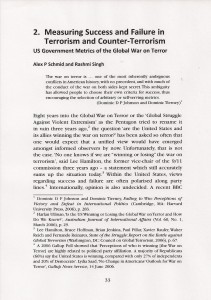
Alex P. Schmid, one of a handful of trully expert scholars in the field of terrorism and counter-terrorism, and his colleague Rashmi Singh, have created a summary that is devasting on multiple fronts. The “Global War on Terror” or GWOT has lasted longer than World Wars I and II combined; the money expended (the authors do not include the military costs of occupying Afghanistan and Iraq) has been enormous, and in all that time, no one has defined the metrics by which to measure the endeavor. The chapter in included in After the War on Terror: Regional and Multilateral Perspectives on Counter-TerrorismStrategy
Last night President Obama crossed the Rubicon and made the Afghan War his war. Will this decision come back to haunt him? Juan Cole argues that this is likely to be the case, because Obama's escalation decision is based on a flawed analogy.
Reasoning by analogy is powerful albeit particularly dangerous form of thinking. A valid analogy can unleash the creative mind to see new connections that were previously not seen, but a false analogy can capture the imagination and cause one to see and believe visions of things as they are not. False analogies are perhaps the most powerful mental engine for taking an otherwise rational decision maker off the cliff. Nevertheless, The courtiers in the Court of Versailles on the Potomac, addicted as they are to snappy sound bytes, love analogies, the more simple minded the snapping sound, the better.
Juan Cole, professor of modern Middle Eastern and South Asian history at the University of Michigan
Full Story Online
author of widely read blog Informed Comment explains how Obama has been taken to the cleaners and induced to bet his Presidency by buying into the fatally flawed Beltway Consensus that (1) the Iraq Surge was an unambiguous success and (2) its corollary, namely the analogy to Afghanistan that posits a similar kind of surge will produce a similar “success” in Afghanistan. Cole makes his argument by using the simple technique of describing and comparing likenesses and differences, something Obama and his advisors should have done.
Phi Beta Iota: The Salon story is complemented by the below blog from the same author.
10. The biggest threat of derailment comes from an American public facing 17 percent true unemployment and a collapsing economy who are being told we need to spend an extra $30 billion to fight less than 100 al-Qaeda guys in the mountains of Afghanistan, even after the National Security Adviser admitted that they are not a security threat to the US.
Amidst reports that the Department of Homeland Security is adding 30,000 positions, below are two items on the continued expansion of the surveillance state.