Wal-Mart Stores Inc. asked the U.S. Supreme Court to block female employees from suing on behalf of as many as 1.5 million women in what would be the largest gender-bias suit against a private employer in U.S. history.
. . . . . . .
The company agreed in 2008 to pay as much as $640 million to settle 63 federal and state class actions claiming the company cheated hourly workers and forced them to work through breaks.
Five years ago at IC2 Institute in Austin, we were talking about digital convergence, and those talks spun off an organization called the Digital Convergence Initiative, the idea being to build a local business cluster of convergent companies. We were ahead of our time, and it was hard for many to get their heads around how such a “horizontal” cluster would work. We were onto an effect of convergence that could be pretty interesting: the edges of verticals will blur, and companies that before convergence had nothing in common will find affinities and synergies that create new forms of business.
Phi Beta Iota: We have been beneficiaries of Jon Lebkowsky's good-hearted genius and will start following his blog, which is being added to Righteous Sites today. The ten areas covered by the cited article include Shopping, Relationships, Business Deliveries, Maps, Education, Politics, Society, War, Advertising. The bottom line for the public is that accountability and transparency is virtually inevitable, and we will eventually eradicate corruption including fraud, waste, and abuse. The only question is how soon and will it be soon enough. We think it will. Like Jon, we are optimists.
Here are the last two paragraphs with the links recommended:
Linked data and the future
The examples of data mentioned in this article are innovative, exciting and life changing, but the best is yet to come. The majority of the information that we use in our daily lives is “dumb”, or unconnected. The next step is “linked data”, or data that talks to each other. In the UK, Tim Berners-Lee and the team behind Data.gov.uk are aiming to create a linked database of Government information. By providing all data the Government produces in a linked format, individuals will be able to pull in different sets of data to produce new and innovative ways of understanding how our Government and the world works.
FluidDB, a start-up company run by Terry Jones, and with backing from Tim O'Reilly and Esther Dyson and others, is tackling this field from a different angle. FluidDB wants to create a “writeable world”, where physical objects have virtual identities, which can be updated and called upon by any individual with access to the internet. That could mean tweets and status updates about everything from a brand of toothpaste to the Eiffel Tower could contribute to a collective database. The possibilities for collaboration are endless.
Many years ago I attended a series of Headquarters briefings for out-going CIA Chiefs of Station. Our main speaker was Richard Helms, then the Agency’s Director and one of the lions of American foreign policy in the 1960’s and 70’s. A man who was subsequently crucified in the Nixon catastrophe. Dick was essentially giving us our instructions, and in my mind his most telling directive was the quiet statement: “Ring the Bell.” Telling us to sing out when we apprehended a major disaster in the offing.
It’s time to ring the bell on Iraq.
Briefly put, in a matter of months Iran will emerge the unchallenged military and economic power dominating the area from Lebanon to Pakistan. It will control Iraq, and be in a position to shut off all oil supplies from the Persian Gulf. It will be free to provide extensive assistance to the Taliban in Afghanistan, thus ensuring a NATO defeat in that country. It will be in a position to provide crucial support to radical Islamic elements in Pakistan – which may well result in the collapse of that already shaky nuclear-armed government. It will be free to radically increase its support to a variety of terrorist organizations targeting the US. And, in conjunction with well-armed radical Palestinian forces that already exist on Israel's borders, it will pose the greatest threat ever faced by Israel. A threat that I do not believe Israel could survive without direct US military intervention.
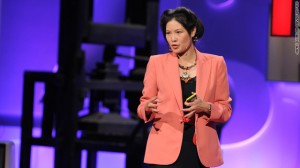
(CNN) — Discrimination against women and girls takes a staggering toll around the world, says author Sheryl WuDunn. It leads to as many as 100 million fewer females than males in the world.
Ending the oppression of women is the great moral challenge of the 21st Century, a cause she compares to fighting slavery in the 19th century and totalitarianism in the 20th Century.
The solutions, she says, are education and economic opportunity. Overpopulation is one of the larger contributors to poverty, WuDunn said. “When you educate a girl, she has significantly fewer kids.” Girls who go to school get married later in life and educate their children “in a more enlightened way.”
“So let us be clear about this up front: We hope to recruit you to join an incipient movement to emancipate women and fight global poverty by unlocking women's power as economic catalysts.
Phi Beta Iota: It merits comment that micro-lending was a success because its founder recognized that women, not men, would be the more reliable and productive catalyst. It also merits comment that the best aid investment, dollar for dollar, is in the education of women. What is missing is the “giant leap forward” that would come from distributing free telephones and creating multi-lingual call centers that educate women–and men–one cell call at a time, while serving as catalysts for harnessing the distributed intelligence of the Whole Earth, creating smart neighborhoods to smart nations to a smart planet.
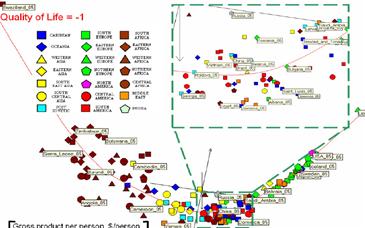
Mathematicians Create Objective Quality of Life Index
The US comes second in a new quality of life index designed to be mathematically objective
Phi Beta Iota: The explanation of this is wrong. There is nothing “objective” about it, and nothing “subjective” about the other indexes. What is useful here is “elastic mapping”. A linear model makes things seem clear, but it introduces distortions. A non-linear modeling technique, while confusing in one sense because you don't know exactly how it works, it still sensible if you use an image, as they do here, of relaxing springs among all the nodes. And the result is less distortion, less to criticize, and more opportunity to consider the meaning, as they do here. GDP gets you something, but health gets you something else, and it would be nice to have a mathematical rule that doesn't make it completely arbitrary how you balance the two, or the many contrastive factors that you choose.
Beyond belief, but here it is: the “official” explanation of why we are going to waste 12 billion dollars a year on contractors without a clue (vapor-ware). There is zero return on investment here for the taxpayer, only for the contractors and Congress, neither of which will be held accountable for fraud, waste, and abuse.
William J. Lynn III WILLIAM J. LYNN III is U.S. Deputy Secretary of Defense.
In 2008, the U.S. Department of Defense suffered a significant compromise of its classified military computer networks. It began when an infected flash drive was inserted into a U.S. military laptop at a base in the Middle East. The flash drive's malicious computer code, placed there by a foreign intelligence agency, uploaded itself onto a network run by the U.S. Central Command. That code spread undetected on both classified and unclassified systems, establishing what amounted to a digital beachhead, from which data could be transferred to servers under foreign control. It was a network administrator's worst fear: a rogue program operating silently, poised to deliver operational plans into the hands of an unknown adversary.
Social Security remains one of the greatest achievements of the Democratic Party since its creation 75 years ago. Although Republicans have historically fulminated against the program (Ronald Reagan once likened it as something akin to “socialism”), they have actually made little headway in touching this sacred “third rail” in American politics. President Bush pushed for partial privatization of the program in 2005, but the proposal gained no policy traction (even within his own party) because Social Security continues to be hugely popular with American voters. It’s a universal program that benefits all Americans, not a government handout to a few privileged corporations.
Which is why it’s odd that Democrats seem almost embarrassed to continue to champion the legacy of FDR. The party frets about long-term deficits and the corresponding need to “save” Social Security from imminent bankruptcy and, in doing so, opens the gate to radical cuts in entitlements that will do nothing but further destroy incomes and perpetuate our current economic malaise.