“There are diplomatic tensions because we are fighting a full-on undeclared war on the territory of a country with which we are an ally, using covert agents as the commanding officers”.
So what’s new? Didn’t we fight a full-on undeclared war on the territory of Laos from about 1961 to 1973? Wasn’t Laos an ally while trying to maintain the fig-leaf of neutrality? Wasn’t the United States government using ‘covert agents as commanding officers’?
What is rarely recognized is that even if the US can emerge from a weak economy within a few years, the economic foundation that existed before the cataclysm of 2007 and 2008 may not be adequate to restore the widely shared prosperity the US needs. For more than three decades, economic growth had been largely dependent on rapidly rising levels of debt and on two major speculative bubbles, first in high technology and dot-com stocks in the late 1990s, then in housing in the 2000s. What will now replace them?
Income inequality widened sharply in these years and average wages stagnated for the many while record high fortunes were made by the few. The financial security and access to adequate health care and education for children that had defined the middle class since World War II have eroded rapidly. Meanwhile, investments in infrastructure such as transportation, as well as clean energy and education, have been badly neglected. All this raises doubts about America’s future economic vitality whether or not it balances its budget, and it does so at a time when international competition from Asia and the Southern Hemisphere will pose serious challenges during this century. How will Americans live a decade from now?
CHUCK SPINNEY: The budget/tax compromise just agreed to by President Obama and the Republicans blew a hole in the out-year deficits by continuing for two years the Bush 2001 tax cuts to the wealthy in the hope that a stimulative effect will trickle down to grow the economy before the 2012 election. That the economy grew sluggishly after 2001, that federal deficits exploded after 2001, that the economy continued to hemorrhage manufacturing jobs after 2001, that income inequality continued to increase after 2001, that middle class wages continued to stagnate after 2001, and that the first decade of the 21st Century ended in the worst economic crisis since the 1930s do not seem to affected the political calculus in 2010 to increase these tax cuts to 2012.
Two noted professors on opposite sides of the cultural wars come together and engage in “cooperative argumentation.” One, a “Jewish, atheist libertarian” and the other a “mixed blood American Indian” bring to the table two radically different worldviews to bear on the role of colleges and universities in studying social and ecological justice. The result is an entertaining and enlightening journey that reveals surprising connections and previously misunderstood rationales that may be at the root of a world too polarized to function sanely.
ANSWER: Actually he did under “Challenge Seven” on inter-agency co-operation. In general his observations on inter-agency co-operation complement what you have often noted over the years. In this chapter he also has a scathing section called “The Impact of New Intelligence Hierarchy” in which he notes “serious limitations” of the DNI, but more interestingly argues that what really need to be reformed are intelligence processes and culture. He also dislikes the phrase ‘information sharing' because it implies that information is proprietary to specific agencies rather than belonging to the government as a whole. He also notes that the Intellgience Community “sometimes seem to have never learned that the Cold War is over.”
Finally he notes that what is really needed in the IC is “real time sharing and fusion of information of all kinds at all levels” rather than mindless protection of information that is of short term value.
It strikes me as very strange that someone like Cordesman who has been Mr. Inside for thirty years would come to roughly the same conclusions as Robert Steele, himself one of the most independent (and perceptive) thinkers on intellgience and information operations issues that I know.
I read Cordsman's treatment of Intellgience issues as evidence that the so-called IC is pretty close to becoming entirely irrelevant.
IMPORTANT MONETARY NEWS ALERT: MAJOR, HISTORIC PROGRESS BEING MADE
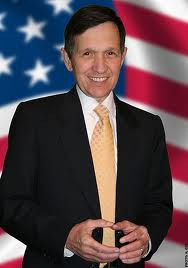
On Friday December 17th Congressman Dennis Kucinich (D,Ohio, 10th District) took a crucial and heroic step to resolve our growing financial crisis and achieve a just and sustainable money system for our nation by introducing the National Emergency Employment Defense Act of 2010, abbreviated NEED. The bill number is HR6550.
While the bill focuses on our unemployment crisis, the remedy proposed contains all the essential monetary measures being proposed by the American Monetary Institute in the American Monetary Act. These are what decades of research and centuries of experience have shown to be necessary to end the economic crisis in a just and sustainable way, and place the U.S. money system under our constitutional checks and balances. Yes it can be done!
We expect this bill will also be re-introduced next year in the 112th Congress. By putting it in now Congressman Kucinich accomplishes these important things:
* First, the seriousness of intent is underscored;
* Second, it gives our nation the opportunity to view, discuss and understand the necessary provisions, giving the chance to make improvements for re-introduction;
* Third it serves as a beacon to our beleaguered people, cutting through the error, vested interest and disinformation that has blocked monetary reform understanding and action in the past.
The American Monetary Institute has activated its blog to discuss and review any questions about this act. Just click on the blog link at our homepage.
To participate in this process, please sign up at the bottom of our home page at . Then, after reading the proposed legislation feel free to make comments or put questions on the blog, including thoughtful suggestions on how it might be improved.
A federal judge on Tuesday awarded $20,400 each to two American lawyers
illegally wiretapped by the George W. Bush administration, and granted
their counsel $2.5 million for the costs litigating the case for more than
four years.
It was the first and likely only lawsuit in which there was a ruling
against the former administration’s secret National Security Agency
surveillance program adopted in the wake of the September 11, 2001 terror
attacks.
WikiLeaks and Operation Payback have put distributed denial of service (DDoS) attacks in the news recently, but independent media and human rights Web sites have been battling these attacks on a consistent basis with no easy solution in sight, according to a Wednesday study.
While major sites can fend off a DDoS or recover quickly, smaller sites can be crippled by these attacks, which often hit in conjunction with other attacks like filtering, intrusions, and defacements, according to the Berkman Center for Internet & Society.
“DDoS is an increasingly common Internet phenomenon capable of silencing Internet speech, usually for a brief interval but occasionally for longer,” the report said. “Our report offers advice to independent media and human rights sites likely to be targeted by DDoS but comes to the uncomfortable conclusion that there is no easy solution to these attacks for many of these sites, particularly for attacks that exhaust network bandwidth.”
The report's authors suggest that DDoS attacks will become more common amidst news about similar WikiLeaks and Operation Payback attacks. Even before that, however, DDoS attacks on independent media and human rights sites were quite common during the last year, happening even outside of major events like elections, protests, and military operations.
These sites are being hit with two types of DDoS: application and network. Application attacks exhaust local server resources and can usually be rectified with the help of a skilled system admin. Network attacks, however, exhaust network bandwidth and can usually only be fixed with the (costly) help of a hosting provider.