Harrison Owen: Public Administration in the 21st Century

Advanced Cyber/IO, Blog Wisdom, Communities of Practice, Cultural Intelligence, Ethics, Methods & Process, Officers Call
Harrison Owen

Asked to comment on the preliminary abstract for a new article, below the line at Search: public administration in 21 century, Harrison responded as follows.

I like your story line, if only because you reach a conclusion that closely parallels one of my own. Coming off a very different base, I found myself convinced that we are at the cusp of a transformative moment, caught between a control oriented, rationalistic awareness (consciousness) of ourselves and our world, verging into an interactive, self organizing consciousness. And “cusps” are always painful and disorienting, which would seem to be an accurate, albeit mild, characterization of our times.

—  extract from the end advanced here—

The real issue was that The Millennium Organization was not a “new program” – it was a profound paradigm shift. And if Thomas Kuhn has taught us anything it is that paradigm shifts are counterintuitive, painful and always the last thing that anybody in their right mind would care to do. Even worse shifting paradigms is not something you can think or reason yourself into. You can’t plan it, design it, program it, manage it, nor control it. The journey forward follows a very different route. I believe there are any number of useful approaches – but none of them come from the Old Proactive Toolbox. I think.

—read the full story—

Continue reading “Harrison Owen: Public Administration in the 21st Century”

Seth Godin: Asimov to the Edges–Perceiving Knowledge

Blog Wisdom, Communities of Practice, Cultural Intelligence
Seth Godin Home

From Asimov to Zelazny

When I was in high school, I read every single science fiction book in the Clearfield Public Library. Probably 250 books altogether.

I don't think I had a big plan, I was mostly looking for something to do. What I discovered, though, was that domain knowledge, edge to edge knowledge of a field, was incredibly valuable. It helped me understand where the edges were, and it gave me the confidence to be selective, to develop a taxonomy, to see what was going on.

As the deluge of information grows and choices continue to widen (there's no way I could even attempt to cover science fiction from scratch today, for example), it's easy to forget the benefits of acquiring this sort of (mostly) complete understanding in a field. I'm not even sure it matters which field you pick.

Click on Image to Enlarge

Expertise is a posture as much as it is a volume of knowledge.

Reading every single trade journal, for example, or understanding the marketing, engineering and sales of your field–there are countless ways to go deep instead of merely paying lip service to the current flavor of the moment.

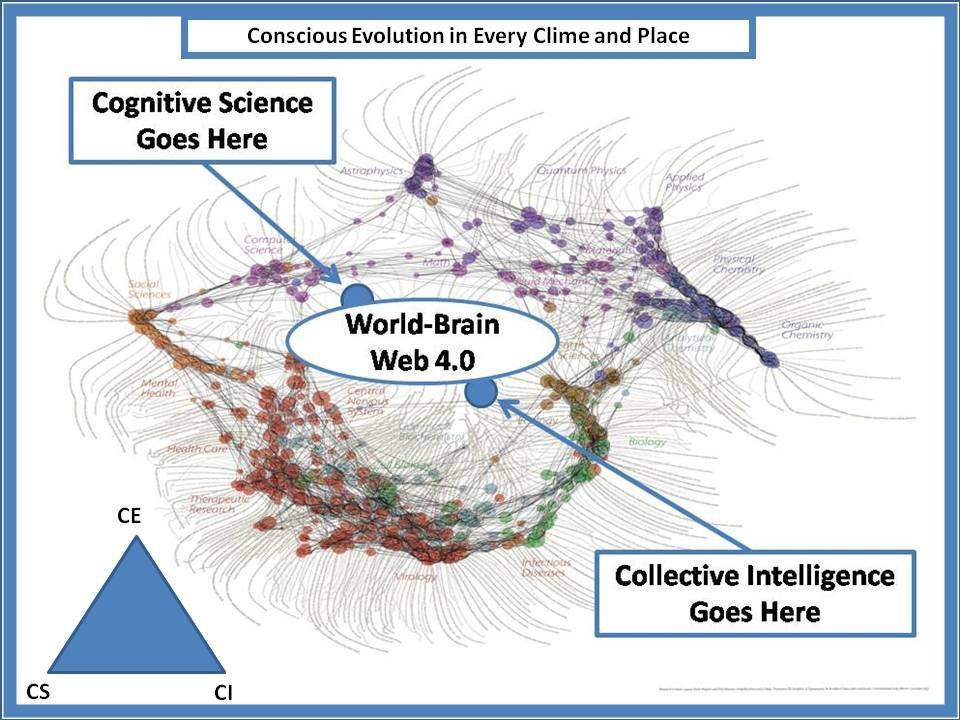
Phi Beta Iota:  Dick Klavans (Maps of Science) has marked the fragmented edges as well as the fragmented Strengths of Nations.  Our task now is to recreate the whole–the unification of diversified knowledge in the public interest.  There are eight tribes of knowledge, not one, or two, or three.

Koko: US EPA & Ford Commit Massive Atrocity

03 Environmental Degradation, 07 Health, 07 Other Atrocities, 09 Justice, Corruption, Earth Intelligence, Government, IO Sense-Making, Movies
Koko the Reflexive

Robert Redford's Son Exposes US Toxic Disaster

The Associated Press  –  Jul 15, 2011

Robert Redford's son Jamie and film co-director Micah Fink on their documentary, premiering July 18 on HBO, about one of the largest toxic-waste cases in U.S. history. (July 15)

Phi Beta Iota:  This is complete documentation of a massive atrocity to which the US Government is a co-conspirator.  There is absolutely no question but that Ford Motor Company executives–including the Board of Directors–should be indicted and investigated.    There is also no question but that the Environmental Protection Agency (EPA) “leadership” then and now should be investigated.  Sadly, Congress is itself impeachable.  The US Government (and the two parties that front for Wall Street) are NOT the public's friend–they are bought and paid for–CORRUPT.  We are long overdue for “The Virgin Truth” as a brand able to provide intelligence with integrity in the public interest.

Koko: Oil Prices & Human Ingenuity

03 Economy, Advanced Cyber/IO, Blog Wisdom, Civil Society, Collective Intelligence, Commerce, Cultural Intelligence, Earth Intelligence
Koko the Reflexive

Published 23 August 2005, the Ludwig von Mises Institute article by Pierre Lemieux discusses the actual decline of resource prices–including “scarce” resources–and the reason: advances in human ingenuity.  This supports our basic proposition on this web site, that the single best investment that could be made to create a prosperous world at peace is to give the five billion poor free access to the Internet so as to nurture and harvest their brainpower.

The Oil Price Mirage

Mises Daily: Tuesday, August 23, 2005 by

EXTRACT

Until his death in 1997, economist Julian Simon predicted a continuous decline in resource prices. In 1980, he made a famous bet with environmentalist Paul Ehrlich. Simon’s bet was that a $1,000 basket of any five metals chosen by Ehrlich would be worth less (in constant dollars) 10 years later. Ehrlich lost. In 1990, the value of the basket at current market prices was down more than 50%. Ehrlich had to send a $576.07 check to Simon, representing the drop in the basket value. In fact, the prices of all the metals chosen by Ehrlich had fallen.[5]

In his challenging 1981 book The Ultimate Resource, Simon showed that resource prices had generally decreased over time. The relative price of oil (in terms of other goods) has fallen by perhaps as much as two-thirds between the 1860s and today. During the same period, the price of oil in terms of salaries has decreased by more than 90%.


Reference: USAWC Information Operations Primer

Advanced Cyber/IO, DoD
Click on Image to Enlarge

Information Operations Primer (USAWC, AY 11, November 2010

This latest revision of the Information Operations Primer provides an overview of Department of Defense (DoD) Information Operations (IO) doctrine and organizations at the joint and individual service levels. The IO Primer begins with an overview of Information Operations, Strategic Communication and Cyberspace Operations. (Note: as the emergent concepts of Strategic Communication and Cyberspace continue to assume increasing importance, the Primer has expanded to include discussion and input of these topics). At each level it describes strategies or doctrine, agencies, organizations, and educational institutions dedicated to the information element of national power. Finally, the document concludes with an IO specific glossary and hyperlinks to information operations, strategic communication and cyberspace operations related websites.

This is a document prepared primarily for use by the staff, faculty, and students of the U.S. Army War College. Wherever possible, internet web sites have been given to provide access to additional and more up-to-date information. The book is intentionally UNCLASSIFIED so that the material can easily be referenced during course work, while engaged in exercises, and later in subsequent assignments.