This short documentary reveals the hazards of the electronics industry in China profiling workers poisoned by chemicals and their struggle for compensation.
Thousands of young people in China enter export factories to make the West's favorite electronic gadgets, only to find they have contracted occupational diseases or worse, leukemia, by the age of 25.
Benzine is a class one carcinogenic banned everywhere EXCEPT China.
Jeffrey K. Silverman, 22 years resident of the former Soviet Union, since October 1991, resides in Tbilisi Georgia worked with Radio Free Europe, crime, corruption and terrorism report. USAR, 100th Division Training, Fort Knox and Blue Grass Army Chemical Weapons Depot, both Kentucky bases: decorated veteran, 19D, Calvary Scout. Jeffrey has a track record in breaking through language barriers and bureaucracies to gather information under unconventional circumstances.
EXTRACT
Journalists Jeffrey Silverman and Lika Moshiashvili are credited with having discovered the secret and illegal operations taking place in the US-controlled Central Reference Laboratory (CPHRL) in the Tbilisi suburb the Alekseevka Settlement.”As soon as this scary information was made known to the public, Georgia & World contacted Tbilisi based American journalist and researcher Jeffrey Silverman.
. . . . . . .
A number of labs, strewn across Eastern Europe, are linked like an umbilicial cord to the Biological Weapons Proliferation Prevention (BWPP) programme and various projects within it. This programme provides a cover for what is most likely an offensive programme. If the strains they are investigating turn out to be antibiotic resistant, this implies they are conducting ongoing research into special organisms that can eat bacteria and attack infections that are antibiotic resistant, which can be quickly accessed. Whoever has the capacity to release these controls the bioweapons battlefield.
Missing the Target: Why the US Has Not Defeated al Qaeda
Frederick W. Kagan, TESTIMONY
American Enterprise Institute, 8 April 2014
All conditions are set for a series of significant terrorist attacks against the US and its allies over the next few years. But that's not the worst news. Conditions are also set for state collapse in Iraq, Syria, Lebanon, Yemen, and possibly Jordan. Saudi Arabia, facing a complex succession soon, is likely to acquire nuclear weapons shortly, if it has not already done so. Turkey and Egypt confront major crises. Almost all of Northern and Equatorial Africa is violent, unstable, and facing a growing al Qaeda threat. And Vladimir Putin's assault on Ukraine is likely to empower al Qaeda-aligned jihadists in Crimea and in Russia itself. That eventuality is, of course, less worrisome than the prospect of conventional and partisan war on the European continent, likely threatening NATO allies. The international order and global stability are collapsing in a way we have not seen since the 1930s. There is little prospect of this trend reversing of its own accord, and managing it will require massive efforts by the US and its allies over a generation or more.
This distressing context is essential for considering the al Qaeda threat today. On the one hand, it makes that threat look small. The long – term effects of global chaos and conflict among hundreds of millions of people across Europe, Africa, and the Middle East on US security, interests, and way of life are surely greater than any damage al Qaeda is likely to do to us in the immediate future. Yet the two threats feed each other powerfully. Disorder and conflict in the Muslim world breed support for al Qaeda, which is starting to look like the strong horse in Iraq and even in Syria. Al Qaeda groups and their allies, on the other hand, powerfully contribute to the collapse of state structures and the emergence of horrific violence and Hobbesian chaos wherever they operate. They are benefiting greatly from the regional sectarian war they intentionally triggered (the destruction of the Samarra Mosque in 2006 was only the most spectacular of a long series of efforts by al Qaeda in Iraq to goad Iraq’s Shi’a into sectarian conflict , for which some Shi’a militants, to be sure, were already preparing) — and have been continuing to fuel.
Al Qaeda is like a virulent pathogen that opportunistically attacks bodies weakened by internal strife and poor governance, but that further weakens those bodies and infects others that would not otherwise have been susceptible to the disease. The problem of al Qaeda cannot be separated from the other crises of our age, nor can it be quarantined or rendered harmless through targeted therapies that ignore the larger problems.
Yet that is precisely how the Obama administration has been trying to deal with al Qaeda.
For 20 years, the world has been promising “never again.” It's been an empty promise.
Timothy McGrath
Global Post, 8 April 2014
For those who lived through the genocide in Rwanda, the mass killings were an indescribable horror. For those who watched from afar, it was an international shame. The world stood idle as an estimated 800,000 men, women, and children were slaughtered in the course of 100 days in 1994. After, hanging its collective head, the world promised that “never again” would it allow such a horrifying conflict to unfold.
But even while making that promise, the world watched as people in Liberia and the Democratic Republic of Congo killed and displaced each other by the millions. Conflicts in Darfur and Syria would also later test the world's “never again” resolve. The US invasion of Iraq and Mexico's drug war created new armed conflicts that also failed to live up to the lofty promise.
“Never again,” it seems, was an empty promise. The world of international actors capable of preventing or intervening in such conflicts has over and over again avoided doing so, even when there was the political and public will to do so.
Here are just seven examples:
LIST ONLY:
1) Democratic Republic of Congo: First & Second Congo Wars, aftermath (1996 – present)
2) First and Second Liberian Civil Wars (1989-2003)
3) Eritrean – Ethiopian War (1998-2000)
4) Darfur conflict (2003 – present)
5) Iraq: US invasion, insurgency, civil war (2003 – present)
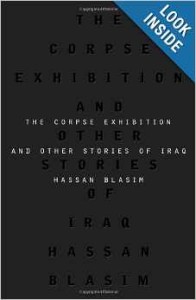
The Corpse Exhibition: And Other Stories of Iraq, by Hassan Blasim, is the most important book to come out of the Iraq War. Blasim, whom I met with last week in Princeton, N.J., has a faultless eye for revealing detail, a ribald black humor and a psychological brilliance that makes every story in his book a depth charge. In this collection of short stories he explores through fiction the culture of violence unleashed under the bloody dictatorship of Saddam Hussein and exacerbated by an American occupation that has destroyed the damaged social cohesion and civil life that survived Saddam's regime. His prose, courtesy of a brilliant translation by Jonathan Wright, is lyrical, taut, and riveting.
Amazon Page
Militarism and violence are diseases. It does not matter under what guise they appear. Renegade jihadists, Shiite death squads, Sunni militias, Saddam's Baathists and secret police, Kurdish Peshmerga rebels, al-Qaida cells, gangs of kidnappers and the U.S. Army 101st Airborne are all infected with the same virus. And it is a virus Blasim fearlessly inspects. By the end of this short-story collection the reader grasps, in a way no soldier's memoir or journalistic account from Iraq can explicate, the crucible of war and the unmitigated horror of violence itself. The book is a masterpiece.
“When I was 6, during my first year at school, the Iran-Iraq War erupted,” Blasim told me in a mixture of English and Arabic. “We were living in Kirkuk. We were taught in school to draw tanks or the face of Ayatollah Khomeini as the enemy. The city of Kirkuk was beautiful. There were flowers everywhere. But we were never taught the names of the flowers. Even today I do not know the names of these flowers. I tried to learn their names as an adult.”
“There was a culture of violence that predated the occupation,” he said…