Owl: Open Season on Gun Advocates — Is There a Domestic Covert Action Program Underway that Includes Individual Assassinations and Staged Mass Murders?

07 Other Atrocities, 09 Justice, 11 Society, Corruption, Government, Law Enforcement, Media
Who?  Who?
Who? Who?

Gun Makers on Obama's “Red List”?

According to some observers, several well-known manufactures of guns have died recently, and in one case, police declare the death a homicide.

“John Noveske is one of the most celebrated battle rifle manufacturers in America. His rifles, found at www.NoveskeRifleworks.com are widely recognized as some of the finest pieces of American-made hardware ever created. (I own one of his rifles, and it's a masterpiece of a machine that just keeps on running.) Sadly, John Noveske was killed in a mysterious car crash just a few days ago, on January 4, 2013.

“John Noveske wasn't the first prominent gun rights supporter to be killed in the last few days. Keith Ratliff, the creator of a super-popular YouTube channel featuring videos of exotic weapons, was also recently found dead. The Daily Mail reports that Ratliff was “discovered on a rural road in Carnesville, Georgia. Ratliff had a single gunshot wound the head and police are treating his death as a homicide.” Someone murdered Ratliff, in other words, and it had to be someone with the ability to get close enough to Ratliff to take him out without warning.”

“…the widely-discredited CNN journalist Piers Morgan, wanted for questioning in Britain's Daily Mirror phone hacking scandal, invited guests onto his show who threatened Alex Jones' children and laughed about the idea of Piers Morgan shooting Alex Jones with an AR-15.”


Continue reading “Owl: Open Season on Gun Advocates — Is There a Domestic Covert Action Program Underway that Includes Individual Assassinations and Staged Mass Murders?”

SchwartzReport: Canadian Oil Sands Destroying Nearby Lakes

05 Energy, 07 Health, 07 Other Atrocities, Earth Intelligence

schwartz reportCanadian oil sands pollute nearby lakes. Report is blow to Keystone pipeline.

Oil sands production in Canada has contaminated surrounding lakes with substances linked to cancer, according to a new study. The scientific findings may help the case against building Keystone XL, a pipeline that would connect Canadian oil sands with American refineries.

Click on Image to Enlarge

Production at the world's third largest source of oil has polluted surrounding waters with toxic substances, according to a new study. The findings add fuel to a fiery debate over a proposed pipeline connecting Canadian oil sands with US refineries.

Lakes as far as 56 miles away from production facilities near Fort McMurray, Alberta, show unnaturally high levels of substances linked to cancer. Researchers say they are the result of roughly half a century of development at the Athabasca oil sands.

While concentrations of carcinogens remain low compared with those found in urban lakes, scientists at Queen's University in Kingston, Ontario, called the findings, released Monday, “worrying” and warned of future effects from the spread of oil sands contaminants.

Read full article.


NIGHTWATCH: Chinese Using Senkaku Islands Dispute to Experiment with Managing “Total War” Across All Domains

02 China, 03 Economy, 04 Inter-State Conflict, 10 Security, 11 Society, IO Sense-Making

Japan-China: Bloomberg has published an excellent report that describes the economic consequences of Japan's dispute with China over ownership of the Senkaku Islands. No other news outlet has published a comparably insightful and detailed account.

The first point the journalists made is that trade relations between China and Japan multiply the costs of a territorial dispute. Japan's trade with China is valued at more than $300 billion per year, which is potentially at risk.

A Chinese boycott of Japanese imports would hurt China but might already have resulted in a reduction of GDP, according to Bloomberg citing JPMorgan Chase, because of reduced Chinese purchases of Japanese goods.

Ripple effects in China from boycotts of Japanese manufactures put at risk the jobs of millions of Chinese who work in Japanese industries in China. Japanese auto sales declined. Air travel cancellations increased in both countries. One Japanese department store retailer closed 60 of 169 stores because of anti-Japanese vandalism and threats.

Comment: The key point is that global economic integration magnifies the consequences of international disputes. Interdependency means both sides seriously suffer economically, although security incidents result in no casualties. Japan might have sustained a .5 per cent decline in GDP in the last quarter of 2012, essentially because of Chinese hostile, nationalistic responses to the islands dispute.

Both sides got hurt, but China can absorb the consequences more than Japan.

Another key point is that the dispute shows how the Chinese fight in every kind of battle space – at sea, in the air, on the land, in cyber space, in international political space and in economic space. Total warfare means total to the Chinese. They are experimenting with that in the Senkakus dispute.

Continue reading “NIGHTWATCH: Chinese Using Senkaku Islands Dispute to Experiment with Managing “Total War” Across All Domains”

Berto Jongman: Maplecroft Global Terrorism Risk Map 2013

09 Terrorism
Berto Jongman
Berto Jongman

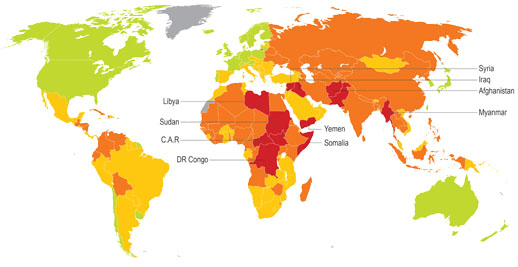
The spread of violence and instability from Syria and Libya; increasing terrorism across key growth economies; the heightened risk of social unrest driving regime change; and resource nationalism will be the drivers of political risk for 2013, according to the fifth annual Political Risk Atlas, released by Maplecroft.

Maplecroft’s Political Risk Atlas 2013 (PRA) includes 50 risk indices and interactive maps developed to enable companies and investors to monitor the key political issues and trends affecting the business environments of 197 countries. The Atlas includes dynamic short-term risks, such as rule of law, political violence including terrorism, the macroeconomic environment, expropriation, resource nationalism and regime stability, as well as structural long-term risks, such as economic diversification, resource security, infrastructure readiness, and human rights. Indeed, changing patterns of human rights risk on the ground are considered leading indicators of political risk by Maplecroft.

Click on Image to Enlarge

Phi Beta Iota: There is still a need for a map that integrates the ten high level threats to humanity and performance across all organizations on the twelve core policies.

See Also:

2002 Jongman (NL) World Conflict & Human Rights Map 2001/2002

Marcus Aurelius: CIA’s Double Standard Exploitation of Secrecy — Use It to Hide Official Attrocities, While Screwing Iconoclasts + RECAP

07 Other Atrocities, 11 Society, Corruption, Director of National Intelligence et al (IC), Government
Marcus Aurelius
Marcus Aurelius

Secret Double Standard

By Ted Gup

New York Times, January 9, 2013

Cambridge, Mass. — IN the last week, the American public has been reminded of the Central Intelligence Agency’s contradictory attitude toward secrecy. In a critique of “Zero Dark Thirty,” published last Thursday in The Washington Post, a former deputy director of the C.I.A., Jose A. Rodriguez Jr., defended the use of waterboarding and said that operatives used small plastic bottles, not buckets as depicted in the film, to carry out this interrogation method on three notable terrorists. On Sunday, The New York Times reported on the Justice Department’s case against a former C.I.A. officer, John C. Kiriakou, a critic of waterboarding who faces 30 months in prison for sharing the name of a covert operative with a reporter, who never used the name in print.

The contrast points to the real threat to secrecy, which comes not from the likes of Mr. Kiriakou but from the agency itself. The C.I.A. invokes secrecy to serve its interests but abandons it to burnish its image and discredit critics.

Over the years, I have interviewed many active and retired C.I.A. personnel who were not authorized to speak with me; they included heads of the agency’s clandestine service, analysts and well over 100 case officers, including station chiefs. Five former directors of central intelligence have spoken to me, mostly “on background.” Not one of these interviewees, to my knowledge, was taken to the woodshed, though our discussions invariably touched on classified territory.

Somewhere along the way, the agency that clung to “neither confirm nor deny” had morphed into one that selectively enforces its edicts on secrecy, using different standards depending on rank, message, internal politics and whim.

I am no fan of excessive secrecy, or of prosecuting whistle-blowers or leakers whose actions cannot be shown to have damaged American security. The C.I.A. needs secrecy, as do those who place their lives in the agency’s hands, but the agency cannot have it both ways.

Read full article.


Continue reading “Marcus Aurelius: CIA's Double Standard Exploitation of Secrecy — Use It to Hide Official Attrocities, While Screwing Iconoclasts + RECAP”

Mini-Me: Kerry-Hagel as Obama Attempt to Change Direction Away from War and Toward Domestic Reconstruction

02 Diplomacy, 03 Economy, 04 Inter-State Conflict, 07 Other Atrocities, 10 Security, 11 Society, Corruption, Cultural Intelligence, DoD, Government, Military, Peace Intelligence
Who?  Mini-Me?
Who? Mini-Me?

Huh?

A view of what's really behind Hagel nomination fight

From CNN's “Early Start”

January 8, 2013

EXTRACT:

CNN: Peter wrote what I think is (one of the) most … interesting and compelling articles about the Hagel nomination, explaining it perhaps better than anyone I've seen, including the president.

The first paragraph of the piece, you write, it may prove the most consequential foreign policy appointment of his presidency because the struggle over Hagel is a struggle over whether Obama can change the terms of the foreign policy debate. Explain that for me.

Peter Beinart: I think so far, the debate about military action in Iran has been conducted by and large in Washington, as if Iraq and Afghanistan didn't happen.

As if we haven't learned anything from the disaster (of) these two wars over the last 10 years. I think the real struggle between Hagel and his foes is he wants to bring some of the lessons in to the Iran debate that we learned about (Iraq) and Afghanistan.

He talks very compellingly about the fact wars once launched can't be fully controlled. He is very cognizant of the enormous financial cost that these wars have imposed on the United States, and I think the heart of the hostility is the fear that his recognition about what happened in Afghanistan and Iraq will make taking us to war in Iran harder.

Hagel vows to fight ‘distortions'

[Note: An Open Source Agency (OSA) controlled by Kerry-Hagel would go a very long way toward fighting the information pathologies that abound in Washington.]

CNN: You suggest there are no consequences for the Iraq War in terms of those who supported or imposed it.

Continue reading “Mini-Me: Kerry-Hagel as Obama Attempt to Change Direction Away from War and Toward Domestic Reconstruction”

Marcus Aurelius: Fact-Checking CIA Fact-Checking 0 Dark 30 [with Robert Steele Fact-Checking Both] 1.2

07 Other Atrocities, 08 Proliferation, 09 Terrorism, Corruption, Cultural Intelligence, Director of National Intelligence et al (IC), Government, Ineptitude, IO Deeds of War, IO Impotency
Marcus Aurelius
Marcus Aurelius

Fact-Checking the CIA's Fact-Check on ‘Zero Dark Thirty

By J.K. Trotter | The Atlantic Wire – Fri, Dec 28, 2012

“The CIA is a lot different than Hollywood portrays it to be,” reads an official explainer issued today by the Central Intelligence Agency — a thinly veiled attempt to continue debunking Zero Dark Thirty, the controversial Oscar favorite that its director admittedly hates. Referring to James Bond, the fictional MI6 agent, depictions of “shootouts and high speed chases,” and scenes of “CIA officers chasing terrorists through the American heartland,” the memo goes on to try and dispel an array of “myths” pertaining to the agency's operations, from its impact on foreign policy to its ability to spy on Americans. The effort follows a December 21 letter addressed to CIA employees from the agency's acting director, Michael Morrell, concerning the “artistic license” of Zero Dark Thirty. Today's release touches on the same themes: whether the CIA of our popular imagination corresponds to the CIA of reality, and how movies like Zero Dark Thirty (which isn't name-checked directly) blur the distinction between fact and fantasy. Should you believe the CIA's interpretation of Hollywood? We break down each agency claim with actual details from the movies — and Homeland, obviously.

RELATED: CIA Emails Reveal Winners and Losers of National Security Access

Below the line:  each of the five “myths” and Robert Steele's “best truth” answer, Steve Coll's negative review of film.

Continue reading “Marcus Aurelius: Fact-Checking CIA Fact-Checking 0 Dark 30 [with Robert Steele Fact-Checking Both] 1.2”

noble gold