Home to well over one-fifth of the population, South Asia continues to be a hotbed of conflict and upheaval. Human rights abuses, the war in Afghanistan, and climate change all present critical challenges to the region and to U.S. foreign policy. In our new focus, FPIF contributors examine current obstacles and future solutions in South Asia.
U.S. military strategy in Afghanistan is built on two coups, one in Kabul and the other in Islamabad, writes Shibil Siddiqi in Obama's Surge and Pakistan.
The AfPak Train Wreck: Conn Hallinan says that the president's goals in escalating the war in Afghanistan are deeply flawed. Just ask the Russians.
Adil Shamoo, in Nation-Building in Afghanistan, writes that the United States can learn from the mistakes made in Iraq to craft a new approach for that country.
Robert Naiman, in ‘Legitimacy' in Afghanistan, points out that escalation has just brought more death and destruction. More escalation could close off opportunities for a political solution.
Much of the Afghanistan debate has been centered in the U.S. But what do Afghans think? Gabriela Campos interviews Mariam Nawabi in Underlying Causes of Security in Afghanistan.
Here are two opposing views on how to win in Afghanistan:
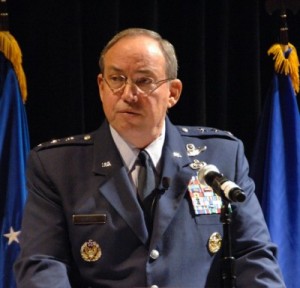
1. An Air Force general's view from the Top Down
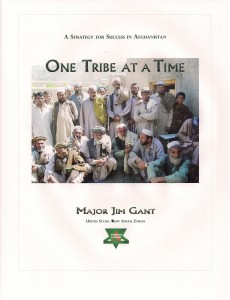
2. Army Special Forces major's view from the bottom up
SOF Major Strategy for AF
My comment: While I think the major is far closer to reality than the general, I would argue that the Pentagon, which is run by generals, does not have a clue how to go about executing the major's strategy, if they chose to do so — and they won't. But that might not matter, because, paradoxically, I think the major's excellent appreciation of the Afghan conundrum illustrates indirectly why we need to get out of Afghanistan asap.
There are at least two reasons why this is so:
First, the military has no clue how to execute the kind of strategy advocated by the major. That is why General McChrystal asked for a large increase in conventional troops. The surge just approved by the President shows (a) that the military is completely wedded to an approach that uses a large US footprint, centralized command and control, and a reliance on heavy firepower, like the AF general's predilection for bombing; and (b) the politicians are wedded to the concept that strengthening an already corrupt centralized Afghan gov't and Afghan national army and national police forces will “win the hearts and minds” of the rural population.
Note that the weakest parts of the major's excellent analysis occur when he tries to reconcile support of the Afghan central government and Afghan national army with his decentralized tribal strategy — they can not be reconciled except through tribal mediation processes that start a village level jirgas and slowly work upwards to “national” level loya jirga. But that traditional approach would result in a repudiation of the central gov't as it is now constituted.
Second. I am not sure there will ever be enough time to make his strategy work on a war-winning scale. As the major makes clear, we are struggling to deal with a culture that is based on profoundly important concepts of honor and revenge. Planners in Washington and Kabul are trying to shape the cultural DNA of a rural tribal society that is the product of a 3000 years of cultural evolution. This culture may seem primitive to strategists in Washington trying to export the our way of life (not the major, who clearly understands that strategy must be shaped by the mores of the Afghan culture), but this tribal culture is in fact a highly evolved in a complex relationship to its environment. The problem as I see it is that too much water has gone over the dam since we foolishly began trying to cynically manipulate the value systems of this tribal culture by inflating the Islamic crazies in late 1970s (with goal of making it more likely that Sov's would invade and enmesh the Sovs in their Vietnam-like quagmire).
There's nothing inherently wrong with the analysis of Al Qaeda (I just glanced at it, if you wish I can read in detail today). The PROBLEM lies not so much in how we analyze support to terrorism (state, crime, other) but rather in the way we analyze (or rather do NOT analyze) EVERYTHING.
Here's what I have thrown together for you, in six pages with links.
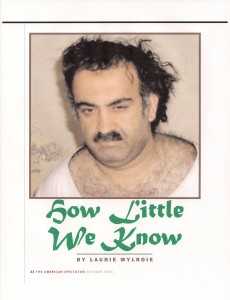
This contribution by Dr. Laurie Mylroie is so good we are also cataloging it as a Historic Contribution. See her Wikipedia page as well. The article appeared originally in The American Spectator (October 2006). As much as we disagree with many of her beliefs on this matter, we do agree that our national intelligence community was not up to the task of determining the best available truth across the board. Her two books:
General Barry McCaffrey, USA (Ret)Afghanistan Trip Report
After Action Report–General Barry McCaffrey, USA (Ret)
Visit to Kuwait and Afghanistan 10-18 Nov 09
11 pages
Extracted points
01 Phenomenally useful report with too much cheerleading. This is a 10-year regional war, State Department and AID are pulling out for next several years (too dangerous), costing us roughly half per day what we paid for all of WW II per day. Allies not really showing up and being effective, less the British.
02 Talked to Generals, Ambassadors, and Ministers–no Captions, no village chiefs. Nothing in her on intelligence, glosses over the C4I and protocol issues (see Journal: Beyond Weber to Epoch B Leadership).
03 Achilles' heels are multiple: 90% of the logistics come through Karachi, Pakistan and then overland. Without fire support and aviation this war is lost. Taliban now up to battalion-sized operations and believe they have high moral ground and time on their side. 100% US movement by air. (See Review: Firepower In Limited War; aviation sounds like a repeat of Viet-Nam; only thing keeping logistics open are the same decision made by NVA in Viet-Nam and by Iran-Syria in Iraq: better to let the Americans bleed themselves to death than cut their main supply line.
Chuck Spinney sends:
In my opinion, this is an extremely important piece of writing and needs to be read very carefully. The author of this article built an international reputation for excellence during his reporting on the Iraq War, and now he is positioning himself to do the same on Afghanistan. Conflating al Qaeda with the Taliban will mutate the so-called war on terror into an Anti-Pashtun (AF-Pak) War, with unknowable ramifications that could very well make the lunacy of Mad King George's aggression in Iraq look miniscule in comparison.
Full Story Online
A Wider and Unnecessary War: The March of Folly
By PATRICK COCKBURN December 7, 2009
By treating Pashtun villagers as if they were all Taliban, and Taliban as being the equivalent of al-Qa’ida, Mr Obama is increasing, not reducing, the threat of terrorist attack on the US or Britain. He is providing the battleground bin Laden hoped for and, like President Bush before him, has jumped willingly into the al-Qa’ida trap.
. . . . . .
One of the most foolish and misleading claims by US and British generals is that fighting a guerrilla war can be successfully combined with dispensing aid and building bridges and roads. But, as one commentator puts it, such a mixture of Wyatt Earp and Mother Theresa is not feasible. Soldiers are trained to get what they want by force and that is generally what they do. Afghans whose families have just been killed by a bomb will not be conciliated by a fine new drainage system.
Other minefields face incoming American and British forces. The Afghan government is in many respects a criminal racket.