Journal: Technology Can Save Feds $1T in 10 Years

03 Economy, 09 Justice, 10 Security, Computer/online security, Government
content by Greener World Media

By GreenerComputing Staff at Greener World Media

Tue Oct 26, 2010 1:00am EDT

Throughout this highly charged election season, government spending and the federal deficit have been a linchpin of political arguments. At the same time, a gridlocked Congress means that very little has been accomplished despite all the debate.

But a report published earlier this month highlights seven ways that, using existing technologies, the federal government could save $100 billion dollars a year for the next 10 years, not-insignificant portion of the current federal deficit.

The report, “One Trillion Reasons,” was published by the Technology CEO Council, a group chaired by IBM CEO Samuel Palmisano. It lays out how technologies from data center management to fraud-fighting tools can improve efficiency and productivity in the government.

– – – – – –

Initiative 1: Consolidate Information Technology Infrastructure
Initiative 2: Streamline Government Supply Chains
Initiative 3: Reduce Energy Use
Initiative 4: Move to Shared Services for Mission-Support Activities.
Initiative 5: Apply Advanced Business Analytics to Reduce Improper Payments.
Initiative 6: Reduce Field Operations Footprint and Move to Electronic Self-Service.
Initiative 7: Monetize the government's assets

Read Full Article

Download Report (10 Page PDF)

Tip of the Hat to Bob Gourley at LinkedIn.
Secrecy News Headlines

10 Security, 10 Transnational Crime, Corruption, Government, IO Multinational, Law Enforcement, Methods & Process

**      ODNI ISSUES NEW SECURITY STANDARDS FOR INTEL FACILITIES

**      INFORMATION SHARING: FEAST OR FAMINE

**      POLYGRAPH TESTING AGAINST BORDER CORRUPTION

Phi Beta Iota: As long as the IC persists in sticking with the TS/SCI “all or nothing” approach to information, it will continue to fail in serving the  needs of virtually all of the current and all of the unrecognized but potentially legitimate customers for its proven sources and methods.  The Open Source Agency under diplomatic auspices, that includes both the 50 community intelligence networks managed by the National Guard as well as the Multinational Decision Support Centre with regional multinational Stations, are necessary first steps if intelligence is to be useful into the future.

Regarding the polygraph, it works and has been hugely successful within the International Commission Against Impunity in Guatemala (CICIG) and within the Government of Guatemala itself, with two major caveats: 1) polygraph results must be reported directly to the leadership by the polygraphers, we have seen polygraphs manipulated or fabricated by security managers intent on achieving specific personnel or political or budget goals; and 2)  out of area polygraphers are essential–in Central America, and we suspect in the Southwest border region as well, most local polygraphers have been employed by and well compensated by and are deathly afraid of, the narco-traffickers who know how to use the polygraph to keep their own ranks free of penetrations and betrayal from within.  A global cadre of polygraphers under deep cover is needed.

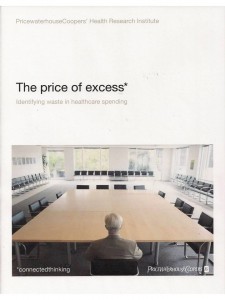
2010 Reference: HEALTH–The Price of Excess (PWC)

07 Health, Analysis, Budgets & Funding, Commerce, Commercial Intelligence, Methods & Process, Reform, Waste (materials, food, etc)
Free with Registration Online

EXCERPT:  Our research found that wasteful spending in the health system has been calculated at up to $1.2 trillion of the $2.2 trillion spent in the United States, more than half of all health spending. Defensive medicine, such as redundant, inappropriate or unnecessary tests and procedures, was identified as the biggest area of excess, followed by inefficient healthcare administration and the cost of care necessitated by conditions such as obesity, which can be considered preventable by lifestyle changes.

Phi Beta Iota: PriceWaterhouse Coopers hit it out of the park with this study, and we are even more pleased that after we pointed out the unreadability of the orange print/gray scale text as originally posted, they have now posted a solid black very readable version.  It is free with registration and we urge all who have an interest of any sort in Health to get this document, print it, and send this link on to others.  It is “Ref A” for our forthcoming Sense-Making Summit '11: Public Health.

Reference: 10 High-Level Threats to Humanity

Analysis, Blog Wisdom, Threats
Robert David STEELE Vivas

ROBERT STEELE: As I watch DNI Dan Coats embarrass himself, I cannot help but be reminded of the only decent high-level threat study ever done, by a panel including LtGen Dr. Brent Scowcroft, USAF (Ret), the last serious National Security Advisor in modern US history.  The DNI is either being lied to or is actively misleading Congress. See in passing Soft Coup and False Flag Attacks. I am dismayed by the failure of the DNI to provide a national threat report that is holistic and inclusive of true cost economics.

10 High-Level Threats to Humanity

Or, everything no one ever told DNI Dan Coats that he was incapable of thinking of by himself.

Full text with graphics below the fold.

Continue reading “Reference: 10 High-Level Threats to Humanity”

The Antonio Pizzigati Prize For Software in the Public Interest

Technologies

Established in 2006, the Antonio Pizzigati Prize for Software in the Public Interest annually awards $10,000 to a software developer who adds significant value to the nonprofit sector and movements for social change. The Pizzigati Prize honors the brief life of Tony Pizzigati, an early advocate of open source computing.

Our Mission
Software developers who create, for free public distribution, open source applications and tools that nonprofit and advocacy groups can put to good use are making a two-faceted contribution to social change.

Our Application
The Pizzigati Prize welcomes applications from–and nominations of–single individuals. Those nominated for the prize should have developed a software product that is open source, as defined by the Open Source Initiative, and easily and widely available. This software must have already demonstrated its value to at least one nonprofit organization, and be a product that can be a value to multiple nonprofit organizations. Applicants will be evaluated on a range of criteria by an advisory panel that includes national leaders in public interest computing and past winners of the Prize.
Please visit the Prize Information pages for more information about eligibility, the application and nomination processes, and evaluation criteria.

2011 PRIZE NOMINATION PROCESS NOW OPEN
Nominations are now open for the fifth annual awarding of the $10,000 Antonio Pizzigati Prize for Software in the Public Interest, the nation's top honor for software developers working with nonprofits to help forge innovative social change. The Tides Foundation will be accepting nominations for this year's competition through December 15, 2010. The 2011 prize winner will be announced this March at the Nonprofit Technology Network (NTEN) annual conference in Washington, D.C.Please visit the Prize Information section for full details on the nomination and application process.

Thanks to those who update the inSTEDD Twitter feed

Greg Palast, Big Oil, & PBS (Petroleum Broadcast System)

03 Environmental Degradation, 05 Energy, Commerce, Corporations, Journalism/Free-Press/Censorship, Media, Power Behind-the-Scenes/Special Interests

The Petroleum Broadcast System Owes Us an Apology

by Greg Palast for Truthout/Buzzflash
Wednesday, October 27, 2010

Tonight, my dog Pluto and I watched the PBS ‘Frontline' investigation of BP, “The Spill.”

PBS has uncovered a real shocker:  BP neglected safety!

Well, no shit, Sherlock!

Pluto rolled over on the rug and looked at me as if to say, Don't we already know this?

Then PBS told us – get ready – that BP has neglected warnings about oil safety for years!

That's true.  But so has PBS.  The Petroleum Broadcast System has turned a blind eye to BP perfidy for decades.

If the broadcast had come six months before the Gulf blow-out, after the 2005 BP Refinery explosion in Texas, after the 2006 Alaska pipeline disaster, after the years of government fines that flashed DANGER-DANGER, I would say, “Damn, that Frontline sure is courageous.”  But six months after the blow-out, PBS has shown us it only has the courage to shoot the wounded.

Continue reading “Greg Palast, Big Oil, & PBS (Petroleum Broadcast System)”

noble gold