Journal: Afghanistan Myths & Triumph Foresaken

08 Wild Cards, Strategy

Full Story Online
Full Story Online

November 9, 2009

Afghan Mythologies by Victor Davis Hanson

As President Obama decides whether to send more troops to Afsghanistan, we should remember that most of the conventional pessimism about Afghanistan is only half-truth.

Remember the mantra that the region is the “graveyard of empires,” where Alexander the Great, the British in the 19th century, and the Soviets only three decades ago inevitably met their doom?

In fact, Alexander conquered most of Bactria and its environs (which included present-day Afghanistan). After his death, the area that is now Afghanistan became part of the Seleucid Empire.

Centuries later, outnumbered British-led troops and civilians were initially ambushed, and suffered many casualties, in the first Afghan war. But the British were not defeated in their subsequent two Afghan wars between 1878 and 1919.

The Soviets did give up in 1989 their nine-year effort to create out of Afghanistan a communist buffer state — but only because the Arab world, the United States, Pakistan and China combined to provide the Afghan mujahideen resistance with billions of dollars in aid, not to mention state-of-the-art anti-aircraft and anti-tank weapons.

While Afghans have been traditionally fierce resistance fighters and made occupations difficult, they have rarely for long defeated invaders — and never without outside assistance.

Other mythologies about Afghanistan abound.

Continue reading “Journal: Afghanistan Myths & Triumph Foresaken”
Journal: Empire as Usual–and Then Collapse

Cultural Intelligence, Government, Reform

Chuck Spinney
Chuck Spinney

Chuck Spinney sends….

Obama's policies are making Democrats the party of Bloated Plutocracy.

November 8, 2009     OP-ED COLUMNIST

The Night They Drove the Tea Partiers Down

Frank Rich

The Obama administration does not seem to understand that this rage, left unaddressed, could consume it.

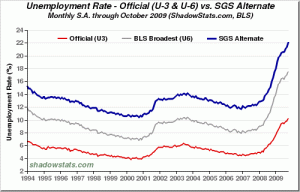
The system is going back to the way it was with a vengeance, against a backdrop of despair. As the unemployment rate crossed the 10 percent threshold at week’s end, we learned that bankers were helping themselves not just to bonuses as large as those at the bubble’s peak but to early allotments of H1N1 vaccine. No wonder 62 percent of those polled by Hart Associates in late September felt that “large banks” had been helped “a lot” or “a fair amount” by “government economic policies,” but only 13 percent felt the “average working person” had been. Unemployment ranked ahead of the deficit and health care as the No. 1 pocketbook issue in the survey, with 81 percent saying the Obama administration must take more action.

Continue reading “Journal: Empire as Usual–and Then Collapse”

Worth A Look: System Vulnerability Approach to Climate Change

03 Environmental Degradation, Methods & Process, Worth A Look

Berto Jongman Recommends:

Impacts of Climate Change: A System Vulnerability Approach (2007)

By Nils Gilman, Peter Schwartz, Doug Randall

Over the past two decades, and especially in the last few years, climate change has become one of the most heavily researched subjects in science. Yet climate change impact studies remain at the low end of usefulness for policymakers and others; they are not predictive enough to be actionable because the exact nature of the events that will jar the planet in the near- and long-term future—the wheres, whens, and hows of climate change—remains both unknown and unknowable. This paper offers policymakers an alternative approach to thinking about climate change and its impacts. Instead of starting with climate change and working out toward impacts, we focus on systems that are already generally vulnerable first, and then consider what the geophysics of climate change may do to them. This approach has two benefits. First, it limits the number of logical steps necessary for thinking about the impacts of climate change, enabling more confident insights and conclusions. Second, it cuts across analytic stovepipes and gives regional specialists a framework for thinking about what climate change will mean for their particular areas, based on expertise they already have. Download PDF

Journal: Google “Privacy” the New Oxymoron

Technologies

Full Story Online
Full Story Online

Google Dashboard: A Closer Look

Ian Paul, PC World

Nov 5, 2009 1:42 pm

Google showed Thursday it's getting more serious about privacy when it launched a tool called Google Dashboard that aims to give you more control over your personal data stored on Google's servers. From your Google Dashboard you can view the company's privacy policies, easily access your most recent activity for each Google service you use, and manage settings for those services.

Phi Beta Iota: Google has never provided privacy and it never well.  Google Enterprise devices are Trojan Horses, and anything Google touches goes into the Google Cloud forevermore.  This is why Phi Beta Iota believes that we must move to bottom-up clouds in which the individual and their device are both infrastructure-independent (localized clouds) and able to control all rules for content they create at the point of creation.  John Chambers refuses to offer Application Oriented Network services in this fashion, so perhaps Nokia will steal a march on him and recognize that a cell phone CPU AON and Haggle would be totally cool and *very* disruptive.

Journal: Out of Touch with Reality I

03 Economy, 04 Education, Commerce, Commercial Intelligence, Ethics, Methods & Process, Mobile

Full Story Online
Full Story Online

Lifestyle Hackers

Jim Routh and Gary McGraw examine why twenty-somethings skateboard  right past security controls, and what it means for employers (i.e.  you!)

November 02, 2009

The insider threat, the bane of computer security and a topic of  worried conversation among CSOs, is undergoing significant change.  Over the years, the majority of insider threats have carried out  attacks in order to line their pockets, punish their colleagues, spy  for the enemy or wreak havoc from within. Today's insider threats may
have something much less insidious in mind—multitasking and social  networking to get their jobs done.

Continue reading “Journal: Out of Touch with Reality I”

Journal: Out of Touch with Reality II

07 Other Atrocities, 08 Immigration, 09 Justice, 10 Security, Civil Society, Cultural Intelligence, Methods & Process

Full Story Online
Full Story Online

The Elephant in the Room: A war of ideas within Islam

Backward views hold sway in much of the Muslim world. And yet there is hope.

By Rick Santorum    Thu, Nov. 5, 2009

The students, one man and two women, wore Western-style clothes and spoke English with little or no accent. They disputed my description of Islam as it's practiced in the Middle East, maintaining that al-Qaeda's version of Islam in no way reflects the Islam that is practiced around the world.

So I asked them a question: Should apostates – Muslims who convert to another religion – be subject to execution?

One of the women quickly said no. She insisted that she was free to leave Islam if she wanted to, and that she knew other people who had done so without a problem – in the United States.

I said I wasn't talking about her and others' freedom of religion in this country. What if they lived in a Muslim-majority country?

Silence. Eventually, the young man blurted out, “That's different.”

Continue reading “Journal: Out of Touch with Reality II”

noble gold