
In the attached essay, my friend Jeff Madrick uses the unbridled greed of the finance industry (now trying to rescue itself from its own excesses by sucking at the government teat) to highlight the basic hypocrisy in the so-called free-market economy of go-go capitalism. Jeff summarizes the results of two recent mainstream economic studies which show the egregious bonuses in the finance industry are simply the fruits of unfair economic privilege. To economists, this privilege takes the form of obscene economic “rents” — i.e., the excessive revenues and inefficiencies that competition is supposed to eliminate under the capitalist theory (ideology) of free markets.
Journal: Human Intel Or Technical Intel?
Methods & Process, Military, Peace IntelligenceDoDBuzz,com
August 5, 2009
Human Intel Or Technical Intel?
By Greg Grant
Some of the leading doyens of the Washington national security set recently returned from Afghanistan where they were part of new Afghan commander Gen. Stanley McChrystal’s strategy review. CSIS’s Anthony Cordesman reported back last week with a generally pessimistic take on the state of affairs on that front.
One point Cordesman made in his briefing to Washington reporters really jumped out: the surprisingly poor intelligence we have on the enemy. How is it that eight years into this war we don’t have better intelligence on exactly who we’re fighting?
2009 Arnold Google: The Digital Gutenberg
Historic Contributions, Technologies, Tools
Robert Steele, the #1 Amazon reviewer for non-fiction, considers Stephen E. Arnold to be the single most professional analyst of emerging information technologies and their social meaning. His “Google Triology” may well be the most significant body of work of practical significance not just to the information industry, but to civil liberties, capitalism, civil society, democracy, digital dictatorship, digital ethics, governance, intellectual property, privacy, and all manner of community, budget, policy, and threat as it is impacted by Google, a supranational predator with out of this world computational mathematics and no commitment at all to public intelligence in the public interest. Below is the cover to his latest offering, with a link to Infonortics UK, the sole source of this e-book that we recommend be printed.
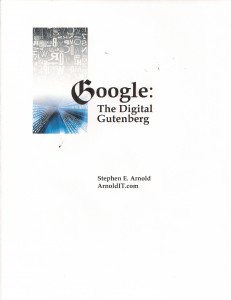
The link within the book cover includes immediate free access to the table of contents and a sample chapter as well as the author's three-point summary. At the book's home page are also links to his first two works, The Google Legacy and Google 2.0: The Calculating Predator, and a special offer for the Google Trilogy.
Below are the printing instructions we use with this kind of work:
——-
Color, double-side, laser paper except last two and first pages which should be on 80 cover stock. Wire binding, please use closest possible to avoid overage of wire beyond book's natural thickness.
Continue reading “2009 Arnold Google: The Digital Gutenberg”
Journal: Military says linguists can’t keep up in Afghanistan
Methods & Process, Military, Technologies, Tools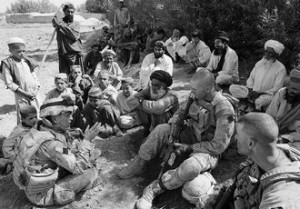
PHOTO:David Guttenfelder/The Associated Press
Josh Habib, far left, a 53-year-old translator for the U.S. Marines, speaks with Afghan villagers and two Marines in the Nawa district of Helmand province.
By JASON STRAZIUSO Associated Press writer
July 26, 2009 6:00 AM
NAWA, Afghanistan — Josh Habib lay in a dirt field, gasping for air. Two days of hiking with Marines through southern Afghanistan's 115-degree heat had exhausted him. This was not what he signed up for.
Habib is not a Marine. He is a 53-year-old engineer from California who was hired by a contracting company as a military translator. When he applied for the lucrative linguist job, Habib said his recruiter gave no hint that he would join a ground assault in Taliban land. He carried 40 pounds of food, water and gear on his back, and kept pace — barely — with Marines half his age.
U.S. troops say companies that recruit military translators are sending linguists to southern Afghanistan who are unprepared to serve in combat, even as hundreds more are needed to support the growing number of troops.
Some translators are in their 60s and 70s and in poor physical condition, and some don't even speak the right language.
. . . . . . .
At Camp Leatherneck, four U.S.-citizen interpreters spoke with AP but none gave his name for fear of losing his job.
The translators said dozens of linguists quit soon after arriving in Afghanistan in recent weeks. Spangler declined to provide numbers but said “quite a bit” resigned or were fired because they were too old, unfit or couldn't speak Pashto.
Army Sgt. Will Gamez, 26, of Los Angeles, said he recently worked with a linguist who spoke only the Afghan language of Dari, instead of Pashto.
One translator alleged that most of his colleagues cannot speak Pashto, and that some recruits in the U.S. were bypassing the language test administered for Mission Essential by having a skilled Pashto speaker take it over the phone. The company does not require the initial test be taken in person but later gives in-person tests.
Spangler said the military is working its way through dozens of newly arrived interpreters and that the system will weed out the weaker ones by September.
But Gamez said soldiers need translators now, and that some feign sickness to avoid work.
“If he doesn't go out, I can't do my job,” Gamez said. “If locals come up to us, we can't tell what they're saying. They might be warning us about a minefield. They might be warning us about an ambush.”
+++++++Phi Beta Iota Editorial Comment+++++++
Click on the photograph above for the full story online.
How the Pentagon manages to persist in demanding US Citizens eligible for SECRET clearances is the question of the year. In a combat situation, cut-off from the world, a native linguist with a European city ability to speak in English, no clearances, a fit young man until recently unemplpyed–indeed, two of them, to cross check each other at a quarter of the price being paid for overweight elderly white non-hakcers form the USA…the mind simply boggles.
General Al Gray, Commandant of the Marine Corps, nailed in in 1989 when he sought to focus Department of Defense attention on our shortfalls with respect to the Third World, and others nailed it when they pointed out that access to open sources in languages we do not speak was then and remains now the “sucking chest wound” in US intelligence. Perhaps it should not be called intelligence at all, but rather “Dollar Roulette.”
It also troubles us that the Department of Defense has not figured out how to use Telelanguage.com, which could make available, 24/7 thousands of translators able to provide accurate calm translations, including quality control oversight, from their homes or offices worldwide. C4I is supposed to combine communicatios, computing, and intelligence assets in innovative ways. From where we sit, the translation problem is being handled in a 1950's manner and our Marines and Army soliders are at risk because of a lack of imagination and integrity in how this specific program is being managed.


Journal: The List of Negatives Keeps Growing Report Card on Obama From a New Frontiersman
Government, Legislation, Reform
by William Polk
Probably like most of you, I am engaged in a daily attempt to make up my mind about President Obama. I was an early supporter.
And as a former Washington “player,” I am aware how difficult is his position. I began to worry when he failed to grasp what I have seen to be the early window of opportunity for a new administration — the first three months — when the government is relatively fluid. As the months have flown by, I have seen that there are many positive things, mainly in his eloquent addresses on world problems, notably his speech at the University of Cairo on world pluralism, but also quite a few negative things. With sadness and alarm I find that my list of the negatives keeps on growing.
Among them are the following:
(1) The commitment to the war in “Af-Pak” which (I believe) will cost America upwards of $6 trillion but perhaps only a few hundred casualties since we are relying increasingly on drone bombing. Just the money costs could derail almost everything Obama's supporters hoped and thought his administration would do.
(2) the choice of personnel is (to me) baffling:
[BULK OF THIS WORK NOT BROUGHT FORWARD–CLICK ON COUNTERPUNCH LOGO TO READ IT ALL.]
I am waiting for the Obama we elected to show up. I hope this drama does not follow Samuel Beckett's script.
William Polk served as the Middle East expert on the State Department's Policy Planning Staff during the Kennedy administration. He is the author of Violent Politics: a History of Insurgency and Terrorism from the American Revolution to Iraq.
+++++++Phi Beta Iota Editorial Comment+++++++
The essence of intelligence qua decision-support is “360 degree awareness” as well as historical and cultural depth, and a green-eye shade understanding of “true costs” not only in fiscal terms, but in moral, demogrpahic, environmental, and social terms.
It is our view that President Barack Obama isa good man trapped in a bad system, and that all he needs to do in order to restore America's integrity and fiscal as well as moral health is these two things:
1) Demand of Congress the Electoral Reforn Act of 2009, a copy of which can be seen by clicking on the Frog to the left; and
2) Demand of Congress the Smart Nation Act of 2009, a copy of which can be seen by clicking on the Frog in the middle.
There is nothing wrong with America, or the Earth, that cannot be fixed by restoring the Constitution and the Republic Of, By, and For We the People, the soverign people replete with common sense and public intelligence in the public interest.
There is nothing wrong with the Obama Administration professionally that cannot be fixed by the introduction of a Whole of Government strategic planning, programming, and budgeting process, as well as a transformation of national intelligence to provide all necessary decision support to the President AND everyone else. Click on the Frog to the left for that White Paper, forthcoming in the International Journal of Intelligence and Counterintelligence (Winter 2009-2010).

Electoral Reform is straight-forward. It restores free and open elections in place of the two-party tyranny, and it restores the right to vote across every district. This version does not contain a number of rightwous ideas from the Independent voters who now outnumber BOTH the Democratic and Republican voters.
The Smart Nation Act was devised the Congressman Rob Simmons (R-CT-02), himself a professional intelligence officer and retired Army Colonel. It enables “school-house to White House” decision support against all threats across all policies.
Finally, we have the urgent need to fix the inner workings of the White House and National Intelligence. Many Commissions have reported on this since 1947, most notably and presciently Jim Schlesinger's in the 1970's, and more recently Aspin-Brown (completely ignored by successive Administraitons). America is too complicated to be run by one cabal lacking in global knowledge.
Journal: Tech ‘has changed foreign policy’
Best Practices in Management, Civil Society, Decision-Making & Decision-Support, Democracy, Diplomacy, Government, Information Society, Methods & Process, Peace Intelligence, Policy, Technologies
Tech's inroads to a “global society” will influence its governance, Mr Brown said
By Jonathan Fildes
Technology reporter, BBC News, Oxford
Technology means that foreign policy will never be the same again, the prime minister said at a meeting of leading thinkers in Oxford.
The power of technology – such as blogs – meant that the world could no longer be run by “elites”, Mr Brown said.
Policies must instead be formed by listening to the opinions of people “who are blogging and communicating with people around the world”, he said.
Mr Brown's comments came during a surprise appearance at TED Global.
“That in my view gives us the first opportunity as a community to fundamentally change the world,” he told the TED Global (Technology, Entertainment and Design) conference.
“Foreign policy can never be the same again.”
Global change
The prime minister talked about the power of technology to unite the world and offer ways to solve some of its most pressing problems.
He said that issues such as climate change could not be solved alone, adding that digital technology offered a way to create a “global society”.
“ You can't deal with environmental problems through the existing institutions ”
Gordon Brown
Gordon Brown
“Massive changes in technology have allowed the possibility of people linking up around the world,” he said.
In particular, he said, digital communications offered the possibility of finding common ground “with people we will never meet”.
“We have the means to take collective action and take collective action together.”
He talked about recent events in Iran and Burma and how the global community – using blogs and technologies such as Twitter – was able to bring events to widespread attention.
He also highlighted the role of technology in recent elections in Zimbabwe.
“Because people were able to take mobile phone photographs of what was happening at polling stations, it was impossible for [Robert Mugabe] to fix that election in the way that he wanted to do.”
But Mr Brown also stressed the need to create new organisations to tackle environmental, financial, development and security problems.
“We are the first generation to be able to do this,” he told the conference. “We shouldn't lose the chance.”
He said that older institutions founded after the Second World War, such as the United Nations or the International Monetary Fund, were now “out of date”.
“You can't deal with environmental problems through the existing institutions,” he told the conference.
Journal: Chuck Spinney Highlights: West ignores lessons of Soviet humiliation in Afghanistan
Analysis, Military
Its Afghan war spelt disaster for the USSR and now Nato is making the same mistakes
Victor Sebestyen
The Sunday Times [UK]
July 19, 2009
“There is barely an important piece of land in Afghanistan that has not been occupied by one of our soldiers at some time or another,” the commander said. “Nevertheless, much of the territory stays in the hands of the terrorists. We control the provincial centres, but we cannot maintain political control over the territory that we seize.”
He added: “Our soldiers are not to blame. They’ve fought incredibly bravely in adverse conditions. But to occupy towns and villages temporarily has little value in such a vast land, where the insurgents can just disappear into the hills.”
They could have been the words of a Nato general in the past few days. In fact they were spoken by Marshal Sergei Akhromeyev, commander of Soviet armed forces, to the USSR’s politburo in the Kremlin on November 13, 1986.
The Soviet forces were in the seventh year of their nine-year war in Afghanistan and had lost about 12,000 men. Akhromeyev, a hero of the siege of Leningrad in the second world war, had been summoned to explain why a force of 109,000 troops from the world’s second superpower appeared to be humiliated, year after year, by a band of terrorists.
Akhromeyev explained about the rough terrain, insisted the army needed more resources – including additional helicopters – and warned that without more men and equipment “this war will continue for a very long time”.
He concluded with words that sound uncannily resonant today, in the eighth year of Nato’s war: “About 99% of the battles and skirmishes that we fought in Afghanistan were won by our side. The problem is that the next morning there is the same situation as if there had been no battle. The terrorists are again in the village where they were – or we thought they were – destroyed a day or so before.”
The Soviet campaign in Afghanistan is a largely forgotten war. Few strategists from Russia or the West seem to think anything can be learnt from it. But study Soviet archives and many lessons become clear.
As the world was not watching, the Soviet troops could be brutal, yet massive air raids and the destruction of villages, which killed 800,000 Afghans, did not work. Tactics changed over the years, each time accompanied by a “surge” of new troops that temporarily improved security for the Russian-backed communist government in Kabul.
Much of the fighting was in places that have become familiar to us. Soviet troops were sent on sweeps in the most troublesome areas on the border with Pakistan, through which most of the guerrillas’ weapons flowed, and the southern provinces of the country, such as Helmand. As soon as they left their fortified bases, the troops were in danger of ambush from bands of mujaheddin – the army of God.
That war, like today’s, was characterised by disputes between soldiers and politicians. As newly revealed Russian documents show, the Communist party bosses ordered the invasion against the advice of senior commanders. This caused continual friction in Moscow for many years.
Marshal Nikolai Ogarkov, the chief of the Soviet defence staff, and Akhromeyev, his number two, raised doubts shortly before Soviet forces were dispatched on Christmas Day 1979. They suggested to Dmitri Ustinov, the defence minister, that the experiences of the British and tsarist armies in the 19th century should encourage caution.
Ustinov told them to “shut up and obey orders”, according to politburo minutes.
Ogarkov went further up the chain of command to Leonid Brezhnev, the party boss. He warned that an invasion “could mire us in unfamiliar, difficult conditions and would align the entire Islamic East against us”. He was cut off in mid-sentence.
“Focus on military matters,” he was told. “Leave the policy making to us and to the party.” Not long afterwards the marshal was fired.
The Soviet troops realised soon after they entered Afghanistan that they had blundered, but Kremlin officials felt trapped. When Mikhail Gorbachev became leader in March 1985 he declared privately that ending the war – “our bleeding wound” – was his priority. But he could not do so for fear of losing too much face. Withdrawing the troops took a further four years as they searched for that difficult prize for armies on the run: peace with honour.
It was an agonising process that marked the beginning of the end of the Soviet empire and eventually the USSR itself. “How to get out of this racks one’s brains,” Gorbachev despaired to his fellow Soviet magnates in the spring of 1986. He told his generals later that year: “After all this time we have not learnt how to wage war there.”
When the last troops left on February 15, 1989, about 15,000 of their comrades had been killed. It was the only war the USSR lost. To Gorbachev, one vital issue was how to “spin” it correctly. As he wrote to his key aides during the last phase of the retreat, presentation was key: “We must say that our people have not given their lives in vain,” he said.
– Victor Sebestyen is the author of Revolution 1989: The Fall of the Soviet Empire, to be published on July 30 by Weidenfeld and Nicolson
