Josh Kilbourn: War Against Iran Has Been Underway

04 Inter-State Conflict, 07 Other Atrocities, 10 Security, 11 Society, Corruption, Government, IO Deeds of War, Military, Peace Intelligence, Power Behind-the-Scenes/Special Interests
Joshua Kilbourn

Is Iran Already Under Attack?

The Atlantic, Dec 2, 2011

Adam Chandler, the Goldblog deputy-editor-for-monitoring-Iran-obsessively-even-though-Goldblog-himself-also-monitors-Iran-obsessively, pointed out to me the other day that perhaps the West has already begun the attack on Iran's nuclear facilities, that perhaps we ought to reframe this issue a bit. The attacks he mentioned are not the usual sub-rosa, eyebrow-raising tech and computer virus sort of attacks, but outright physical attacks. This is more a semantic issue, I suppose (and yes, I realize the Iranian regime is virulently anti-semantic), but operations against Iran are seeming to move away from the pure Mossad-in-the-70s-style attacks to straight-up military confrontations. I don't know if this is a sign of escalation or desperation or both, though it seems fair to say that less subtlety on the part of Israel, the U.S. and whoever else is doing this suggests that the previous tactics were deemed insufficient.

Following a (perhaps not-so-mysterious) explosion on a military base last month that took with it the life of Gen. Hassan Tehrani Moghaddam–one of the Iranian missile program's most distinguished OGs–comes news of a second explosion in Isfahan this past Monday, which according to sources “struck the uranium enrichment facility there, despite denials by Tehran.”

Of course, accurate news out of Tehran is hard to come by, but if you want to take this a step further, one might consider Tuesday's (perhaps not-so-spontaneous) storming of the British embassy by Iranian “students” to be quite an effective smokescreen in keeping news of this second explosion from making serious waves. If you've had a lot of coffee, it's also worthy to note that on Monday evening, following the explosion in Iran, four missiles fired from southern Lebanon struck Israel–the first such incident in over two years.

I'm not entirely convinced, but it's not unreasonable to group these recent explosions with the Stuxnet virus of last summer that haywired an uranium enrichment facility in Natanz; last October's explosion at a Shahab missile factory; the killing of three Iranian nuclear scientists in the past two years, last November's attempted assassination of Fereydoun Abbasi-Davan–a senior official in the nuclear program — and rumblings of a second supervirus deployed this month as proof that the West's war on Iran's nuclear program is getting less covert by the minute.


Howard Rheingold: Expert Information Access Strategies

Advanced Cyber/IO, Blog Wisdom, Methods & Process
Howard Rheingold

SkillCraft: Information Access Strategies

EXTRACT:

So, how does expertise affect these information access strategies? A study of professional athletes’ demonstrated the idea that experts use a “just-in-time” strategy, where information that is required to do well in their respective sports is accessed at the time it necessary. Such strategies also appear to be employed in everyday tasks such as making tea or a peanut butter sandwich (Hayhoe & Ballard, 2005). It seems that experts merely use the same strategies in their specific tasks to perform better. Through the acquisition of a “just-in-time” strategy experts are able to look at what they needed to, when they needed to, faster than novices (Land & McLeod, 2000).

Read more.

Chuck Spinney: UXO Waste of War Decades Later

04 Inter-State Conflict, 07 Other Atrocities, 11 Society, Blog Wisdom, Military, Waste (materials, food, etc)
Chuck Spinney

For every square meter of land along the Western front from the Channel coast to the Swiss border it is estimated that a ton of explosives fell during WW1 (the “Iron Harvest“)

Belgian UXO (unexploded ordnance) experts estimate there are 450 million pieces of UXO in Belgium alone. At Verdun in France the estimate is that 12 million pieces of UXO remain.

Belgium – 450 million pieces

Verdun 12 million pieces

Verdun II

Belgian EOD

French UXB info

630 French UXO personnel have been killed since WWII working on this stuff. Currently in France the UXO specialists recover about 900 tons per year, with 30 tons of that being chemical munitions (mustard gas shells, phosgene shells, etc.), and they estimate there's enough work there to keep them busy for another 900 years.

French UXO specialist deaths

Continue reading “Chuck Spinney: UXO Waste of War Decades Later”

Theophilis Goodyear: Equal Voice! Break the Corporate Mega-Media Dictatorship by Reintroducing the Wagner-Hatfield Amendment

07 Other Atrocities, Civil Society, Commerce, Counter-Oppression/Counter-Dictatorship Practices, InfoOps (IO)
Theophilis Goodyear

Equal Voice! Break the Corporate Mega-Media Dictatorship by Reintroducing the Wagner-Hatfield Amendment

The Wagner-Hatfield Amendment was a proposed amendment to the Communications Act of 1934, sponsored by senators Robert F. Wagner, Democrat, of New York and Henry D. Hatfield, Republican, of West Virginia. The amendment would have reserved 25% of all radio stations for non-profit radio broadcasters, including universities. The amendment was enthusiastically supported by educators. Of course it was vigorously attacked by the for-profit radio lobby.

The amendment almost passed but was defeated. If the amendment were reintroduced and passed, it would effectively break the corporate mega-media monopoly. Universities would be more likely than corporations to give alternate voices a chance to be heard.

Using the internet to challenge the corporate mega-media view of things is an admirable use of the internet. But why should we accept that inherent disadvantage? Reintroduce the Wagner-Hatfield amendment and pass it, and the disadvantage will disappear overnight. There were no TV stations when the amendment was proposed. But today it would have to include them to be fair. If universities had their own TV stations they could reach far more people than the average blog. And if they had of had equal access to media since 1934, American history might be quite different.

“Equal Voice” should become an issue of emergent democracy. The average voter doesn't have an equal voice even with their elected representatives, because campaign contributions talk louder. And media outlets have an even louder voice than politicians, who are limited to C-SPAN and periodic coverage by mainstream media of things like press conferences and State of the Union addresses. The public voice is effectively stifled by the arrangement.

No. Equal voice needs to mean equal access to media! That's the only way voters will ever be able to effectively challenge a system that is stacked against them. All we need is a little volume so that our voices can be heard as loudly as the collective voice of mega-media corporations. The Wagner-Hatfield amendment might be just the crowbar we need to pry an opening in the iron wall of corporate mega-media control and give disenfranchised American voters the voice they have long been denied.

Thomas Briggs: No, China Does Not Have 3,000 Nuclear Weapons (Nor Does CIA Have Clandestine Assets Anywhere Relevant)

02 China, 10 Security, Academia, Budgets & Funding, Corruption, Director of National Intelligence et al (IC), DoD, Government, IO Deeds of War, Military, Peace Intelligence
Thomas Leo Briggs

Here is another posting related to this topic to balance the earlier piece from the Washington Post.

No, China Does Not Have 3,000 Nuclear Weapons

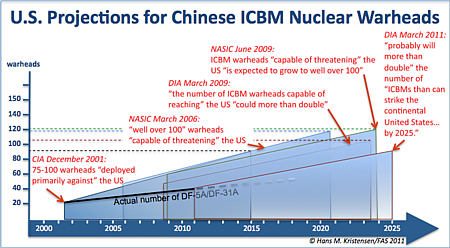
A study from Georgetown University incorrectly suggests that China has 3,000 nuclear weapons.The estimate is off by an order of magnitude.

By Hans M. Kristensen

EXTRACT:

According to the International Panel on Fissile Materials, China has produced an estimated 2 tons of plutonium for weapons. Some has been consumed in nuclear tests, leaving roughly 1.8 tons. The estimate is consistent with what the U.S. government has stated and theoretically enough for 450-600 warheads.

Total production of HEU is thought to have been approximately 20 tons. Some has been spent in nuclear tests and research reactor fuel, leaving a stockpile of some 16 tons. That’s theoretically enough for roughly 640-1,060 warheads.

Another critical material is Tritium, which is used in thermonuclear weapons. China probably only produces enough Tritium at its High-Flux Engineering Test Reactor (HFETR) in Jiajiang to maintain an arsenal of about 300 weapons.

The U.S. intelligence community concluded in 2009 that China likely has produced enough weapon-grade fissile material to meet its needs for the immediate future. In other words, no vast warhead expansion is in sight.

Read more, several excellent images.

Click on Image to Enlarge

Phi Beta Iota:  We are reminded of how the British government sacrificed its intelligence and integrity in copying from a university paper to inflate the Iraq WMD threat, and we continue to believe that the “restricted” papers the students were given are both grounds for an investigation of their professor, and grounds for an Inspector General if not a Department of Justice inquiry into illegal PSYOP funding influence from the Pentagon to Georgetown University.  It merits positive comment that neither the CIA's “all source” Directorate of Intelligence nor the CIA's Open Source Center are capable of this level of work–the students, and their professor–have done a great deal of good.  They simply cannot combine — as the CIA and DIA cannot combine — open sources in all languages; deep analytic tradecraft; and rigorous personal integrity….nor does the CIA have any clandestine assets in China relevant to this particular inquiry, nor does the US Intelligence Community have leadership capable of focusing all-source collection and requisite (non-existent) processing on this vital question.  On the one hand, the Pentagon is correct to say that the US intelligence community stinks on all questions Chinese; on the other, the Pentagon and the White House are telling impeachable lies to Congress and the public on all matters relating to the Chinese threat and the Pentagon budget.  Our personal speculative estimate of China's nuclear capability is closer to 30 operable weapons, to which we add that the US has never actually tested any of its nuclear weapons–we literally do not know if they will work as advertised.

Patrick Meier: Architecture and Calendars as Trojan Horses for Repressive Regimes [Cognitive Dissonance 101]

07 Other Atrocities, 09 Justice, 11 Society, Civil Society, Collective Intelligence, Counter-Oppression/Counter-Dictatorship Practices, Cultural Intelligence, DHS, Government, IO Impotency
Patrick Meier

Why Architecture and Calendars Are Trojan Horses for Repressive Regimes

by Patrick Meier

The simple thought first occurred to me while visiting Serbia earlier this year. As I walked in front of the country's parliament, I recalled Steve York's docu-mentary, “Bringing Down a Dictator.” In one particular scene, a large crowd assembles in front of the Serbian parliament chanting for the resignation of Slobodan Milosevic. Soon after, they storm the building and find thousands of election ballots rigged in the despot's favor. I then thought of Tahrir Square and how more than a million protestors had assembled there to demand that Hosni Mubarak step down. There was one obvious place for protestors to assemble in Cairo durin g the recent revolts. The word Tahrir means “liberation” in Arabic. That's what I call free advertising and framing par excellence.

These scenes play out over and over across the history of revolutions and popular resistance movements. In many ways, state architecture that is meant to project power and authority can just as easily be magnets and mobilization mechanisms for popular dissent; a hardware hack turned against it's coders. A Trojan Horse of sorts in the computing sense of the word.

Read rest of post.

Phi Beta Iota:  Understanding cognitive dissonance between a public and a regime (or between troops / officers and their corrupt chain of command) is not a competency of the national intelligence communities or their political “clients.”  What is so sad is that this is the PRECISE competency needed to avoid an all-consuming revolution.

Mini-Me: When All Else Fails, Try Crowd-Sourcing

Civil Society, Collective Intelligence, Collective Intelligence, Director of National Intelligence et al (IC), Government, Intelligence (government), IO Impotency, Methods & Process
Who? Mini-Me?

U.S. Government Turns to Crowdsourcing for Intelligence 

National Defense, December 2011

By Dan Parsons

The Pentagon and U.S. intelligence community spend billions of dollars each year trying, with mild success at best, to predict the future.

They organize elaborate wargames, develop computer algorithms to digest information and rely on old-fashioned aggregation of professional opinion.

Past intelligence failures have been costly and damaging to U.S. national security. Trying to avoid previous pitfalls, agencies are on a constant treasure hunt for new technologies that might give them an edge.

The Intelligence Advanced Research Projects Activity in February solicited industry proposals for how to improve the accuracy of intelligence forecasting. Under the auspices of the Office of the Director of National Intelligence, IARPA invests in research programs that provide an “overwhelming intelligence advantage over future adversaries.”

Applied Research Associates, a New Mexico-based firm, has launched a program it hopes will improve upon the traditional methods of gathering expert opinion by using computer software that could make better-informed predictions. The system chooses the best sources of information from a huge pool of participants.

ARA won the bid and started working on its Aggregative Contingent Estimation System, or ACES, in May.

Read more.

Phi Beta Iota:  A more nuanced understanding, from 55 top authors in the field, can be found in COLLECTIVE INTELLIGENCE: Creating a Prosperous World at Peace (Earth Intelligence Network, 2008).

noble gold