The recent Net Impact conference in Portland proved to be an ideal space to take a few steps back and reflect on the bigger picture. There was much talk of new and alternative approaches to traditional development. The word “participatory” in particular was a trending topic among both presenters and participants. But exactly how “participatory” are these “participatory” approaches to develop-ment? Do they fundamentally democratize the development process? And do these “novel” participatory approaches really let go of control? Should they? The following thoughts and ideas were co-developed in follow-up conversations with my colleague Chrissy Martin who also attended Net Impact. She blogs at Innovate.Inclusively.
I haven’t had the space recently to think through some of these questions or reflect about how the work I’ve been doing with Ushahidi fits (or doesn’t) within the traditional development paradigm—a paradigm which many at the confer-ence characterized as #fail. Some think that perhaps technology can help change this paradigm, hence the burst of energy around the ICT for Development (ICT4D) field. That said, it is worth remembering that the motivations driving this shift are more important than any one technology. For example, recall the principles behind the genesis of the Ushahidi platform: Democratizing information flows and access; promoting Open Data and Do it Yourself (DIY) Innovation with free, highly hackable (i.e., open source) technology; letting go of control.
What a stark difference from the Tea Party movement. Patriots holding American flags have orderly events with poignant messages about liberty and freedom and then leave in an orderly fashion. Contrast that with the Occupy Wall Street miscreants! Arrests, rapes, flag burnings, pro-communist chanting, garbage, incessant drumming, filth, profanity and lots and lots of losers who still don’t really know why they’re there!
Phi Beta Iota: We find this upsetting and disgusting. Mindful of the protection of free speech, and mindful of the deep legitimate grievances that most (99%) of US citizens and even global citizens have against what the US Government has done in our name, the flag does not represent the US Government, it represents We the People. Occupy Wall Street (OWS) is a mix of four parts: anarchists and undercover provocateurs; local only; alternative direct democracy; and electoral reform act and other tangible change agents seeking a national unity approach. OWS is already facing twin challenges from police departments over-funded by the Department of Homeland Security (using borrowed money), and a massive corporately-funded disinformation campaign seeking to cast them as irresponsible and even dangerous. As a movement, we find OWS to be as responsible as it is possible to get–they have the intelligence and the integrity that the US Government lacks. However, they have not learned the art of counter-intelligence and internal security, and will continue to suffer from this kind of gratuitous and totally uncalled for stomach-turning crap (pun intended).
Below is an excellent interview with Anthony DiMaggio in Counterpunch. DiMaggio author ofThe Rise of the Tea Party, due out in November 2011. He uses the “propaganda model” developed by Noam Chomsky and Edward Herman in their bookManufacturing Consent to document and explain the Tea Party’s organizational dynamics for manufacturing dissent, and he compares these dynamics to those of the Occupy Wall Street movement.
Before reading the interview, consider please the following: The forces powering the rage of the Tea Party — the stagnation of incomes and the increasingly unequal distribution of income — were around long before the Tea Party erupted on the national scene.
Click on Image to Enlarge
That the distribution of income had shifted in a very fundamental way toward the wealthy and especially the super-wealthy at the expense of the bottom 80% of the working population was clearly demonstrated in a classic study by Emanuel Saez and Thomas Piketty (Quarterly Journal of Economics, February 2003, updated in 2009), and subsequently confirmed by many other others, including just last week, on 25 October 2011, by the Congressional Budget Office.
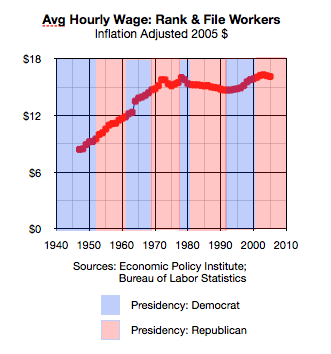
It has also clear for years that inflation-adjusted wage growth that underpinned the improved living standards of great American dream machine sputtered out during the 1970s (see chart below).
So, it is simply beyond dispute that a fundamental change in the income distribution has taken place since the late late 1970s. That change is also correlated with the wave of deregulation, tax cutting, defense spending increases (with a slight interregnum following the Soviet Union’s collapse), and deindustrialization/globalization that took off after 1980 during the Reagan Administration and accelerated during the Clinton and Bush II Administrations.
Phi Beta Iota: Keep an open mind. This is deeply serious and directly relevant to understanding the convergence of the honest right, the honest left, and OccupyWallStreet.
What Lenin meant to convey was that the Soviets were not the ordinary class organisation, whose purpose, according to the Mensheviks and Social-Revolutionists, was to fight only for the economic demands of the working class within the framework of bourgeois society. In his opinion such Soviets would be doomed in advance. In fact, no Soviets were needed for such a purpose. In his view, the Soviets were organisations for the seizure of state power, and for transforming the workers into the ruling class. That is why he again and again told the Petrograd workers in the course of 1916: ‘Ask yourselves a thousand times whether you are prepared, whether you are strong enough; measure your cloth nine times before you cut. To organise Soviets means to declare a war to a finish, to declare civil war upon the bourgeoisie, to begin the proletarian revolution.’
The OWS formations carry such potential, albeit (likewise) in an embryonic state. Their internal democratic structures are the key to this, and that is the part that should be replicated. As assemblies of people are constituted among more and more communities (and the accomplishment of this is extremely important to insuring that the internal democracy of each group is replicated in the aggregation of all such groups, in whatever form that ultimately takes, should it develop that far), both the possibility of coordinate mass action and the potentiality of an alternative political structure that represents all segments of the population emerges. The lesson from Lenin as applied to OWS is to recognize both the positive and negative potential that it represents and to both engage it and shape it to fit the needs of all communities. In the United States in particular, given the historically dominant role of racism in the social order, that means ensuring that the construct that is springing into existence before our eyes is made to become responsive to the direction of the traditionally oppressed communities, particularly communities of color.
Assuming that the most important task is to address the racist nature of this society and to prevent this from being replicated in whatever emerges from the present activities, it would seem that, as the best defense is a good offense, the oppressed communities here (and elsewhere, as this is becoming a global phenomenon) must organize as never before, and in a way that is compatible – in form and substance – with the present model, and which will thus insure that the voices and self-determined interests of these communities will find full expression.
More from Dan DeBar: My thinking on this is not fully developed, but, if you can spare 58 minutes and suffer some of the fits-and-starts of my thought process in the process, I did go into some depth in this video – – which starts off a bit slow, but eventually gets across a good picture of my thinking on the matter. As I felt I got deflected somewhat by the host from my main point – that of the centrality of the issue of racism to any solution of the problems being articulated by, or serving as the catalyst for, the OWS “movement” – I fleshed that out a bit more in this video.
These specific individuals are the starting point for a nation-wide move to demand the Electoral Reform Act of 2012 at the state level.
Seats that hold only two years terms are marked with an asterisk.
DELAWARE: Jack Markell (D)
INDIANA: Mitch Daniels (R)
MISSOURI: Jay Nixon (D)
MONTANA: Brian Schweitzer (D)\
NEW HAMPSHIRE: John Lynch (D)*
NORTH CAROLINA: Beverly Perdue (D)
NORTH DAKOTA: JackDairymple (R)
UTAH: Gary Herbert (R)
VERMONT: Peter Shumlin (D)*
WASHINGTON: Christine Gregoire (D)
WEST VIRGINIA: Earl Ray Tomblin (D)
Mega-bank Goldman Sachs (assets $933bn), has declared war on one of the smallest banks in New York (assets $30m), the customer-owned community bank that happens to also be the banker for Friends of Liberty Plaza, Inc, also known as Occupy Wall Street. And you thought Goldman didn't care.