Most patriotic thing we can do is NOT taking down the US Government.
All three of those are big lies.
Let's rebuild the dream.
Van Jones
In the coming weeks, people all across the country will come together for American Dream house meetings. Let's talk about what a new American Dream looks like and commit to stand together to make it happen.
Find an American Dream house meeting near you. We want YOU to be part of this movement, from the very beginning.
Phi Beta Iota: This is an extraordinarily good contribution–a virtual compendium of every side of the secret world. Amusingly it acknowledges that 90% of what we need to know comes from open sources of intelligence without noting the irony that we spend $80 billion on everything other than open sources. It repeats the US Government mis-conception that open sources are “second-hand,” and it neglects multinational intelligence and counterintelligence precisely because the US Government refuses to be serious about that necessary evolution. Over-all, an absolute pleasure to read, a serious contribution.
Can the US Have an Expansionary Fiscal Contraction?
All … the attached essay was written by Simon Johnson, Ronald Kurtz Professor of Entrepreneurship, MIT Sloan School of Management; Senior Fellow, Peterson Institute for International Economics; and co-founder of Baseline Scenario. Johnson used to be Chief Economist of IMF and is, IMO, one of the sanest voices in economics. It summarizes his recent testimony to the Joint Economic Commitee of Congress. The question is — Should we reduce federal debt to slow the build up of private debt? He lays out 4 reasons why such a contractionary fiscal policy will create even worse problems.
Click on Image to Enlarge
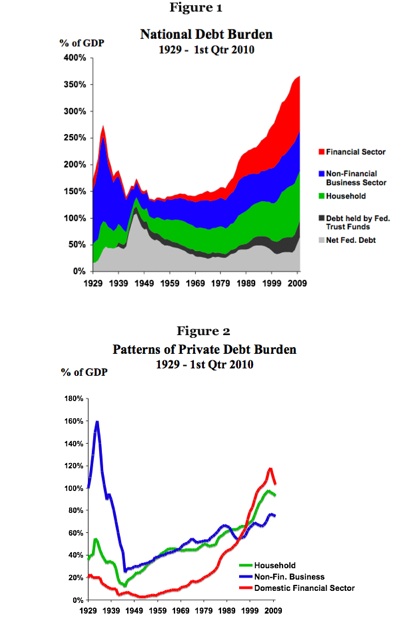
His penultimate paragraph places the real issue — who is going to pay for the liquidation of the private bubble (see chart below, which I compiled from Fed. Reserve data) into context (the red typing is mine to clarify the ambiguity in his double use of debt). Also, I urge you to read his testimony (you can download it from the link indicated below) — it is more detailed and he has a brief discussion about how the cost of the financial meltdown (looming private debt liquidations — particularly the bubbles of debt in the financial and household sectors — which Fig 2 shows has not really begun to bite) are being shifted to the middle class. Note, the rise in the light gray area in Figure 1 is the spike in federal debt that has taken place since the meltdown.
What happened to the global economy and what we can do about it
Could The US Have An “Expansionary Fiscal Contraction”?
By Simon Johnson. My full written testimony to Tuesday’s hearing of the Joint Economic Committee of Congress is available here.
The US has a large budget deficit and a debt-to-GDP ratio that, in most projections, continues to rise over time. Some House and Senate Republicans are arguing strongly that this situation calls for large and immediate cuts to government spending, for example as part of any agreement to increase the federal government’s debt ceiling.
The Joint Economic Committee of Congress held a hearing on Tuesday to discuss whether such spending cuts would be “contractionary” or “expansionary” for the economy in the short-run. My assessment, after participating as a witness at the hearing, is that large immediate spending cuts would tend to slow the economy (a webcast of the hearing is here).
Hub Culture is a global collaboration network with over 25,000+ members distributed across 110 countries. Their stated mission to expand collective consciousness is driven by the blend of online workspaces for knowledge sharing with offline Pavilions for meeting and connecting – all powered by their digital currency, Ven. Below is an interview with Hub Culture’s Founding Director, Stan Stalnaker.
What compelled you to create Ven?
For us it was a matter of practicality – with a global, diverse community, we found that no single currency could offer a single pricing structure for global inventory in Hub Culture. Our members needed a global wallet – as simple to use in Rio as Shanghai. As a social network, we thought linking this system to the social profile of our users would help them share and create value. We needed a simple, transparent way for our members to exchange value and favors, and the answer was Ven. It has been a learning experience for us. The currency has evolved and grown since its debut in the summer of 2007, and we have discovered ways to make it more useful for our members and the planet at large.
You’ve said Ven can be thought of as ‘green money’? Why?
Today Ven is the only digital currency to be priced from a basket of currencies, commodities and carbon futures. These components give the Ven advantages of other currencies: the basket encourages price stability on a forward basis, and the link to commodities grounds value in hard assets. The introduction of carbon to the basket is helping us think about how money can serve better social purposes – in this case to support and stimulate demand for carbon credits and social impact development, driving offsets for every transaction used with Ven. This is how the idea of ‘green money’ developed with Ven – because its carbon linkages are able to play a role in this area. I really like the idea that Ven is green, social and efficient, with a mission to improve the lives of its users and the communities that use it.
Believe it or not….NATO appears to be attentive to and leveraging the “intellectual capital” outside the confines of its Member state intelligence services.
Robert Rowley, 48, supervisor of a Dairy Queen in Arizona, said he has already seen results from his Twitter activism. He was among the first to notice fuel tankers slipping past NATO warships and docking at ports controlled by Col. Gadhafi, which led to NATO interdictions.
He also wonders whether his tweets might be connected to the bombing of a Gadhafi communications centre in Tripoli. Combing through satellite images, he noticed that a property listed as a commercial warehouse had a yard containing what appeared to be military vehicles. He published his observations; 10 hours later, the spot was hit by a NATO air strike.
“I’m 5,000 miles away,” he said, in an interview before his shift at the ice-cream parlour. “It’s a very weird feeling.”
But they still cannot distinguish between a person taking a dump and one planting a bomb…..technology does not win wars. This does not improve the analytical ability of the force.
Phi Beta Iota: It also perpetuates the twin evils of spending money we don't have to kill, maim, and anger people who have nothing to do with anything that matters to the US public. The BEST use of micro-drones is to provide eyes and ears for the infantry. The WORST use of armed drones is to give the power to kill to someone remote from reality with no ethical grounding. As we now know, bandwidth is more expensive than a human pilot, who also comes with situational awareness.