Review: Preparing America’s Foreign Policy for the 21st Century

5 Star, Diplomacy

Amazon Page
Amazon Page

5.0 out of 5 stars Starting Point for 21st Century Security Strategy Dialog,

October 2, 2000
David L. Boren
I know of no finer collection of relevant views on our current and prospective foreign policy challenges. In the foreword to the book, William Crowe, former Chairman of the Joint Chiefs of Staff and then Ambassador to the Court of Saint James, observes that “A reappreciation of government is also in order.” He clearly articulates both the range of challenges facing us (most of them non-military in nature), and the disconnect between how we organize our government and how we need to successfully engage.His bottom line is clear: we are not spending enough on the varied elements of national security, with special emphasis on a severely under-funded and under-manned diplomatic service.

From Gaddis Smith and Walter Mondale to Sam Nunn and Robert Oakley, from David Gergen to David Abshire to David Boren, from Kissinger to Brzezinski to Kirkpatrick, in combination with a whole host of lesser known but equally talented practitioners, capped off by comments from five Directors of Central Intelligence, this books sets a standard for organized high quality reflection on the future of U.S. foreign policy.

Most interestingly, there is general consensus with David Abshire's view that we are in a strategic interregnum, and still lacking for a policy paradigm within which to orchestrate our varied efforts to define and further our vital interests.

David Gergen clearly articulates the shortfalls in our national educational, media, and political patterns that leave the vast majority of Americans ignorant of our foreign interests and unsupportive of the need for proactive engagement abroad. Reading this book, I could not help but feel that our national educational system is in crisis, and we need both a wake-up call and a consequent national investment program such as occurred after the first Sputnik launch.

David Boren is clearly a decade or more ahead of most current commentators in his call for a new paradigm, for a new analytical framework, for the internationalization of American education across the board. I am reminded of the quotation from early America: “A Nation's best defense is an educated citizenry.” Interestingly, he cites Daniel Boorstein's caution that we must not confuse information with knowledge, and in the next sentence notes: “I watched during my term as chairman of the Senate Intelligence Committee while the CIA greatly increased its information, its raw data, but became overwhelmed and unable to separate the important from the unimportant.”

I would itemize just a few of the many, many useful insights that this book offers:

1) Diplomacy is the sum total of familiarity with the role, knowledge of the component parts of the overall national security policy, and the ability to design and implement comprehensive policies that achieve the national objectives;

2) Politicians and policy-makers are losing the ability to think objectively and act with conviction…they are too dependent on short-term domestic polling and opinion;

3) (Quoting Donald Kegan): Power without the willingness to use it does not contribute to world peace;

4) We must strengthen the domestic roots of national power if we are to have a sound strategy;

5) Future of U.S. education and strength of U.S. family unit will quite simply determine whether U.S. can meet the economic challenges of the 21st Century;

6) Our domestic insecurity and domestic violence-and resulting foreign perceptions and disrespect for our competence at home-reduce our effectiveness overseas;

7) U.S. is its own worst enemy, with declining attention to foreign policy matters;

8) Weapons of mass destruction are our only substantive vital interest today;

9) Hunger, pestilence, and refugees within Africa will affect all nations;

10) Corruption has replaced guerrilla movements as the principal threat to democratic governance;

11) Commerce rather than conflict will be the primary concern of 21st century foreign policy;

12) The environment joins trade and commerce as an essential objective for foreign policy;

13) Long-term non-military challenges, and especially global financial markets, require refocusing of our security perspectives;

14) Asia will edge out Europe as our primary trading partner;

15) China in Asia and Turkey in the West are linch-pin nations;

16) NATO will survive but we must take care not to threaten Russia;

17) The UN is not very effective at peacekeeping operations-it is best confined to idea exchanges;

18) Our military is over-extended and under-funded but still the best in the world;

19) For the cost of one battalion or one expensive piece of military equipment, one thousand new Foreign Service officers could be added toward preventive diplomacy;

20) Lessons from the Roman empire: its decline results in part from a loss of contact with its own heartlands, a progressive distancing of the elite from the populace, the elevation of the military machine to the summit of the power hierarchy, and blindness in perceiving the emergence of societies motivated by nationalism or new religious ideologies; and

21) We may need a new National Security Act.

If I had one small critical comment on the book is would be one of concern-concern that these great statesmen and scholars appear-even while noting that defense is under-capitalized-to take U.S. military competence at face value. I perceive a really surprising assumption across a number of otherwise brilliant contributions to the effect that we do indeed have all that we need in the way of information dominance, precision firepower, and global mobility (strategic lift plus forward presence)-we just need to use it with greater discretion. I do not believe this to be the case. I believe-and the Aspin-Brown Commission so stated-that we lack effective access to the vast range of global multi-lingual open sources; that our commitment to precision munitions is both unaffordable and ineffective (we ran out in 8 days in the Gulf, in 3 days in Kosovo); and that we fail terribly with respect to mobility-naval forces are generally 4-6 days from anywhere, rather than the necessary 24-48 hours. This book is a very fine starting point for the national dialogue that must take place in 2001 regarding our new national security strategy.


Vote on Review
Vote on Review

Review: Water–The Fate of Our Most Precious Resource

5 Star, Water, Energy, Oil, Scarcity

Amazon Page
Amazon Page

5.0 out of 5 stars Brilliant–Puts Water in Context of War, Peace, and Life,

October 2, 2000
Marq De Villiers
I rank this book as being among the top ten I have read in the decade, for the combined reason that its topic concerns our survival, and its author has done a superior job of integrating both scholarly research (with full credit to those upon whose work he builds) and what must be a unique background of actually having traveled to the specific desolate areas that comprise the heart of this book-from the Aral Sea (“the exposed seabed, now over 28,000 square kilometers, became a stew of salt, pesticide residues, and toxic chemicals; the strong winds in the region pick up more than 40 million tons of these poisonous sediments each year, and the contaminated dust storms that follow have caused the incidence of respiratory illnesses and cancers to explode.”) to the heart of China (“According to China's own figures, between 1983 and 1990 the number of cities short of water tripled to three hundred, almost half the cities in the country; those who problem was described as ‘serious' rose from forty to one hundred.” The author provides a thoughtful and well-structured look at every corner of the world, with special emphasis on the Middle East, the Tigris-Euphrates System, the Nile, the Americas, and China; and at the main human factors destroying our global water system: pollution, dams (that silt up and prevent nutrients from going downstream or flooding from rejuvenating the lower lands), irrigation (leading to salination such that hundreds of thousands of acres are now infertile and being taken out of production), over-engineering, and excessive water mining from aquifers, which are in serious danger of drying up in key areas in the US as well as overseas within the next twenty years. The author provides a balanced and well-documented view overall. His final chapter on solutions explores conservation, technical, and political options. Two statements leapt off the page: first, that it is the average person, unaware of the fragility of our water system, that is doing the most damage, not the corporations or mega-farms; and second, that for the price of one military ship or equipped unit ($100 million), one can desalinate 100 million cubic meters of water. The bottom line is clear: we are close to a tipping point toward catastrophe but solution are still within our grasp, and they require, not world government, but a virtual world system that permits the integrated management of all aspects of water demand as well supply. This book should be required reading for every college student and every executive and every government employee at local, state, and federal levels; and every citizen.
Vote on Review
Vote on Review

Review: Preventive Defense–A New Security Strategy for America

5 Star, Diplomacy, Force Structure (Military)

Amazon Page
Amazon Page

5.0 out of 5 stars Fully Half of the Right Answer–Bi-Partisan and Serious,

August 30, 2000
Ashton B. Carter
The authors provide a coherent discussion of fully half of the security challenges facing us in the 21st century. They wisely avoid the debate swirling around the so-called Revolution in Military Affairs (RMA)-but deserve credit for their predecessor “offset strategy”-and simply note that the absence of “A List” threats gives us an opportunity to strengthen and maintain our traditional nuclear and conventional capabilities against the day when a Russia or China may rise in hostility against us. The book as a whole focuses on the “B List” threats, including Russia in chaos, a hostile China acting aggressively within its region, proliferation of weapons of mass destruction, and catastrophic terrorism. They note, correctly, that most of the spending and effort today is focused on responding to the crisis de jure, some but not enough resources are applied to preparing for the future, and virtually nothing is being done against the latest concept, that of “shaping” the environment through “forward engagement.” Perhaps most importantly, they introduce the term “defense by other means” and comment on the obstacles, both within the Administration and on the Hill, to getting support and funding for non-military activities with profound security benefits.Although others may focus on their discussion of Russia and NATO as the core of the book, what I found most helpful and worthwhile was the straight-forward and thoughtful discussion of the need for a new national strategy, a new paradigm, for dealing with potentially catastrophic terrorism. Their understanding of what defense resources can be applied, and of the impediments to success that exist today between state & local law enforcement, federal capabilities such as the Federal Bureau of Investigation (FBI) and the Federal Emergency Management Agency (FEMA) and defense as well as overseas diplomatic and intelligence capabilities, inspire them to propose several innovative approaches to this challenge. The legal and budgetary implications of their proposals are daunting but essential-their proposals for dealing with this one challenge would be helpful in restructuring the entire U.S. government to better integrate political-diplomatic-military-law enforcement operations with judicial and congressional oversight as well as truly all-source intelligence support.

Interesting side notes include 1) the early discovery in US-Russian military discussions that technology interoperability and future collaboration required the surmounting of many obstacles associated with decades of isolated (and often secret) development; 2) the absence of intelligence from the entire book-by this account, US defense leaders spend virtually all of their time in direct operational discussions with their most important counterparts, and there is very little day to day attention to strategic analysis, estimative intelligence, or coordination with diplomatic, economic, and law enforcement counterparts at home; 3) the difficulty of finding a carrier to send to Taiwan at a time when we had 12 carriers-only four appear to have been “real” for defense purposes; and 4) the notable absence of Australia from the discussion of security in Asia.

The concept of Preventive Defense is holistic (requiring the simultaneous uses of other aspects of national power including diplomacy and economic assistance) but places the Department of Defense in a central role as the provider of realigned resources, military-to-military contacts, and logistics support to actual implementation. Unfortunately the concept of Preventive Defense has been narrowly focused (its greatest success has been the dismantling of former Soviet nuclear weapons in the Commonwealth of Independent States), and neither the joint staff nor the services are willing to give up funds for weapons and manpower in order to make a strategy of Preventive Defense possible.

This resistance bodes ill for the other half of the 21st Century security challenge, what the author's call the “C List”-the Rwandas, Somalias, Haitis and Indonesias. They themselves are unwilling to acknowledge C List threats as being vital to U.S. security in the long-term (as AIDS is now recognized). I would, however, agree with them on one important point: the current budget for defense should be repurposed toward readiness, preparing for the future, and their concept of preventive defense, and it should not be frittered away on “C List” contingencies-new funds must be found to create and sustain America's Preventive Diplomacy and its Operations Other Than War (OOTW) capabilities. It will fall to someone else to integrate their concept of Preventive Defense with the emerging concepts of Preventive Diplomacy, International Tribunals, and a 21st Century Marshall Plan for the festering zones of conflict in Africa, Arabia, Asia, and the Americas–zone where ethnic fault lines, criminal gangs, border disputes, and shortages of water, food, energy, and medicine all come together to create a breeding ground for modern plagues that will surely come across our water's edge in the future. On balance, through, this book makes the top grade for serious bi-partisan dialogue, and they deserve a lot of credit for defining solutions for the first half of our security challenges in the 21st Century.

Vote on Review
Vote on Review

Review: Security Studies for the 21st Century

5 Star, Budget Process & Politics, Change & Innovation, Force Structure (Military), Future, Military & Pentagon Power, Strategy

Amazon Page
Amazon Page

5.0 out of 5 stars Outstanding Structured Education for Adult (Policy) Readers,

August 30, 2000
Richard H. Shultz
This book is actually a guide for professors, with chapters presenting specific courses in security studies complete with fifteen-week outlines and all recommended readings. It is in my view a very fine structured reading program for the adult policy maker who is well beyond the need for going back to school, but much in need a fast means of coming to grips with the dramatic changes that have occurred in our international security environment. Early on it addresses the competing approaches to security studies-from the traditionalist national, international, and regional security approaches to the emerging transstate (non-state actors acknowledged as major sources of conflict and instability) to the global (to include human rights, environmental protection, economic prosperity, and social development as fundamental security issues). It's iteration of the weaknesses of 20th century security studies reads like a list of current biases inherent in those prescribing defense reform today: overemphasis on theory (or worst-case scenarios); insufficient attention to non-combat missions for military forces in peacetime; excessive focus on the US, Europe, and Russia to the exclusion of the rest of the world; too little attention to culture and the relationship of culture to conflict deterrence and resolution; insufficient attention to history prior to World War II; and finally, a neglect of non-military instruments of power and their interaction with the military. Intelligence in particular is singled out as being a relatively recent open topic for discussion, meriting more study. The chapters on Transstate Security by Roy Godson (on non-state actors and the growing prevalence of “global ungovernability”) and on Nontraditional Uses of Military Force by George H. Quester, as well as the introduction and conclusion by Richard H. Schultz, Jr., are each, alone, worth the price of the book. Each chapter, with its course outline, discussion, and recommended references, is worthy of careful examination by any serving or aspiring policymaker. However distinguished one's pedigree, we are all students today, and Graham E. Fuller is correct when he notes on page 124 that “most policymakers do not even fully realize the dynamics of the new world we live in.”
Vote on Review
Vote on Review

Review: Deliver Us from Evil–Peacekeepers, Warlords and a World of Endless Conflict

5 Star, Crime (Government), Crime (Organized, Transnational), Diplomacy, Empire, Sorrows, Hubris, Blowback, Executive (Partisan Failure, Reform), Force Structure (Military), Humanitarian Assistance, Insurgency & Revolution, Justice (Failure, Reform), Military & Pentagon Power, Security (Including Immigration), Stabilization & Reconstruction, Threats (Emerging & Perennial), Truth & Reconciliation, United Nations & NGOs, War & Face of Battle

Amazon Page
Amazon Page

5.0 out of 5 stars Fundamental Primer on Real-World Security Challenges,

August 29, 2000
William Shawcross
EDIT of 23 Feb 08 to add links. This remains a priceless reference work.

This book is serious, scholarly yet down to earth, compassionate, insightful, terribly relevant and most useful to any citizen, overseas practitioner, or policymaker. By the books own rendering, “good will without strength can make things worse.” Most compellingly, the author demonstrates both the nuances and the complexities of “peace operations”, and the fact that they require at least as much forethought, commitment, and sustainment as combat operations. Food scarcity and dangerous public health are the root symptoms, not the core issues. The most dangerous element is not the competing sides, but the criminal gangs that emerge to “stoke the fires of nationalism and ethnicity in order to create an environment of fear and vulnerability” (and great profit). At the same time, humanitarianism has become a big part of the problem-we have not yet learned how to distinguish between those conflicts where intervention is warranted (e.g. massive genocide campaigns) and those where internal conflicts need to be settled internally. In feeding the competing parties, we are both prolonging the conflict, and giving rise to criminal organizations that learn to leverage both the on-going conflict and the incoming relief supplies. Perhaps more troubling, there appears to be a clear double-standard-whether deliberate or circumstantial-between attempts to bring order to the white western or Arab fringe countries and what appears to be callous indifference to black African and distant Asian turmoil that includes hundreds of thousands victim to genocide and tens of thousands victim to living amputation, mutilation, and rape. When all is said and done, and these are my conclusions from reading this excellent work, 1) there is no international intelligence system in place suitable to providing both the global coverage and public education needed to mobilize and sustain multi-national peacekeeping coalitions; 2) the United Nations is not structured, funded, nor capable of carrying out disciplined effective peacekeeping operations, and the contributing nations are unreliable in how and when they will provide incremental assistance; 3) we still have a long way to go in devising new concepts, doctrines, and technologies and programs for effectively integrating and applying preventive diplomacy, transformed defense, transnational law enforcement, and public services (water, food, health and education) in a manner that furthers regionally-based peace and prosperity instead of feeding the fires of local unrest.

See also:
The Bottom Billion: Why the Poorest Countries are Failing and What Can Be Done About It
The End of Poverty: Economic Possibilities for Our Time
The Fortune at the Bottom of the Pyramid: Eradicating Poverty Through Profits (Wharton School Publishing Paperbacks)
The Shock Doctrine: The Rise of Disaster Capitalism
Confessions of an Economic Hit Man
Manufacture of Evil: Ethics, Evolution, and the Industrial System
Plan B 3.0: Mobilizing to Save Civilization, Third Edition
The Future of Life
The leadership of civilization building: Administrative and civilization theory, symbolic dialogue, and citizen skills for the 21st century

Vote on Review
Vote on Review

Review: Deliver Us from Evil: Peacekeepers, Warlords and a World of Endless Conflict

5 Star, Empire, Sorrows, Hubris, Blowback, Humanitarian Assistance, Military & Pentagon Power, Peace, Poverty, & Middle Class, Stabilization & Reconstruction, Threats (Emerging & Perennial)
Amazon Page
Amazon Page
5.0 out of 5 stars Fundamental Primer on Real-World Security Challenges
August 29, 2000
EDIT of 23 Feb 08 to add links. This remains a priceless reference work.This book is serious, scholarly yet down to earth, compassionate, insightful, terribly relevant and most useful to any citizen, overseas practitioner, or policymaker. By the books own rendering, “good will without strength can make things worse.” Most compellingly, the author demonstrates both the nuances and the complexities of “peace operations”, and the fact that they require at least as much forethought, commitment, and sustainment as combat operations. Food scarcity and dangerous public health are the root symptoms, not the core issues.

The most dangerous element is not the competing sides, but the criminal gangs that emerge to “stoke the fires of nationalism and ethnicity in order to create an environment of fear and vulnerability” (and great profit). At the same time, humanitarianism has become a big part of the problem-we have not yet learned how to distinguish between those conflicts where intervention is warranted (e.g. massive genocide campaigns) and those where internal conflicts need to be settled internally.

Continue reading “Review: Deliver Us from Evil: Peacekeepers, Warlords and a World of Endless Conflict”

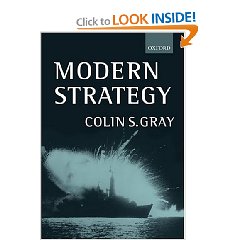
Review: Modern Strategy

5 Star, Strategy

Amazon Page
Amazon Page

5.0 out of 5 stars

Fundamental Reading for National Security Dialog,

August 27, 2000
Colin S. Gray
Edit of 23 Feb 08 to add links. This book remains priceless & relevant.

First published in 1999, this is an original tour d-horizon that is essential to any discussion of the theory and practice of conflict in the 21st Century, to include all those discussions of the alleged Revolution in Military Affairs (RMA), the need for “defense transformation”, and the changing nature of civil-military relations.

I am much impressed by this book and the decades of thinking that have gone into it, and will outline below a few of its many signal contributions to the rather important questions of how one must devise and manage national power in an increasingly complex world.

First, the author is quite clear on the point that technology does not a revolution make-nor can technology dominate a national strategy. If anything-and he cites Luttwak, among others, with great regard-an excessive emphasis on technology will be very expensive, susceptible to asymmetric attack, and subversive of other elements of the national strategy that must be managed in harmony. People matter most.

Second, and this is the point that hit me hardest, it is clear that security strategy requires a holistic approach and the rather renaissance capability of managing a multiplicity of capabilities-diplomatic, economic, cultural, military, psychological, information-in a balanced manner and under the over-arching umbrella of a strategy.

Third, and consistent with the second, “war proper” is not exclusively about force of arms, but rather about achieving the national political objective by imposing one's will on another. Those that would skew their net assessments and force structure capabilities toward “real war” writ in their conventional terms are demeaning Clausewitz rather than honoring him.

Fourth, as I contemplate in this and other readings how best to achieve lasting peace and prosperity, I see implicit in all that the author puts forward, but especially in a quote from Donald Kegan, the raw fact that it is not enough for America to have a preponderance of the traditional military and economic power in the world-we must also accept the burden and responsibility of preserving the peace and responding to the complex emergencies around the globe that must inevitably undermine our stability and prosperity at home.

Fifth, it is noteworthy that of all the dimensions of strategy that are brought forward, one-time-is unique for being unimprovable. Use it or lose it. Time is a strategic dimension too little understood and consequently too little valued by Americans in particular and the Western alliance in general.

Sixth, it merits comment that the author, perhaps the greatest authority on Clausewitz in this era, clarifies the fact that the “trinity” is less about people, government, and an army, than about primordial violence, hatred, and enmity (the people); chance and probability on the battlefield, most akin to a game of cards (the army); and instrumental rationality (the government)-and that these are not fixed isolated elements, but interpenetrate one another and interact in changing ways over time and space.

Seventh, the author devotes an entire chapter to “Strategic Culture as Context” and this is most helpful, particularly in so far as it brings forward the weakness of the American strategic culture, notably a pre-disposition to isolationism and to technical solutions in the abstract. Perhaps more importantly, a good strategic culture with inferior weapons can defeat a weak strategic culture with an abundance of technology and economic power.

Eighth, and finally, the author courageously takes on the issue of small wars and other savage violence, seeking to demonstrate that grand strategy applies equally well to the savage criminal and warlord parasites that Ralph Peters has noted are not susceptible to our traditional legal and military conventions. While he does not succeed (and notes in passing that Clausewitz's own largest weakness was a failure to catalogue the enemy and the dialog with the enemy as a major factor in strategic success and failure), the coverage is acceptable in making three key points:

1) small wars and sub-national conflicts are generally not resolved decisively at the irregular level-conventional forces are required at some point;

2) special operations forces have a role to play but lack a strategic context (that is to say, current political and military leaders have no appreciation for the strategic value of special operations forces); and

3) small wars and non-traditional threats-asymmetrical threats-must be taken seriously and co-equally with symmetrical regular conflicts.

At the end of the day, this erudite scholar finds common cause with gutter warrior Ralph Peters and gang-warfare iconoclast Martin Van Crevald by concluding his book with a quote from Alexander Solzhenitsyn: “In the Computer Age we will live by the law of the Stone Age: the man with the bigger club is right. But we pretend this isn't so. We don't notice or even suspect it-why surely our morality progresses together with our civilization.”

See also (and also my lists):

The Search for Security: A U.S. Grand Strategy for the Twenty-First Century
Beyond Declaring Victory and Coming Home: The Challenges of Peace and Stability Operations
Security Studies for the 21st Century
War, Peace, and Victory Strategy and Statecraft for The Next Century
Strategy: Process, Content, Context: An International Perspective
War and Peace and War: The Life Cycles of Imperial Nations
Strategy: The Logic of War and Peace, Revised and Enlarged Edition
Race to the Swift: Thoughts on Twenty-First Century Warfare (International Series on Materials Science and Technology)
On Strategy: A Critical Analysis of the Vietnam War
The Systems View of the World: A Holistic Vision for Our Time (Advances in Systems Theory, Complexity, and the Human Sciences)

Vote on Review
Vote on Review
noble gold