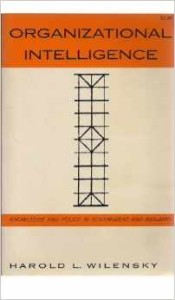
This gem is so valuable to me that when I could not find a copy for sale (this was way back before Amazon made it easy), I made a personal copy.
This is a foundation work for organizational intelligence, which now includes four converging streams: Open Source Intelligence (OSINT), Collective Intelligence, Peace Intelligence, and Commercial Intelligence.
I would like very much to see this re-published, and would be glad to contribute a preface from a commercial point of view while Mark Tovey, editor of the forthcoming book on Collective Intelligence: Creating a Prosperous World at Peace, does the academic preface.
This is a “must have” reference for anyone thinking about group IQ, smart mobs, smart nations, smart corporations, etcetera.
A few key points, with many others not itemized:
01 Explores how knowledge shapes (or does not shape) policy in both governent and industry
02 Information converted into intelligence integrates clear, timely, reliable, valid, adequate, and wide-ranging.
03 Intelligence failures stem in part from hierarchy (which conceals and misinterprets), specialization, rivalry, and other institutional dysfuntionalities.
04 There remains a great shortage of generalists able to select, discriminate, and integrate.
05 Information technology elevates the hard variables, represses the soft variables
06 Those at the top are out of touch; good judgment is rare, decisions are not fully informed nor deliberative.
This book joins my list of books I will never buy, read, nor recommend, because the publisher is charging three times what the book is worth. As a publisher myself, I am happy to inform prospective buyers that this book cost a penny a page to print. You do the math. Authors get 15%, Amazon gets 40%, the rest after actual cost deducation is pure profit.
This publisher is part of the problem, not part of the solution. This book should not cost more than $35. I would buy it at that price and probably find it quite valuable.
Authors are encouraged to demand in advance, in writing, a commitment on affordable pricing. The alternative is to post your book on the Internet as a PDF with a Creative Commons non-commercial license, which is what I do for all the books that I publish (at the same time that they are offered on Amazon at affordable prices to cover costs.
I will buy this book if and when it gets down to $37.50 or so, which is where it should be. The authors should protest this grotesquely expensive profiteering and handicapping of knowledge by posting the book online as a free PDF document.
This book should be selling for no more than $39.95. I'd like to buy it, but not at this price. As a publisher I can tell you it costs a penny a page to publish a book like this. I am adding this book to my list of books I would buy and review if they were more reasonably priced.
Exquisite in Every Respect, Two-Fifths Equations & Charts, April 3, 2008
Martin A. Nowak
I don't do math, so I must disclose right away that the math was lost on me, except in the context of this equisitely presented book, I am compelled to recognize that mathematics as well as computation science is going to be a major player is the EarthGame, in modeling alternative outcomes for social and cultural complexity, and in cross-fertilizing disciplines by creating a common language.
I tend to be hard on publishers, so in this instance I want to say right away that the Belknap Press of Harvard University has done an absolutely phenomenal job with this book. The paper, the use of color and white space, every aspect of this book is exquisitly presented, and at an affordable price. I therefore recommend this book for content as well as for its artistic context, for both those who love mathematics, and those who do not, but want to understand the promise of mathematics for the future of life.
The text across the book is elegant, clear, easy to understand, and coherent. The summaries at the end of each chapter are in English, and for me at least, obviate the fact that I am mathematically-challenged.
I have a number of notes that merit sharing as encouragement to buy and read this book, one of just two that I found in the right context and price range as I venture into the intersection of modeling social complexity and doing real-time science in the context of an EarthGame where everyone plays themselves. The other book I bought and will read shortly is Complex Adaptive Systems: An Introduction to Computational Models of Social Life (Princeton Studies in Complexity). Too many otherwise worthwhile books are grotesquely over-priced, and the authors should release free PDFs online in protest and to have effect on this exciting emergent inter-disciplinary endeavor.
The author stresses early on that Information is what evolves–errors are mutations, mutation plus selection in a noisy (i.e. natural) environment is evolution. I like that idea, and point the reader to Hans Swegen's “The Global Mind: The Ultimate Information Process” (Minerva UK, 1995)which first made the connection for be from DNA to World Brain.
The author inspires with his view that the field of evolutionary dynamics is “on brink of unprecedented theoretical expansion.” I must say, as one who is focused on connecting all people to all information in all languages all the time, I have been slow to understand that while that is a wonderful baseline, only models can project alternative scenarios into the future, and hence, the modeling of the past is but a prelude to the shaping of the future by displaying compelling alternative paths.
The author sees mathematics as a common language that can help disciplines interact, and when they do so, progress occurs. He speaks specifically of disciplinary “cultures” that must understand each other.
Early on he delimits the book, and in the process notes that mathematical biology includes:
+ Reproduction
+ Mutation
+ Selection
+ Random Drift
+ Spatial Movement
Terms of interest (all explained in English not just mathematics):
+ Sequential space
+ Fitness landscape
+ Error threshold
+ Neutral versus random drift
Thoughts that grabbed me across the book (all from the author):
+ Evolutionary game theory is the most comprehensive way to look at the world.
+ Natural selection favors the defectors over the cooperators BUT if there are repeated interactions, cooperation is not assured, but is made possible.
+ Models show alternative scenarios–inclulding coexistence of all.
+ Evolutionary graph theory yields a remarkably simple rule for the evolution of cooperation.
+ Under natural selection the average fitness of the population continuously declines [we're there!]
+ Direct reciprocity is a mechanism for the evolution of cooperation (the collective intelligence world has been calling for reciprocal altruism and a shift to a gift economy with open money and an end to scarcity–I see all this converging).
+ War and peace strategies CAN be modeled (as my own books suggest, the problem is the information asymmetry that Charles Perrow speaks of. Elites make decisions that have consequences for all of us, but they lie to us (935 lies leading to the war on Iraq) and they also externalize costs into the future.)
+ A SINGLE INDIVIDUAL can move an entire population from war to peace.
+ 10 cooperators in a string comprise a sustainable “walker,” and is two such cooperative walkers meet, they can induce a “big bang” in which cooperatives sweep the game away from defectors.
+ Cooperators and defectors can co-exist for near-eternity.
+ Evolutionary graph theory can plot relationships (I think to myself, not only of people to people, but costs to things, time, and space).
+ Language makes infinite use of finite media–bulk of progress in last six hundred million years has been cultural, using language, not genetic.
+ The author credits Noam Chomsky with the Chomsky hierarchy relating language to mathematics. I read most of what Chomsky publishes, and had no idea he had done original work in mathematics back in the day.
+ Learning differs from memorization in that the learner is enabled to acquire generalizations that can then be applied in novel circumstances. I strongly believe that we must radically redirect education toward team learning, project learning, learning to learn, and learning in vivo, one reason I want to map every person, every dollar, every thing, every language, every idea, in Fairfax County.
+ Mathematical analysis of language must combine three fields (at least):
– Formal language theory
– Learning theory
– Evolutionary theory
The author concludes that mathematics is a way to think clearly. I cannot disagree, but as I put the book down, VERY PLEASED with the complete package of such very high quality, I was not convinced that mathematics can do intangible value and cultural nuance is multi-cultural context under stress and with time limitations.
The author provides both a bibliographic essay and a superb extensive bibliography, but if I could change one thing and one thing only in this book, it is that I would integrate the two. I have neither the time nor the inclination to look up each cryptic (Bloom, 1997) in the longer list. I would have preferred to see the actual bibliography organized by chapter, with all books on, for example, “Evolution of Virulence” listed there after the explicatory section. This is a nit.
I learned enough from this book to budget for and demand the full inclusion of evolutionary dynamics in all that the Earth Intelligence Network will strive to accomplish in the next twenty years.
Kudos again to the publisher. Nothing gives me more pleasure, apart from intelligent content, than very high-quality materials, thoughtful editing and lay-out, and honorable pricing. This book is a gem in all respects. BRAVO.
I did not appreciate Stephen Wolfam's A New Kind of Science but treasure the book (another enormous gift to mankind at an affordable price) and urge the mathematically-gifted to take a close look at that work.
I would also point the reader toward Pierre Levy's Information Economy Meta Language (IEML) as one approach to creating a universal dictionary of concepts, easily found on the Internet, and also Doug Englebart's Open Hypertextdocument System (OHS), easily found at the Bootstrap Institute.
Riveting, Gifted Reporting, Deeply Depressing, Call to Arms, May 18, 2008
John Bowe
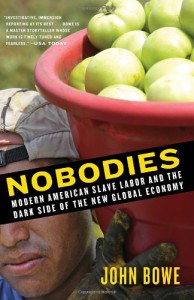
This is a spectacular piece of work with many gifted turns of phrase. The author has done his homework, and melds economic facts and philosophical reflections in a worthy manner. The author opens with a challenge: how should a free people respond to slavery, i.e. should they knowingly buy products and services that are rooted in slavery?
I ordered this book on the strength of the author's appearance on CSPAN BookTV, and this is one of those instances where I think that listening to him talk about the book first is hugely beneficial to appreciating the book. The author, in person (on CSPAN), is funny, intelligent, informative, a really excellent presenter of facts in a coherent manner.
Supreme Court Justice Brandeis is cited in this book: “You can have great concentration of wealth in the hands of a few or you can have democracy. You can't have both.” While the author documents slavery, at least 27 million world-wide (not counting the prison-slave population) with 800 million not enslaved but utterly poor going hungry each day, 33 million of them in the USA, his book is a socio-economic ideo-cultural treatise on “whither globalization.” His bottom line is clear: if we allow slave labor and sweatshop conditions to undercut each of our homeland industries, we are toast.
The author does something quite special with this book. I am deeply impressed. Since the 1970's I have understood the conflict between multinational corporations and governments, the trade-offs between profits and social value, but it is only recently that my reading has brought forth the sharp battle that will define the 21st Century: the battle between Collective Intelligence (one for all, all for one) and Corruption at all levels of government and business.
The meme “true cost” is the ideological battle line. Also known as the triple bottom line (economic, social, and environmental), it is my view that the ability of my generation to promulgate True Cost information in the next ten years is going to determine what kind of future our children have. The author provides numbers, and I am gripped by the 40 cents paid to the slave laborer for a bucket of tomatos, versus the $12.00 plus paid to the farmer or “organizer/enforcer.” The author is eloquent in describing how slave wages have not risen in thirty years, while all else has….
This book is deep, richly textured, a tremendously informative and socially-valuable offering.
Here are a few highlights that stayed with me:
1) US Census statistics are so “delusional and deceptive” that Wall Street investors no longer use them–they commission their own studies.
2) The conditions of slavery and poverty and abuse are so deeply entrenched, and imposed on individual held in isolation from society and the rule of law–when the law is willing to be enforced–that they might as well be on another planet, a slave planet.
3) FBI Special Agents get very high marks for being able to master law enforcement in an illegal immigration environment, but the author speaks of “institutional malfeasance” in how often the FBI transfers people. I have long felt that we need to turn government inside out–we need to mass Latin American specialists across government, military, law enforcement, etc, and we need to start putting people into 10 year tours.
4) It is clear we need a “white hat” side of the Immigration and Naturalization Service (INS), I envision something in which all information they might collect in investigating human rights and other labor violations is firewalled from illigal immigrant status.
5) 911 operators are virtually helpless in responding to foreign langugage calls. I have been saying for years that we need to have an international implementation using Telelanguage.com.
6) The author surprises me with his optimism, his expectation that we can achieve a profound change in attitude across our population, completely boycotting all products and services whose “true cost” include slave labor.
I want to end this laudatory review by pointing readers toward the World Index of Social and Environmental Responsibility, the Interra Project, the World Cafe, and the Earth Intelligence Network.
Below I list a few other books that support this one. The first book documented the commoditization of human labor as the beginning of commercialized evil. The rest are increasingly positive about all of us coming together to overcome power and information asymmetries. “Put enough eyes on it, no bug is invisible. That's us: intelligence officers to the poor and the disenfranchised, who in being lifted from slavery, will create infinite revolutionary wealth. We can do this.
The book reads like a Harvard case study fleshed out from 40 pages to 230.
The book has exactly one bottom line: that self-paced instruction using online learning and (this is the cool part) interaction with other languages and cultures (e.g. connect an Arab learning English with an American learning Arabic), is the only way to introduce flexibility. It is this human dimension that carried the book to a four for the US audience only.
Everywhere else in the world they substitute discipline for technology and do quite well. I was troubled by the book/s very narrow focus. There is no consideration in this book, for example, of any of the following (just one example per literature category):
+ Need to migrate from monolithic “one size fits all” methods (meaning teacher talks, all listen, or “didactic instruction” to student-centric technologies (my note: rather than human scale and practice)
+ Ages 0-4 are where the child actually learns all the self-confidence and other characteristics needed to succeed down the road (but no real discussion of this and how computers could help, that I saw)
+ Schools are too standardized, need modularity and flexibility (of course this is what the last two generations, and especially Generation 2.0, have been telling us–schools beat the creativity out of kids by the fourth grade, and today the best student drop out of high school rather than sit still for another two years).
+ They give Gardner full credit for discovering multiple intelligences, but they lost me a second time when they focus only on technology as the innovative solution, and fail to properly develop the theme for art, music, theater, social work, apprenticeships, and etcetera. This is a book with one simple message and focus on computers in the US classroom.
+ Schools have four jobs (none of them actively discussed in dollar and cents or program planning terms):
– Preserve democracy, inculcate values
– Provide something for every student
– Keep America competitive (ha. China graduates more HONOR students than we graduate students across the board)
– Eliminate poverty (this is a bit lame, reflecting no appreciation for structured inequalities outside the classroom, as well as political disenfranchisement and banking fraud including red-lining for future development profit).
The authors repeat one of the pearls of wisdom from The Innovators Dilemma (link in first line above), and suggest that those who wish to innovate should go after those not served, citing Apple's genius in offering its early computers as toys for children.
+ Four factors are in favor of innovation (in US schools):
– Computer-based learning keeps improving (see Don't Both Me Mom, link above, that book ends with recommendations for learning programs across the board that are online now)
– All can select pathways (this assumes they have been taught discipline and curiosity someplace along the line)
– Looming teacher shortage (I agree–advanced child care and factory worker angle are history–we need to learn to learn in all places)
– Costs fall significantly as market scales
They spend too much time on three business models, my first hint this might be a Harvard Case Study in book form:
– Solution shops
– Value chains
– Facilitated user networks
I write down from the book “best to combine disruptive business model with disruptive commercial system.” I have no idea what this means. From the poverty literature (see my lists), I received the idea of hybrid organizations, non-profits that catalyzed profits sufficient to attract foreign investment, e.g. low cost nutritious yogurt for children in India). Perhaps that is what they mean, I concluded after reading this twice that maybe they meant go after those not served *and* make it free at first (upgrades can cost).
Harnessing user-generated content is a key idea that may not be noticed. It is in fact the foundation for Web 2.0 and I expect the human factor will continue to scale in importance and the cost of technology declines.
The book ends weakly, with disappointing coverage of the 0-4 age or on educational research needed. They conclude with short messages for various stakeholder groups.
I went back through the book a second time, and would note that there are some very clever useful visualizations in the book, especially Figure 8.2 on page 187, and these alone are worth the price of the book.
In the end for me, the book was worthwhile but could have so much better if they had started with innovation ideas for each of the stake-holder groups they address in ending. The five billion poor are never going to be educated in a classroom, but we *can* give out free cell phones and create two call centers, one in China and one in India, that combine Internet access, Skype free telephone access, and access to a global network of 100 million or more volunteers able to answer any question in any language, free, at the time of it value to the poor person asking the question. THAT is world-class innovation because it creates infinite wealth, and does not limit itself to justifying charter schools because they can buy more computers.