Review DVD: Peace One Day (2003)

4 Star, Peace, Poverty, & Middle Class, Reviews (DVD Only)

Amazon Page
Amazon Page

Idealistic, Successful, and Serious,

August 16, 2006
Dalai Lama
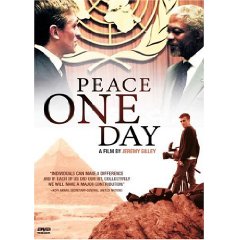
This is quite a nice personal effort, and has not only been added to my List of “Serious DVDs” but also led to my buying a companion DVD “The Peace!” that features interviews with peace advocates world-wide.

For me, one of the most valuable aspects of the DVD was the individual snap-shots of various global leaders including United Nations, Organization of African Unity, and so on.

Costa Rica was initially key and then blew it. French is clearly the language of Africa and the language of peace and inter-cultural communication.

This individual demonstrated that good ideas can raise funds from both individuals and corporations.

The film maker concludes that inter-cultural collaboration and communication are critical, and supplements this with several statements that suggest that truth and reconciliation commissions are essential across the board. One person points out that Palestinian and Israeli schools are both in the business of teaching hate for the other side, and until that is fixed, there will be no peace.

Over all, I found this quite worthwhile. In my own mind I tie it to the Collective Intelligence movement (e.g. Tom Atlee of the Co-Intelligence Institute and author of “The Tao of Democracy,” to spiritual films such as “What the Bleep Do We Know,” and to prayer sit-ints that have demonstrably reduced crime in Washington, D.C. and elsewhere for their duration.

Sadly, just as the film maker was about to succeed, the UN day of peace, 11 September, was turned into a day of terror, 9/11. While the film ends on an uplifting note, we clearly have our challenges.

Most definitely worthwhile for anyone willing to sit still for bit over an hour and absorb all that this film has to offer.

Vote on Review
Vote on Review

Review: Complete Official Mgb Model Years 1962-1974: Comprising the Official Driver’s Handbook, Workshop Manual, Special Tuning Manual (Paperback)

5 Star

Amazon Page
Amazon Page

Not the Same As Hayes Manual, Adds to the Library,

August 14, 2006
British Leyland Motors
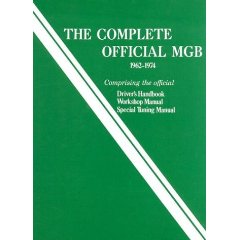
MGB Automotive Repair Manual: All Models of the MGB Roadster and GT Coupe With 1798 CC (110 cu in Engine) (Haynes Manuals) by John Haynes is still the world-class best.

This book is bigger, heavier, more white space, larger print, better diagrams and illustrations, and for all those reasons, it adds to the library.

The “Driver's Handbook” is 22 pages of really basic stuff, while the special tuning manual appears to be more or less a restatement of the calibration data for the car.

If I could only afford to buy one book, I would not buy this, and would go instead with the Haynes Manual. If money is not an issue, I would buy this book fourth in line, after Haynes, “The MGB Restoration Manual” by Porter which dramatically enhances Haynes on points of restoration, and “Original MGB C-V8 Compl: The Complete Guide to All Roadster and GT Models (Original Series)” by Anders Ditlev Clausager which is a dramatic color photo compilation of what perfect looks like.

Vote on Review
Vote on Review

Review: American Gospel–God, the Founding Fathers, and the Making of a Nation (Hardcover)

5 Star, Religion & Politics of Religion

Amazon Page
Amazon Page

Read with Three Other Books (Or My Reviews of All Four),

August 13, 2006
Jon Meacham
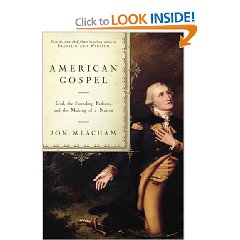
I bought and read this book as part of a series, with The End of Faith: Religion, Terror, and the Future of Reason being the first book. I recommend both highly. “The End of Faith” depicts the threat to America and the world, while this book is more of a historical treatment of how America has always favored religious tolerance and pluralism, but secular governance. Other interesting books deal with misquoting Jesus and the myths of the Bible. I hope to get to them soon.

This book over all an extraodinarily balanced and vital perspective on the good of religion in American life. It puts extremist ideologies in historical context, and concludes in the final chapter that whenever religions become extremist and exclusive, as have both the extreme right Christian evangelicals in America and the radicalized Muslims around the world; they become a tyranny, and must be fought down at all costs.

This is a history book, but it is vibrant with clear and direct quotations showing how successive Presidents used religion to make important points. The books begins with an explosive characterization of liberty and democracy in relation to freedom of religion, and this sets the stage for the entire book which ends by denouncing religious extremism of any sort.

Immortal quotes:

Page 16. “…the Founders understood the dangers of mixing religious passion with the ambitions of politics.”

Page 17. “If totalitarianism was the great problem of the twentieth century, then extremism is, so far, the great problem of the twenty-first.”

The author, while documenting the need for a separation of church and state, is also careful to note that a shared acceptance of public religion and religiosity in all its forms is very helpful to democracy and essential for civil domestic solidarity.

Two books that are unique and distinct from this one, that I recommend be read in addition to this book and “The End of Faith,” are The Left Hand of God: Taking Back Our Country from the Religious Right and Faith-Based Diplomacy: Trumping Realpolitik The four together frame the power of religion in this century, for both good and bad.

The author is quite clear in stating that religions become a problem when their practitioners demand conversion to their own faith, or denigrate all who are not of their faith as unbelievers subject to genocide, confiscation of goods or–as the more rabid Jews taught me in college, full licenses to rape and dishonor, since “chicksas” or gentile girls are “free game.”

This book is the single best authoritative documentation for the hard fact that America was founded as a secular Nation providing for religious tolerance, and it is especially strong in pointing out that Judaism and other religions, including Islam, were present in the early years and America is NOT, per se, a Christian Nation in its founding roots.

The author documents how the Constitution and the intent of the Founders specifically forbade any religious requirements or qualification for holding public office.

On page 93 the author discusses how the Founding Father explicitly favored and sought a diversity of churches and faiths to reduce the possibility of any one faith “coming to play too large a role in politics,” (something I believe we can all see has hurt America gravely as the extremist religious right has trashed civil liberties at home and the Nation of Iraq as a whole–never mind global rendition and torture and a refusal to respect the Geneva Convention.

The author concludes that the USA and radicalized Islam are indeed on a collision course, of pluralism versus monotheism, but a careful reading of the book suggests that we must first heal ourselves internally and stamp down the extremist religious right (I am a moderate Republican who segued from Catholicism to high Episcopal to Methodist via two marriages).

The book includes ten extraordinary appendices and one excellent compilation of Presidential scripture citations up through President Eisenhower (I recommend the DVD on “Why We Fight” to better understand the pernicious effects of faith-based decisions to go to war that ignore all facts and evidence).

This is a serious book. Religion is going to be, as the author documents, a key factor in whether we prosper or implode in the 21st Century. For that reason alone, I strongly recommend all four of the books I have cited above, including this one.

Vote on Review
Vote on Review

Review DVD: Why We Fight (2006)

5 Star, Military & Pentagon Power, Reviews (DVD Only)

Amazon Page
Amazon Page

Foundation Film With Fog of War, Wal-Mart, and The Corporation,

August 11, 2006
Gore Vidal
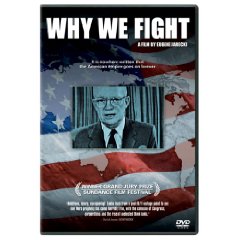
This is a foundation film, a foundation for citizens restoring power to the people and removing it from the corporations. Other films that complement this one are the Fog of War (documentary with McNamara), the Wal-Mart video, and “The Corporation” on how corporations use their “legal personality” to keep their managers immune from accountabiity.

High points of this video:

1) General and President Eisenhower's son says on camara that his dad told him he wished we had never invented the nuclear bomb, when Truman used it it made him feel “low.”

2) Growing gap between the elite and the public. Still a general assumption by the public that the govenrment knows more than they do about the reasons for going to war.

3) Too many accept the premise that democracy can be imposed at gunpoint, and do not realize (see my review of book “The End of Faith”) that religious fanatism must be repressed before secular democracy can be adopted.

4) Huge segment on how the draft was our best defense against being manipulated, how the volunteer Army makes it possible for the elite to use the military for the wrong reasons while lying to the public.

5) Good references to how the rest of the world sees us as practicing economic colonialism combined with unilateral militarism.

6) Oil, oil, oil and lies, lies, lies.

7) Elite lesson from Viet-Nam was that death cannot be seen in US living rooms. The embedded media, far from being more useful is being distracted at the tactical level, and kept from focusing on the strategic question of “is this war necessary?”

8) Senator Byrd is featured as the lone adult voice against the war. Congress is widely perceived as having failed in every possible way because it is both beholden to the military-industrial complex and its bribes, and has (see my review of book “The Broken Branch”) abdicated its role as the “first” branch of government and accepted a subordinate role as “footsoldiers of the President.”

9) Perhaps most useful, as more and more voices call for the impeachment of Bush and Cheney, is the clips of the lies told to us on television by Bush, Cheney, Rumsfeld, and Rice, interspersed with interviews of military and other intelligence analysts who now can speak of the truth as it was known then. This DVD could be “Exhibit A” in any impeachment trial.

10) Hottest quote: “A terrible thing when Americans can't trust their President….the government exploited (my emotions and trust after 9/11)”.

11) Those interviews believe that we had no exit strategy from Iraq precisely because Cheney and Rumsfeld did not plan to leave, and they cite as proof the fact that 14 permanent installations have been built in Iraq, instead of the reconstruction and stabilization of the civil sector that would normally be the priority in an exit strategy.

This is a compelling objective film. Those who demean it by associating it with the Oliver Stone JFK conspiracy documentary are doing Amazon readers and the DVD a great dis-service.

Vote on Review
Vote on Review

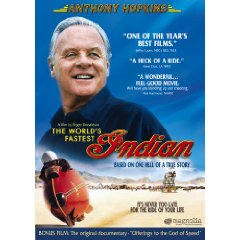
Review DVD: The World’s Fastest Indian

Culture, DVD - Light, Reviews (DVD Only)

Amazon Page
Amazon Page

“A Thoughtful Customer” Says It All,

August 11, 2006
Anthony Hopkins
I can do no more than second the superb review by “A Thoughtful Customer,” with the note that I would not have pulled this movie to watch if it had not had Anthony Hopkins. His participation was for me a guarantee of nuance and value, and the movie proved to be all that “A Thoughtful Customer” discusses.
Vote on Review
Vote on Review

Review: Articles of Impeachment Against George W. Bush

5 Star, Impeachment & Treason

Amazon Page
Amazon Page

Excellent but Incomplete–See Other Books Below,

August 11, 2006
Center for Constitutional Rights
This is a fine little effort, a very fast read, with four articles of impeachment:

1) Violation of privacy and law re the NSA eavesdropping

2) Initiation and continuation of the Iraq war on web of lies

3) Torture & rendition inclusive of US citizens and violation of habeas corpus, making law and interpreting law

4) Abrogation of power from Congress, exceeding the bounds of excutive authority as established by Constitution and laws in effect.

It is not, however, the whole story. At least two other books by constitutional lawyers must be read to appreciate the gravity and full range of impeachable offences that could be judged by Congress: the book “How Would a Patriot Act,” and the book, “The Case for Impeachment,” which is more substantive than this one. Here is the complete list from the latter book:

1. Stole Florida election in 2000.
2. Lied on Iraq to Congress, the Public, and the United Nations.
3. 9-11 Cover-Up and Obstruction of Justice.
4. Violated Rights of Citizens including Habeas Corpus.
5. NSA Program to Listen to Citizens without Warrant.
6. Violated International Treaties Including Geneva Convention.
7. Actively Encouraged, as a Policy, Use of Torture.
8. Gross Negligence on Hurricane Katrina.
9. Iraq Contract Corruption–Bremer “Lost” $8 billion in cash, sole source awards, and gross negligence in managing the peace.
10. Stole Ohio election in 2004.

Still, that is not the whole story. Congress, with the sole brilliant exception of the most extraordinary Senator Byrd (see my review of his book of speeches against the Bush violations, “Losing America: Confronting a Reckless and Arrogant Presidency”) failed all Americans. To understand the failure of Congress, see Senator/Congressman Tom Coburn's “Breach of Trust” and the book just out on “Broken Branch” in which the authors make clear that the extremist Republicans in Congress (not the moderate Republicans like Congressman Rob Simmons, an authentic patriot and man of honor) decided they were the President's “footsoldiers” rather than, as the Founding Fathers intended, the FIRST Branch of Government.

However, even that is not enough. To understand the full extent of the violations that have burned our seed corn, inflicted syphillis on our children, and cost us the moral regard of the rest of the planet, you need to read “The One Percent Doctrine” and “Speaking Freely” and can go on from there to “Downsizing Democracy: How American Sidelined Its Citizedns and Privatized Its Public.” And more. See my lists on evaluating Dick Cheney in relation to both impeachable offenses, and corporate corruption.

It was the Republicans with their grotesque law suite against President Clinton that demeaned Congress and surrended moral authority. This next election may throw out as many Democrats as it does Republicans (Democcrats are Republicans lite–just as corrupt, just less capable), but if we wish to avoid two more years of economic colonialism and unilateral militarism by chicken hawks like Cheney that never served under arms, then we may just have to bite the bullet.

The one thing missing from this book is the “Do It Yourself Impeachment” kit. It turns out that citizens can impeach the President and Vice President if Congress fails to do its dury. Now wouldn't that be something–restoration of the engaged Republic of the whole.

This is a fine book. My reviews of all of these books are the first investment I recommend, followed by any one of the above.

Vote on Review
Vote on Review

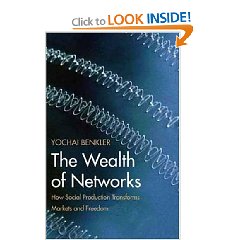
Review: The Wealth of Networks–How Social Production Transforms Markets and Freedom (Hardcover)

6 Star Top 10%, Best Practices in Management, Capitalism (Good & Bad), Change & Innovation, Culture, Research, Intelligence (Collective & Quantum), Intelligence (Public), Intelligence (Wealth of Networks), Values, Ethics, Sustainable Evolution

Amazon Page
Amazon Page

Manifesto for the 21st Century of Informed Prosperous Democracy,

August 9, 2006
Yochai Benkler
Edit of 14 Apr 08 to add links (feature not available at the time).

Lawrence Lessig could not say enough good things about this book when he spoke at Wikimania 2006 in Boston last week, so I ordered it while listening to him. It arrived today and I dropped everything to go through it.

This book could well be the manifesto for 21st Century of Informed Prosperous Democracy. It is a meticulous erudite discussion of why information should not be treated as property, and why the “last mile” should be built by the neighborhood as a commons, “I'll carry your bits if you carry mine.”

The bottom line of this book, and I will cite some other books briefly, is that democracy and prosperity are both enhanced by shared rather than restricted information. The open commons model is the only one that allows us to harness the distributed intelligence of the Whole Earth, where each individual can made incremental improvements that cascade without restraint to the benefit of all others.

As I write this, both the publishing and software industries are in the midst of a “last ditch” defense of copyright and proprietary software. I believe they are destined to fail, and IBM stands out as an innovative company that sees the writing on the wall–see especially IBM's leadership in developing “Services Science.”

The author has written the authoritative analytic account of the new social and political and financial realities of a networked world with information embedded goods. There have been earlier accounts–for example, the cover story of Business Week on “The Power of Us” with its many accounts of how Lego, for example, received 1,600 free engineering development hours from its engaged customers of all ages. Thomas Stewart's “The Wealth of Knowledge,” Barry Carter's “Infinite Wealth,” Alvin and Heidi Toffler's most recent “Revolutionary Wealth,” all come to the same conclusion: you cannot manage 21st Century information-rich networks with 20th Century industrial control models.

Lawrence Lessig says it best when he speaks of the old world as “Read Only” and the new world as “Read-Write” or interactive. His fulsome praise for this author and this book suggest that the era of sharing and voluntary work has come of age.

On that note, I wish to observe that those who label the volunteers who craft Wikis including the Wikipedia as “suckers” are completely off-base. The volunteers are the smartest of the smart, the vanguard for a new economy in which bartering and sharing displace centralized financial and industrial control. Indeed, with the localization of energy, water, and agriculture, this book by this author could not be more important or timelier.

One final supportive anecdote, this one from the brilliant Michael Eisen, champion of open publishing. He captured the new paradigm perfectly at Wikimania when he likened the current publishing environment as one in which scientists give birth to babies, the publishers play a mid-wifery role, and then claim that as midwives, they have a perpetual right to the babies and will only lease them back to the parents. What a gloriously illuminating analogy this is.

I will end by tying this book and this author to C.K. Prahalad's “The Fortune at the Bottom of the Pyramid.” That other book focuses on the fact that the five billion poor are actually worth four trillion in disposable income, versus the one billion rich worth one trillion. C.K. Prahalad posits a world in which capitalism stops focusing on making disposable high-end high cost goods, and turns instead to making sustainable low-cost goods. I see the day coming when–the avowed goal of the Wiki Foundation–there is universal free access to all information in all languages all the time.

If Marx and his Communist Manifesto were the tipping point for communism, this book is the tipping point for communal moral capitalism. Yochai Benkler is–along with Stewart Brand, Howard Rheingold, Bruce Sterling, Kevin Kelly, Lawrence Lessig, Jimbo Wales, Ward Cunningham, Brewster Kahle, and Cass Sunstein, one of the bright shining lights in our constellation of change makers.

He ends his book on an optimistic note. Despite the craven collaboration of the U.S. Congress in extending copyright forever into the distant future, he posits a reversal of all these bad laws (it used to be legal to discriminate against women and people of color) by the combination of cultural, social, economic, and technical forces that have their own imperative. Would that it were so, sooner.

See also:
Infotopia: How Many Minds Produce Knowledge
Infinite Wealth: A New World of Collaboration and Abundance in the Knowledge Era
Revolutionary Wealth: How it will be created and how it will change our lives
The Wealth of Knowledge: Intellectual Capital and the Twenty-first Century Organization
Powershift: Knowledge, Wealth, and Power at the Edge of the 21st Century
The New Craft of Intelligence: Personal, Public, & Political–Citizen's Action Handbook for Fighting Terrorism, Genocide, Disease, Toxic Bombs, & Corruption
Information Operations: All Information, All Languages, All the Time
Peacekeeping Intelligence: Emerging Concepts for the Future
THE SMART NATION ACT: Public Intelligence in the Public Interest
Collective Intelligence: Creating a Prosperous World at Peace

I beg indulgence for listing five books I have published. I know you all know about Smart Mobs, Wisdom of the Crowds, Army of Davids, etc. See also the literature resilience, panarchy, and social entrepreneurship.

Peace (and prosperity) for all, in our time.

Vote on Review
Vote on Review
noble gold