Review: Deep State: Inside the Government Secrecy Industry

Secrecy & Politics of Secrecy
Amazon Page
Amazon Page

Marc Ambinder and D. B. Grady

3.0 out of 5 stars Mish-Mash — Superficial, Avoids Ethics, Corruption, and Cost Issues, April 7, 2013

This is a seriously disappointing book. As another reviewer has noted, and I concur, it is a hodge podge. Worse, it avoids the serious issues of ethics, deep corruption, and the opportunity cost of continuing to spend $70-100 billion dollars a year (depending on how much of the black special operations intelligence world you count) a year to produce what General Tony Tinny has said provided him with “at best” 4% of what he needed to know.

I carefully examined the endnotes and the index first, and rate this book at three stars at best. All ten of the books below are vastly better than this one. While the authors strive to conclude on an intelligent note — when everything is secret nothing can be protected and the cognitive dissonance between real and false secrets will inevitably spawn leaks — there is no substance in this book. It is mish-mash, perhaps useful if integrated into a giant trash can of everything that can be known from open sources, but even there the authors are utterly oblivious to all of the sources that are listed in my own master list, easily found online:

Worth a Look: Book Reviews on Intelligence (Most)

As one of those who testified to the 1993 presidential commission on secrecy, and to the Aspin-Brown Commission and to the Moynihan Commission, I would have expected much more from these authors. Not only have they barely scratched the surface and presented a mish-mash, but there is no substance to this book. Looking at the authors “credentials” what I find is a big fat zero. This is a C-level (A-F) book written without much thought, simply to sell the book.

Continue reading “Review: Deep State: Inside the Government Secrecy Industry”

Review: Born To Learn: Unschooling In the New Paradigm

6 Star Top 10%, Education (General)
Amazon Page
Amazon Page

Kytka Hilmar-Jezek

5.0 out of 5 stars Beyond 5 Stars – Elegant Manifesto & Wake-Up Call for New Parents, April 6, 2013

This slim but extremely coherent and pointed book goes into my best of the best list, 6 Stars, where the top 10% and especially gifted books go.

Unschooling, the author makes clear, is not the same as homeschooling, and this may unnerve some, including those who are pre-disposed toward breaking away from the Prussian educational model intended to create obedient factory workers and soldiers rather than actually educate.

The author is acutely aware that neither homeschooling nor unschooling are remotely possible for most families as we approach the final collapse of a very corrupt ecnomic system optimized to concentrate wealth for the 1% at the expense of the 99%. For this reason her ideas are best embraced as part of a total transformation that includes a return to a one-income family economy in which the family is placed ahead of all other considerations in every policy domain.

Having said that, while the author herself avoids specifics, this book is for me priceless at three levels:

Continue reading “Review: Born To Learn: Unschooling In the New Paradigm”

Reference: The Emperor Wears No Clothes

5 Star, Culture, Research, Economics, Intelligence (Public), Misinformation & Propaganda, Nature, Diet, Memetics, Design, Peace, Poverty, & Middle Class, Politics, Power (Pathologies & Utilization), Science & Politics of Science
Publisher's Page
Publisher's Page

The Emperor Wears No Clothes

Book Chapters (Free)

This is the book that started the hemp revolution. More than 600,000 copies have been sold to date. Jack wanted this information to be available to everyone, so he published the text of the book here on the internet for free.

Chapter 1 – OVERVIEW OF THE HISTORY OF CANNABIS HEMP

Chapter 2 – BRIEF SUMMARY OF THE USES OF HEMP

Chapter 3 – NEW BILLION DOLLAR CROP

Chapter 4 – THE LAST DAYS OF LEGAL CANNABIS

Chapter 5 – MARIJUANA PROHIBITION

Chapter 6 – MEDICAL LITERATURE ON CANNABIS MEDICINE

Chapter 7 – THERAPEUTIC USE OF CANNABIS

Chapter 8 – HEMPSEED AS THE BASIC WORLD FOOD

Chapter 9 – ECONOMICS ENERGY & ENVIRONMENT

Chapter 10 – MYTH, MAGIC & MEDICINE

Chapter 11 – THE (HEMP) WAR OF 1812, NAPOLEON & RUSSIA

Chapter 12 – CANNABIS DRUG USE IN 19TH CENTURY AMERICA

Chapter 13 – PREJUDICE: MARIJUANA AND JIM CROW LAWS

Chapter 14 – MORE THAN SIXTY YEARS OF SUPPRESSION

Chapter 15 – THE OFFICIAL STORY: DEBUNKING “GUTTER SCIENCE”

Chapter 16 – THE EMPEROR’S NEW CLOTHES

Visit book page for source materials and to donate to author of the above book, Jack Herer.

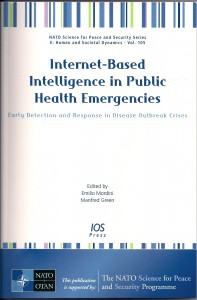
Review: Internet-Based Intelligence in Public Health Emergencies – Early Detection and Response in Disease Outbreak Crises

5 Star, Disease & Health
Publisher's Page
Publisher's Page

Editors Mordini, E., Green, M.
Pub. date March 2013Pages 160
Binding softcoverVolume 105 of NATO Science for Peace and Security Series – E: Human and Societal Dynamics
ISBN 978-1-61499-174-8Subject Computer & Communication Sciences, Security & Terrorism, Social Sciences

Momentous social events result from the sum of micro-level changes in daily individual life, and by observing and fusing publicly available data, such as web searches and other internet traffic, it is possible to anticipate events such as disease outbreaks. However, this ability is not without risks, and public concern about the possible consequences of improper use of this technology cannot be ignored. Opportunities for open discussion and democratic scrutiny are required.

This book has its origins in the workshop Internet-Based Intelligence for Public Health Emergencies and Disease Outbreak: Technical, Medical, and Regulatory Issues, held in Haifa, Israel, in March 2011. The workshop was attended by 28 invited delegates from nine countries, representing various disciplines such as public health, ethics, sociology, informatics, policy-making, intelligence and security, and was supported by the NATO Science for Peace and Security Programme. Its starting point was the 2009 outbreak of swine flu in Mexico. The book includes both scientific contributions presented during the meeting and some additional articles that were submitted later.

Interactions between public health and information and communication technologies are destined to be of great importance in the future. This book is a contribution to the ongoing dialogue between scholars and practitioners, which will be essential to public acceptance and safety as we rely more and more on the internet for predicting trends, decision-making and communication with the public.

Foreword by Robert David Steele

REVIEW

Continue reading “Review: Internet-Based Intelligence in Public Health Emergencies – Early Detection and Response in Disease Outbreak Crises”

Review: On God’s Side: What Religion Forgets and Politics Hasn’t Learned about Serving the Common Good

5 Star, Religion & Politics of Religion
Amazon Page
Amazon Page

Jim Wallis

5.0 out of 5 stars TImely — Relevant to 2014 and 2016, March 29, 2013

God's Politics: Why the Right Gets It Wrong and the Left Doesn't Get It is in my view the better book, here is the first sentence from my review of that book in 2005:

“Jim Wallis has my vote to be Chaplain to the Nation. This is an extraordinary book. Indeed, if the President has a Science advisor, I have to ask myself, why doesn't he have a Faith advisor?”

Along with Rabbi Michael Lerner, Michael Down, Howard Bloom, and yes, I love him so, Rev. Al Sharpton, I believe that Jim Wallis is one of the kindest wisest voices around, an essential contributor to what must inevitably be an era of truth & reconciliation if we are to avoid another war of secession, but this time breaking up into The Nine Nations of North America.

Some books I read from back to front, and this is one of those, so let me start by saying that at the very end he provides a list of ten decisions we can all make, and also points out that we are beginning the third battle of faith in US history. The first was the battle to bring faith into the public sphere and stop its being sidelined as a private matter between man and God; the second battle, still on-going, is the perversion of faith by the fundamentalists, making it all about sexuality instead of about community. This third battle picks up the banner for the powerless, and is about “what kind of society.” Of course this reminds me of What Kind of Nation: Thomas Jefferson, John Marshall, and the Epic Struggle to Create a United States.

I have no quarrel with anything in this book, other than to lament the author appears to believe that politics is defined by two parties, and does not recognize that there are EIGHT accredited national political parties in the USA (Constitution, Green, Libertarian, Natural Law, Libertarian, and Socialist are the other six), and that the Independents are now the largest “party” in terms of voice, followed by the Libertarians. The Democrats and Republicans make up for lower numbers with outrageous corruption of the entire electoral process so as to retain their death grip on the public purse and the right to borrow one trillion a year “in our name.” Certainly I agree with the author when he observes that politics has lost its way and is no longer about the public interest, but instead has become a form of idolatry.

QUOTE (11): God's politics is most concerned with the powerless.

Continue reading “Review: On God's Side: What Religion Forgets and Politics Hasn't Learned about Serving the Common Good”

Review: Global Trends 2030 – Alternative Worlds [Paperback, Well Priced]

3 Star, Future, Intelligence (Government/Secret)
Amazon Page
Amazon Page

National Intelligence Council, Office of the Director of National Intelligence (DNI/NIC)

3.0 out of 5 stars $75 Billion a Year and This is the Poster Child for the Public, March 26, 2013

Certainly worth reading, along with other and generally better reports linked below, but a huge disappointment. There is nothing here actually useful to a national or corporate leader, and generally nothing new. To take one small example upfront, the so-called “disruptive technologies” are pedestrian in the extreme. My disruptive technologies are Open Source Everything (OSE) starting with OpenBTS (Base Transceiver Station) — essentially a free cell phone for every person on the planet from birth — unlimited clean water from the ocean, and free energy. My most significant concern, apart from the fact that this report persists with all of the flaws I pointed out a year ago, is the continued lack of integrity — ethics — a deep commitment to telling the truth about the FACT that government corruption is half the problem, the FACT that half of every US tax dollar is demonstrably spent on fraud, waste, or abuse. Until the National Intelligence Council is capable of telling the truth about our own worst enemy — us — it will be nothing more than an over-paid over-hyped largely useless coffee klatch.

Thoughts in passing as I go through this final report:

01 Still oblivious to rest of the world routing around the USA, e.g. CELAC (Community of Latin American States), the Asian Regional Comprehensive Economic Partnership (RCEP), Haiti joining the African Union, the 57-nation alternative global financial network adopting the Yuan and the Chinese alternative to SWIFT, and so on.

02 Still state-centric, I like the individual empowerment, but the entire report is written from a state-centric point of view and individual empowerment is a virtual footnote. Absent a proper appreciation for the persistent and pervasive corruption of government — and how a properly managed intelligence community can provide decision-support across Whole of Government strategy, policy, acquisition, and operations — this report is merely a curiosity, not a game changer. The National Intelligence Council should be producing block-busters that cannot be ignored and that provide the public as well as the President with compelling reasons to get our act together and make specific pro-active decisions in the public interest.

03 “True Cost Economics” not included. I do find a Human Resilience Index (HRI) from Sandia National Laboratories, but as is so typical of the timid reporting and flawed analytics I have come to expect from all US-based “think tanks,” there is no connection in this index to the three things that really matter: connectivity to the Internet; the eradication of corruption within governments and corporations; and the availability of free energy.

04 Sees half the big players. The report recognizes China and India as major players, is wrong to sell Russia short, and while they mention in passing, “In addition to China, India, and Brazil, regional players such as Colombia, Indonesia, Nigeria, South Africa, and Turkey will become especially important to the global economy” I would have preferred a report building from the regions instead of projected outward from the USA and China with a minor in India. .And of course BRIC is now BRICS, with South Africa as the new formal member of that demographic powerhouse.

Continue reading “Review: Global Trends 2030 – Alternative Worlds [Paperback, Well Priced]”

Review: Trading Secrets: Spies and Intelligence in an Age of Terror

5 Star, Intelligence (Government/Secret)
Amazon Page
Amazon Page

Mark Huband

5.0 out of 5 stars Useful to Policy and Intelligence Professionals, as Well as Students and the Public, March 23, 2013

I enjoyed this book, and particularly enjoyed the rather clever the way the author is able to say some pretty devastating things about intelligence failures in a rather bland manner. This book ends with a clear statement on how the US and UK intelligence agencies are trying — and failing — to “future proof” their calling. As I have spent the past 20 years thinking about that topic, for me this book is perhaps more valuable than some might find it–it has helped me to think about what seven points I might make to the serving heads of intelligence if I were asked, and I end my review with those.

At root this book outlines the following:

01 How the UK and US intelligence systems spent 50 years developing sources and methods suited to the Cold War state on state confrontation, only to find that today those sources and methods are largely useless against both fanatical non-state actors and dispersed non-state actors.

02 How the primary value of intelligence in the past may have been the ability to detect plans and intentions being kept secret, but today there are too few surprises, and the real challenge is understanding the underlying political, socio-economic, ideo-cultural, and techno-demographic parameters that make any given body do what it does.

03 Citing Christopher Andrew, how still today, and for the past decade since 9/11, the intelligence communities have no learned to work together nor learn from history.

04 In relation to the elective war on Iraq, the author finds the intelligence elements seriously abused by policy-makers who misrepresented the truth, and now seriously in need of reinstatement, but does not provide a prescription, something I offer below at the end of my review.

05 Knowing what is “really” going on is a grass-roots human intelligence deliverable, and not to be confused with the blithering of the think tanks, academics, media, and agitating activists.

Continue reading “Review: Trading Secrets: Spies and Intelligence in an Age of Terror”

noble gold