Editor's Note: Shula Aloni was the most principled Israeli elected official I ever met, a champion of the downtrodden and a fearless crusader for the rights of Palestinians. So i was very delighted when she agreed to speak at Tikkun's “Strengthening the Peace Forces” conference that we convened in Jerusalem in 1991 and a subsequent conference in 1994 which we convened at Columbia University. As the preeminent leader of the Ratz (later Meretz) political party, the primary electoral vehicle for the Israeli peace movement, Shula was perceived to be the spokesperson for all of us who sought peace and reconciliation with Palestinians.
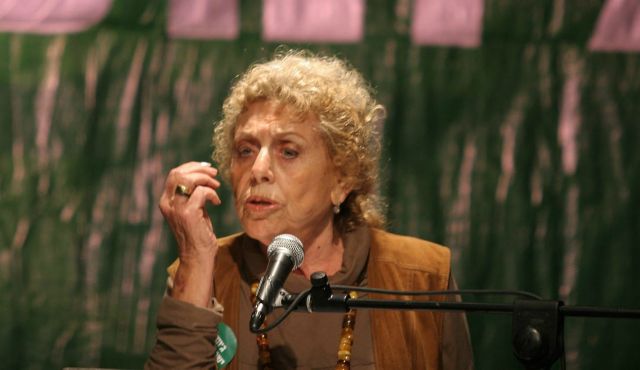
Sadly, Shula had an understandable but in my view counterproductive religiophobia that led her to antagonize not only the ultra-orthodox, but also the “traditional” Israelis who, while rejecting the extremism of the ultra-orthodox, nevertheless felt a deep commitment to Judaism. In this she was completely aligned with the majority of people in the Israeli peace movement who shared her disdain for “the religious” and never made any attempt to articulate their peace and justice message in the language of the Jewish tradition, though that tradition had a wealth of peace and justice traditions upon which they could have drawn to show that reconciliation with the Palestinians and social justice for all the citizens of Israel were goals mandated by Judaism itself, and provided a foundation for a rigorous religious critique of the West Bank settlers and ultra-orthodox fundamentalists.