Syria: President Asad gave an interview to Le Figaro which was published by the Syrian news agency Sana on 3 September. Excerpts follow.
Asad denied Syrian forces launched a chemical attack. He said Syria has no motive to make such an attack because it is winning the fight. He challenged the US to produce its proof and show it to the UN since the party making the accusations has the burden of proving them.
He said his soldiers were wounded in the attack on the 21st and the UN inspectors visited them in hospital.
He accused the US President of being a weak leader who succumbed to pressure from small groups and as one who starts wars instead of prevents them.
Concerning a Syrian response to a US attack, he reminded the interviewer that the architects of a war only control the first shot. He said the first and the greatest danger is that the situation will explode into a regional war.
In response to a question about Russian support he said,
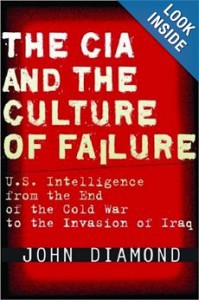
4.0 out of 5 starsGot the Obvious Right, Misses Everything Else, September 4, 2013
I regard Retired Reader as an alter ego and top gun in the field, so his review has my vote. If the book were current (it was published in 2008) I would be tempted to buy it but my time is not my own for the next year or two. Tim Weiner's book remains my top level choice, Legacy of Ashes: The History of the CIA along with The Secret Team: The CIA and Its Allies in Control of the United States and the World (Second Edition), and of course the many other books that I have reviewed here at Amazon, all easily scanned and leading to their respective Amazon page, by searching for “Worth a Look: Book Reviews on Intelligence (Most)”. I last updated it in August 2011.
There are seven CIAs, not just the one that the author writes about, and that costs the book one star. Search for my post of some time ago, “Search: Seven CIAs [Steele on the Record]”.
There is also a total lack of integrity as well as intelligence in Washington, D.C., and while I might normally take a second star away from the book — the author is pimping the cover story and not addressing the deep pathologies across the Executive, Legislative, and corporate worlds — this last bit is something I focus on and will return to in a year or two once I am done with my service overseas.
Yes, the CIA failed on 9/11 because Dick Cheney ordered it so and the Director of the FBI, two weeks on the job, was hired for the explicit purpose of covering it all up (just as the FBI actively covered up George W. Bush's participation in the assassination of John F. Kennedy, and its own culpability in the assassination of Martin Luther King, as well as many other crimes of state from Waco to Oklahoma and beyond).
No, the CIA did not fail on Iraq. Charlie Allen got it right, and George Tenet prostituted his office in willfull betrayal of his oath of office and the public trust. we had the defecting son-in-law, we had the 20 plus legal travelers, we knew they had kept the cook books, destroyed the stocks, and wer bluffing for regional influence's sake.
The latest Snowden document is the US intelligence “black budget.” There’s a lot of information in the few pages the Washington Post decided to publish, including an introduction by Director of National Intelligence James Clapper. In it, he drops a tantalizing hint: “Also, we are investing in groundbreaking cryptanalytic capabilities to defeat adversarial cryptography and exploit internet traffic.”
Honestly, I’m skeptical. Whatever the NSA has up its top-secret sleeves, the mathematics of cryptography will still be the most secure part of any encryption system. I worry a lot more about poorly designed cryptographic products, software bugs, bad passwords, companies that collaborate with the NSA to leak all or part of the keys, and insecure computers and networks. Those are where the real vulnerabilities are, and where the NSA spends the bulk of its efforts.
At first glance, it appears that the Department of Defense (DoD) and the Intelligence Community (IC) have the same cyber security needs as other large organizations in the commercial world. While this is true to a certain extent, the business rules and requirements are significantly different.
The Federal Government, in general, and the DoD/IC are heavily scrutinized and regulated in terms of acquisition policy. The Federal Acquisition Regulations (FAR) and the applicable DoD regulations (DFAR) are comprehensive, administrative and largely bureaucratic in an attempt to protect the interests of the American taxpayer – Cyber Security Solutions have been affected by this process.
This administrative approach has had an initial negative impact on cyber security effectiveness with state sponsored and agile criminal groups enjoying repeated success. As a result, many DoD/IC agencies are reevaluating their cyber security requirements with a more solutions-oriented strategy.
DoD and IC requirements for an effective cyber system include:
Last week, President Obama met with the five-member review board that he recently appointed to review the National Security Agency’s (NSA) controversial electronic surveillance program. The review board is part of the president’s effort to build confidence in the surveillance program and its respect for privacy rights.
But when Obama speaks about the program, he leaves the impression that its existing privacy protections are sufficient, if only we knew enough to appreciate them. That hardly instills confidence. If the president is serious about fixing the enormous overreach of U.S. surveillance that Edward Snowden helped to highlight, he should take these steps:
First, recognize 4th Amendment protection for our metadata. More than 30 years ago, in a different technological era, the Supreme Court ruled that, unlike the content of our phone conversations, we have no privacy rights in the numbers we call. The rationale was that we share those numbers with the phone company. The intrusion mattered little at the time because if the police wanted to reconstruct someone’s circle of contacts, they had to undertake the enormously time-consuming process of manually linking phone number to phone number.
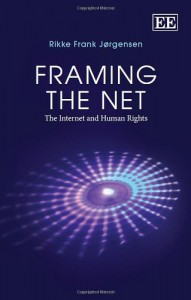
‘Rikke Frank Jorgensen has given us a thoughtful and competent contribution to a debate of increasing global importance. Her theoretical analysis and practical case-study stimulate critical reflection on how we should connect the primary moral domain of our time – human rights – with the primary infrastructure for global communication, the Internet. This book is a must read for all who engage with the search for meaningful and practical normative directions for communications in the 21st century.' – Cees J. Hamelink, University of Amsterdam, The Netherlands ‘Understanding the Internet is key to protecting human rights in the future. In Framing the Net, Rikke Frank Jorgensen, shows how this can be done. Deconstructing four key metaphors – the Internet as infrastructure, public sphere, medium and culture – she shows where the challenges to human rights protection online lie and how to confront them. Importantly, she develops clear policy proposals for national and international Internet policy-makers, all based on human rights. Her book is essential reading for anyone interested in the future of human rights on the Internet: and that should be everyone.' – Wolfgang Benedek, University of Graz, Austria ‘Jorgensen's examination of whether Internet governance can be better aligned with the rights and freedoms enshrined in human rights law and standards of compliance should be read by everyone in the academic, policy and legal practitioner communities. From women's use of ICTs in Uganda to Wikipedia in Germany, information society developments make it imperative that scholars and practitioners understand why it matters how the issues are framed. This book successfully analyses a decade or more of debate in this field in an engaging and very illuminating way.' – Robin Mansell, London School of Economics and Political Science, UK