By Tyler Falk | June 20, 2013
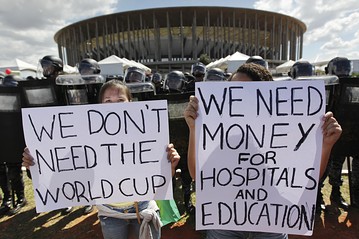
As bus fare hikes in Brazil helped spark the largest protests that the country has seen in 20 years (those fare hikes have since been reversed in Sao Paulo and Rio de Janeiro), The Economist has a provocative proposition: make buses free.
They come to this conclusion looking at the proof-of-payment fare-collection systems that many transit systems have adopted as a way to make transit systems more efficient. But The Economist says that making transit free would take that efficiency a step further. Here’s the argument:
Fares bring in a lot of money, but they cost money to collect—6% of the MTA’s budget, according to a 2007 report in New York magazine. Fare boxes and turnstiles have to be maintained; buses idle while waiting for passengers to pay up, wasting fuel; and everyone loses time. Proof-of-payment systems don’t solve the problem of fare-collection costs as they require inspectors and other staff to handle enforcement, paperwork and payment processing. Making buses and subways free, on the other hand, would increase passenger numbers, opening up space on the streets for essential traffic and saving time by reducing road congestion.
Transit systems aren’t cheap so, of course, the lost fare revenue would have to be made up somehow. That can be done in a number of ways: a congestion charge for cars entering dense downtowns; funneling money from downtown parking into transit; or getting private sponsorships.