Jean Lievens: Nick Ilyadis Wants Intelligent Networks to Make Use of Internet of Things Data — Could This Include Embedded True Cost Data?

Advanced Cyber/IO
0Shares
Jean Lievens
Jean Lievens

We Need Intelligent Networks to Make Use of Internet of Things Data, says Broadcom’s Nick Ilyadis

Nick Ilyadis, CTO of Broadcom, discussed his company’s long lasting relationship with HP, security trends, and the big trend of  Internet of Things with theCube co-hosts John Furrier and Dave Vellante, live at the HP Discover 2013 conference.

“We’re on our 13th generation of Ethernet controllers and HP has been a customer of ours for most of those generations,” Ilyadis said, adding that the quality of the software Broadcom provided was key to the relationship. Asked to detail the quality of the controller they provide, Ilyadis said that “quality has many facets”, and one key point is hardening – the software is field tested over several generations, it is feature rich, and features are incorporated based on feedback from customers. “We’re very responsive to go out and fix” issues, he added. “The fact that they are using it as a default adapter speaks of that.”

Broadcom was also named partner of the year for security by HP. Ilyadis said that the “controller products don’t really have a security aspect, but in broader Broadcom portfolio, we have encryption /crypto capabilities that are best in class.” Broadcom has recently announced a a multi-core processor that provide a hundred gigabytes of crypto in line. What that means it has the ability to encrypt multiple enterprises in terms of their traffic – such as banks – “without breaking a sweat.” The product is “the highest performing multi-core processor in the industry.”
Continue reading “Jean Lievens: Nick Ilyadis Wants Intelligent Networks to Make Use of Internet of Things Data — Could This Include Embedded True Cost Data?”

Robin Good: OpenTopic for Multi-Topic Curation

Crowd-Sourcing, Data, Design, Education, Innovation, Knowledge, P2P / Panarchy, Politics, Resilience, Science, Sources (Info/Intel), Transparency
0Shares
Robin Good
Robin Good

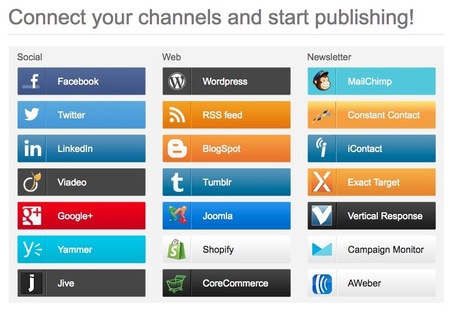
OpenTopic is a news curation service which allows you to aggregate, monitor and filter any number of sources and to publish and share your selected ones to you selected outlets: from your WordPress site, to your social media channels and to your email newsletter engine. Within OpenTopic you can create one or more “Topic” dashboards. These are essentially display pages that aggregate incoming fresh content from the sources you specify. You can jump from one Topic dashboard to the next at the click of your mouse. To curate stories you simpy select the ones that are relevant to your audience and you are provided with an editing module to modify and personalize the story content. At this point you can also select on which one of your outlets (Channels) that story will be published and you can customize the story differently for each one of them. There is even an option that allows you to set-up some form of automated curation, by giving you the option to set up a set of simple rules, which when match, will trigger the publishing of a news story. OpenTopic allows you to hook up to an extended number of possible Channels, making it easy for you to post from one location to your web site, RSS feed, social media and newsletter. Last but not least, OpenTopic integrates a full analytics service, capable of reporting and showcasing the performance of your curation work across stories and distribution channels. My comment: Excellent tool for social media and community managers, as well as web marketing specialists in need to support effectively the finding of relevant news on a topic and the easy publishing to different channels from a centralized platform. Easy to use.

Request an invite here:  opentopic

Click on Image to Enlarge

David Swanson: Old Popes and New Presidents

Civil Society, Corruption, Cultural Intelligence, Government, Idiocy, Ineptitude
0Shares
David Swanson
David Swanson

The Pope and the Kill List

In 1984 — the year not the book, but it was fitting — and five years before she died, Barbara Tuchman published a book called The March of Folly: From Troy to Vietnam.  In one part of the book she looked at the destructive work of a series of a half-dozen popes, work destructive of the papacy, work that brought into being the protestant secession from the Catholic church.  This was offered as an example of folly, of rulers acting against the interest of their own institution.  It was also an example of what we so casually label “the imperial presidency.”  That is, in these popes we watched the mad and cumulative concentration of power and normalization of abuses that Tuchman almost certainly was aware she was living through again — along with the debasement of an institution previously imagined to embody certain principles and integrity.

Does history repeat itself?

Is the Pope Catholic?

. . . . . . . . .

Clement VII, Pope from 1523 to 1534 / Barack Obama, President since 2009

“The new Clement's reign proved to be a pyramid of catastrophes.  Protestantism continued its advance. . . . Supreme office, like sudden disaster, often reveals the man, and revealed Clement as less adequate than expected. Knowledgeable and effective as a subordinate, Guicciardini writes, he fell victim when in charge to timidity, perplexity, and habitual irresolution. . . . By 1527, hardly a part of Italy had escaped violence to life and land, plunder, destruction, misery, and famines.  Clement's misjudgments having prepared the way, Rome itself was now to be engulfed by war.”

“The folly of the popes was not pursuit of counter-productive policy so much as rejection of any steady or coherent policy either political or religious that  would have improved their situation or arrested the rising discontent.  Disregard of the movements and sentiments developing around them was the primary folly. . . . When private interest is placed before public interests, and private ambition, greed, and the bewitchment of exercising power determine policy, the public interest necessarily loses, never more conspicuously than under the continuing madness from Sixtus to Clement.  The succession from Pope to Pope multiplied the harm.  Each of the six handed on his conception of the Papacy unchanged. . . . St. Peter's See was the ultimate pork barrel.  Their three outstanding attitudes — obliviousness to the growing disaffection of constituents, primacy of self-aggrandizement, illusion of invulnerable status — are persistent aspects of folly.  While in the case of the Renaissance popes, these were bred in and exaggerated by the surrounding culture, all are independent of time and recurrent in governorship.”

Full Post Below the Line

Continue reading “David Swanson: Old Popes and New Presidents”

Berto Jongman: Psycho-Pathology in USA

Civil Society, Cultural Intelligence
0Shares
Berto Jongman
Berto Jongman

60 Million People in the U.S. Negatively Affected By Someone Else's Pathology (Think Sociopaths and Psychopaths)

One in 25 people will have the disorders associated with ‘no conscience' which include antisocial personality disorder, sociopath, and psychopath.

304 million divided by 25 = 12.16 million have no conscience.

Each antisocial/psychopath will negatively affect approximately 5 partners with their pathology.  12.16 million x 5 = 60.8 million people!

Continue reading “Berto Jongman: Psycho-Pathology in USA”

Neal Rauhauser: Cyber-Security Global Knowledge Network

Advanced Cyber/IO
0Shares
Neal Rauhauser
Neal Rauhauser

Worth a look.

ICS-ISAC and the Global Knowledge Sharing Network

ICS-ISAC and the Global Knowledge Sharing Network

The Industrial Control System Information Sharing and Analysis Center (ICS-ISAC) is part of the Global Knowledge Network (GKN). The Global Knowledge Network has been evolving for a number of years and is today undergoing a rapid expansion and refinement process. Public and private sector centers for creating and sharing cybersecurity knowledge have arisen around the world at an increasing rate in recent years and have established various working models for knowledge sharing.

The following describes the basic form of the Global Knowledge Network and how it is generally implemented at national and regional scales.

Continue reading “Neal Rauhauser: Cyber-Security Global Knowledge Network”

Michelle Monk: Italian Court Rules Vaccine Caused Autism — US Media Blacks Out the Story

Commerce, Corruption, Government
0Shares
Michelle Monk
Michelle Monk

Italian Court Rules MMR Vaccine Caused Autism: US Media Blacks Out Story

May 8, 2013 by Joe Martino

The debate over vaccines continues as an Italian court ruled in favor of the Bocca family whose nine-year-old son became autistic after receiving the MMR (Measles/Mumps & Rubella) vaccine. I came across this case and felt it was a good idea to report on this as the vaccine debate has been a hot topic here lately. Although the case concluded in 2012, the information is just as relevant today….

Continue reading here.

It's worth noting: Vaccines aren't the only thing that cause autism. A variety of other factors can contribute, including gluten. My mom's friend's nephew had autism until he was 4 years old. They went gluten free, and his autism healed completely.  Learn more here: Wheat conspiracy: How it causes 300+ symptoms, diseases & misdiagnoses and the CURE