Here is the abstract of a research paper, that is one of the first things I ever saw that seriously considered the E-government trend, and how it is going to impact citizens. It was published two years ago and, recently a reader sent it to me, and I read it again. I want you to notice how little has changed in the three year! s since it was published. Why is that, do you suppose?
Also note this odd lacuna. There is not discussion of voting, only communications. With our existing technology it is possible to develop e-voting in such a way that each citizen could vote. You wouldn't have to have polling booths, you wouldn't have to mail things, and you wouldn't have to go anywhere. It could be done from any computer, a pad, or a smartphone. To secure it you could use social security numbers, a pre-set-up ID, and a password.
We do billions of financial transactions each day on less security. By comparison this would be 50 state websites, whose Federal totals were simultaneously sent to a Federal website. Everyone eligible could vote in a single day. It would all be completely transparent to the media and the citizens.
It would bypass voter suppression, hanging chads, and all the rest of the schemes. And it would produce a radically different Congress and serve as the counterweight to Citizens' United.
A growing body of research focuses on the relationship between e-government, the relatively new mode of citizen-to-government contact founded in information and communications technologies, and citizen trust in government. For many, including both academics and policy makers, e-government is seen as a potentially transformational medium, a mode of contact that could dramatically improve citizen perceptions of government service delivery and possibly reverse the long-running decline in citizen trust in government. To date, however, the literature has left significant gaps in our understanding of the e-government-citizen trust relationship. This study intends to fill some of these gaps. Using a cross-sectional sample of 787 end users of US federal government services, data from the American Customer Satisfaction Index study, and structural equation modeling statistical techniques, this study explores the structure of the e-government-citizen trust relationship. Included in the! model are factors influencing the decision to adopt e-government, as well as prior expectations, overall satisfaction, and outcomes including both confidence in the particular agency experienced and trust in the federal government overall. The findings suggest that although e-government may help improve citizens’ confidence in the future performance of the agency experienced, it does not yet lead to greater satisfaction with an agency interaction nor does it correlate with greater generalized trust in the federal government overall. Explanations for these findings, including an assessment of the potential of e-government to help rebuild trust in government in the future, are offered.
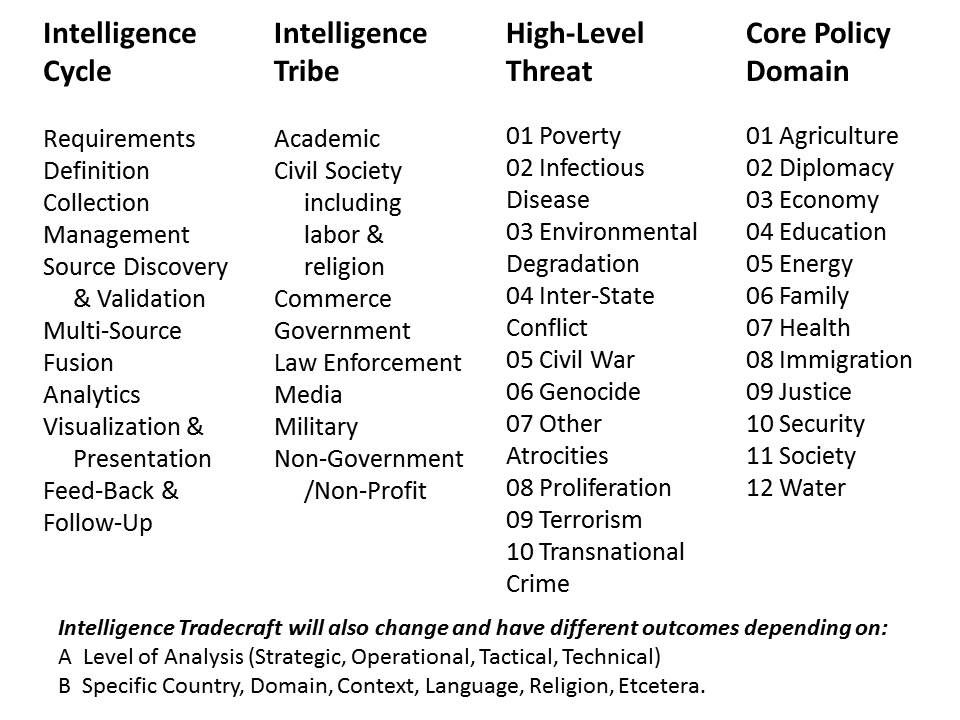
“Intelligence tradecraft” applies to each element of the intelligence cycle and is distinct for each of the eight tribes of intelligence. It also varies depending on the threat target and the policy objective.
Click on Image to Enlarge
Each of the above can be further distinguished at the four different levels of effort (strategic, operatonal, tactical, technical — the threat changes depending on the level of analysis, neither CIA nor DIA have figured that out yet — nor do they care). Each of the above also changes dramatically depending on the specific coiuntry and region — US “assumptions,” for example with respect to politics, culture, economics, and technology — are retarded when it comes to deep analysis of African and Asian countries. The US also does not factor in the reality of how others perceive the US, or the reality that three quarters of the economy is not traditional financial, but rather System D, barter, or via other metrics including kinship. In collection the US secret world collects everything that can be collected digitally (like the drunk looking for his keys under the light instead of where he lost them), processes almost nothing, and confuses powerpoint slides and slick glossies with thinking.
Every dying Empire has its truth telling prophet and America had its own with Chalmers Johnson. Johnson correctly compared the decay of the American empire, with its well over 600 overseas military bases, with the fall of the Roman Empire whereas the Senate becomes a wealthy corporate club and irrelevant compared to the ruling Military Industrial Congressional Complex
Chalmers Johnson was a truth teller and prophet in a political environment where few would stand up to the interests and secrecy of the Pentagon and the intelligence community ~ and since his passing in November of 2010, many of his prophetic fears have been realized in the Obama administration.
Johnson, author of Blowback, Sorrows of Empire and Nemesis,The Last Days of the American Republic, talks in this video interview about the similarities in the decline of the Roman and Soviet empires and the signs that the U.S. empire is exhibiting the very same symptoms ~ overextension, corruption and the inability to reform. (Watch at least the first 20 minutes and also the very end where he predicts an economic collapse)
Johnson’ s main points were; The United States is treading the same three steps as the former Soviet Union;
Inability to deal with corporate corruption.
Imperial over-stretch is leading to fiscal insolvency ( 600 plus bases throughout the world )
Inability to reform, thus accelerating the inevitable fall.
One day in July 1944, as the Second World War raged throughout Europe, General William “Wild Bill” Donovan was ushered into an ornate chamber in Vatican City for an audience with Pope Pius XII. Donovan bowed his head reverently as the pontiff intoned a ceremonial prayer in Latin and decorated him with the Grand Cross of the Order of Saint Sylvester, the oldest and most prestigious of papal knighthoods. This award has been given to only 100 other men in history, who “by feat of arms, or writings, or outstanding deeds, have spread the Faith, and have safeguarded and cham-pioned the Church.”
Although a papal citation of this sort rarely, if ever, states why a person is inducted into the “Golden Mili-tia,” there can be no doubt that Donovan earned his knighthood by virtue of the services he rendered to the Catholic hierarchy in World War II, during which he served as chief of the Office of Strategic Services (OSS), the wartime predecessor to the Central Intelligence Agency (CIA). In 1941, the year before the OSS was officially constituted, Donovan forged a close alliance with Father Felix Morlion, founder of a European Catholic intelligence service known as Pro Deo. When the Germans overran western Europe, Donovan helped Morlion move his base of operations from Lisbon to New York. From then on, Pro Deo was financed by Donovan, who believed that such an expenditure would result in valuable insight into the secret affairs of the Vatican, then a neutral enclave in the midst of fascist Rome. When the Allies liberated Rome in 1944, Mor-lion re-established his spy network in the Vatican; fromthere he helped the OSS obtain confidential reports provided by apostolic dele-gates in the Far East, which included information about strategic bombing targets in Japan.
Pope Pius' decoration of Wild Bill Donovan marked the beginning of a long-standing, intimate relation-ship between the Vatican and U.S. intelligence that continues to the present day. For centuries the Vatican has been a prime target of foreign espionage. One of the world's greatest repositories of raw intelligence, it is a spy's gold mine. Ecclesiastical, political and economic informa-tion filters in every day from thousands of priests, bishops and papal nuncios, who report regularly from every corner of the globe to the Office of the Papal Secretariat. So rich was this source of data that shortly after the war, the CIA created a special unit in its counterintelligence section to tap it and monitor developments within the Holy See.
5.0 out of 5 starsBargain Price, Fast Read Worthy of Re-Reading, a Real Delight, June 1, 2013
I was given this book free in part because I have reviewed a number of books on science versus religion/faith, and I was very surprised to find it a very fast read (worthy of being reread), with a very good style of presentation, and a number of excellent artistic reproductions to make points, as well as graphics. There is also an excellent short annotated bibliography at the end of the book that is alone worth the $5 price — this is a bargain financially and philosophically.
The author and the book focus on the explicatory gap between science and religion that the author settled on calling the “breath of life” or soul. While the soul remains an unverifiable hidden matter, I fully expect that one day there will be a deeper practical understanding of that which is now spiritual, intangible, and despite being invisible, never-the-less a very powerful force. The “breath of life” is that which *animates,” animation is life and interaction in an endless universe of both possibilities, and choices.



 Their Will Be Done