I believe there is a historic opporunity to reconstruct a progressive majority around enabling the commons, which would be based on the following political and sociological complementarity between political forces and parties.
Though the fortunes of the new player in politics are down from the moment I wrote this, I believe the general gist is still valid.
Obviously, my proposals are centered on the European situation.
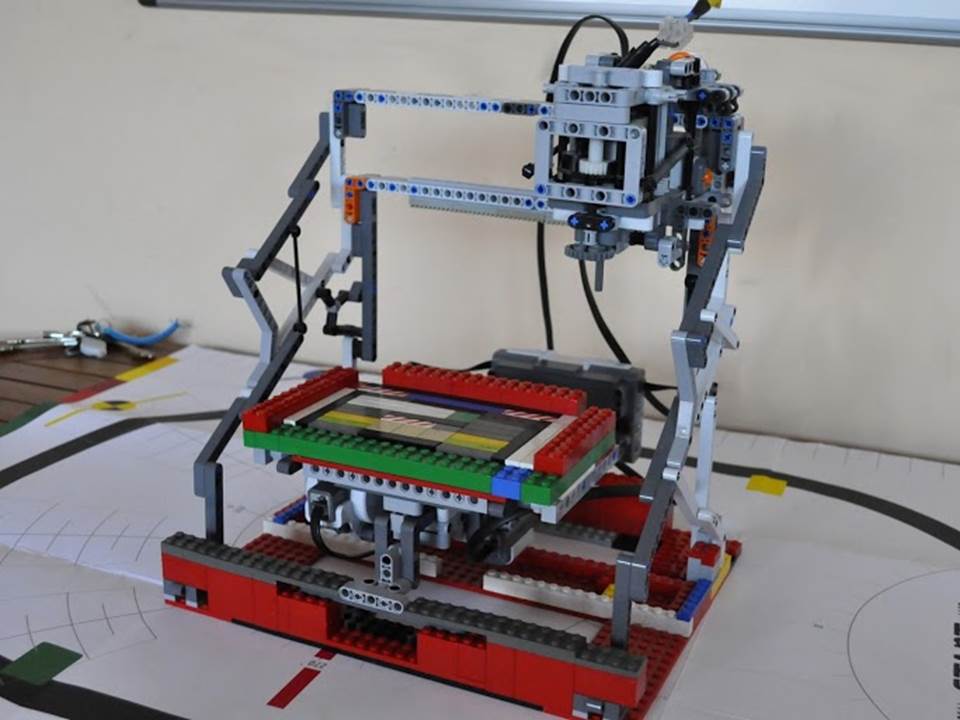
Peer production, modularity & voxels: The RepRap-based, Lego-built 3D printing-milling machine
This research project aims to shed light on the conditions of transferability of Commons-based peer production (CBPP) processes to physical manufacturing. We draw from the political economy of CBPP and its conjunction with digital, desktop manufacturing technologies, the concept of “voxels”, and the case of a hybrid RepRap-based, Lego-built three-dimensional printer-milling machine, to discuss the importance of modular design. We show that modularity, not only in terms of development process but also of hardware components, is necessary to make possible CBPP’s replication for tangible products, decreasing the need for coordination and enabling parallel developments to various directions.
Full title: “Shedding light on the transferability of Commons-based peer production to physical manufacturing: The case of a RepRap-based, Lego-built 3D printing-milling machine”. Vasilis Kostakis and Marios Papachristou. To be submitted.
One of Mark’s [Jones] ideas for the [former “Crashlist”] list, one the moderators share I’m sure, is that the list could be used to share weapons of struggle. Anyone who has done serious mass work, I mean the kind away from the keyboard, knows that sometimes a pithy quote, an uncovered source, an irrefutable fact, a way of phrasing, a piece of reasoning, hypocrisy exposed, an infiltrator outed, a great “expert” really grilled, etc can cause a kind of critical mass and cause all sorts of people from all sorts of backgrounds to take a quantum leap in consciousness or at least take a fork in the road on a whole new direction.
I have been invited several times to debate Zionists on Palestine (usually in the role of a “PalestIndian” as we see Palestinians as the Indians of the Middle East and American Indians as “the Palestinians” of North America). By debatng Zionists, I mean, the official kind, as in working in paid positions for open Zionist organizations clearly tied in with Israel, in the capacity of roving and officially designated “Speakers”. It is Palestinian friends who invite me to join them.
Pirate Parties: This week, the end of May 2013, the European Elections are exactly one year out, and as things stand today, Pirate representation in the European Parliament can be expected to triple. This would follow a Swedish re-election, a German entry, and a Finnish entry following Peter Sunde’s candidacy. While the Pirate movement is still nascent, tripling representation would obviously advance the movement.
One year from the European Elections, we can take a quick look at the lay of the land, country by country for the Pirate Party.
In Sweden, it is reasonable that the Pirate Party defends (at least) one seat of its current two. Seeing that Sweden has twenty seats in the European Parliament, you theoretically need 5% of the vote total per seat in Parliament. (Here, we can also observe that the Swedish Pirate Party’s two seats for 7.13% was a rounding error working heavily in the party’s favor – hence, with a repeated result of 7%, one seat can be expected. In fact, anywhere between 4% and 8% will probably yield one seat.)
In Germany, the Piratenpartei is currently polling at between 3% and 4%. It’s possible that this is enough to get to 5% on September 22 of this year, when Germany has its national election, which would be a huge boost to the movement. But even without such a success, 3%-4% is enough for four German seats in the European Parliament (out of Germany’s 99) in the elections in May 2014.
In Finland, it has been announced that Peter Sunde is running for the European Parliament on a Pirate Party ticket, and his fame could quite probably carry his candidacy all the way.
So the Pirate representation in the European Parliament can be expected to triple in two ways – both in terms of countries represented (one to three) and in terms of Members of the European Parliament (two to six).
Additionally, seeing that there are Pirate Parties in 70 countries and counting, there are a number of dark horses that could break through between now and then, particularly among the Pirate Parties in Eastern Europe.
Remains of endangered Hawaiian petrels – both ancient and modern – show how drastically today’s open seas fish menu has changed.
A research team, led by Michigan State University and Smithsonian Institution scientists, analyzed the bones of Hawaiian petrels – birds that spend the majority of their lives foraging the open waters of the Pacific. They found that the substantial change in petrels’ eating habits, eating prey that are lower rather than higher in the food chain, coincides with the growth of industrialized fishing.
The birds’ dramatic shift in diet, shown in the current issue of the Proceedings of the National Academy of Sciences, leaves scientists pondering the fate of petrels as well as wondering how many other species face similar challenges.
‘Our bone record is alarming because it suggests that open-ocean food webs are changing on a large scale due to human influence,” said Peggy Ostrom, co-author and MSU zoologist. ‘Our study is among the first to address one of the great mysteries of biological oceanography – whether fishing has gone beyond an influence on targeted species to affect nontarget species and potentially, entire food webs in the open ocean.”
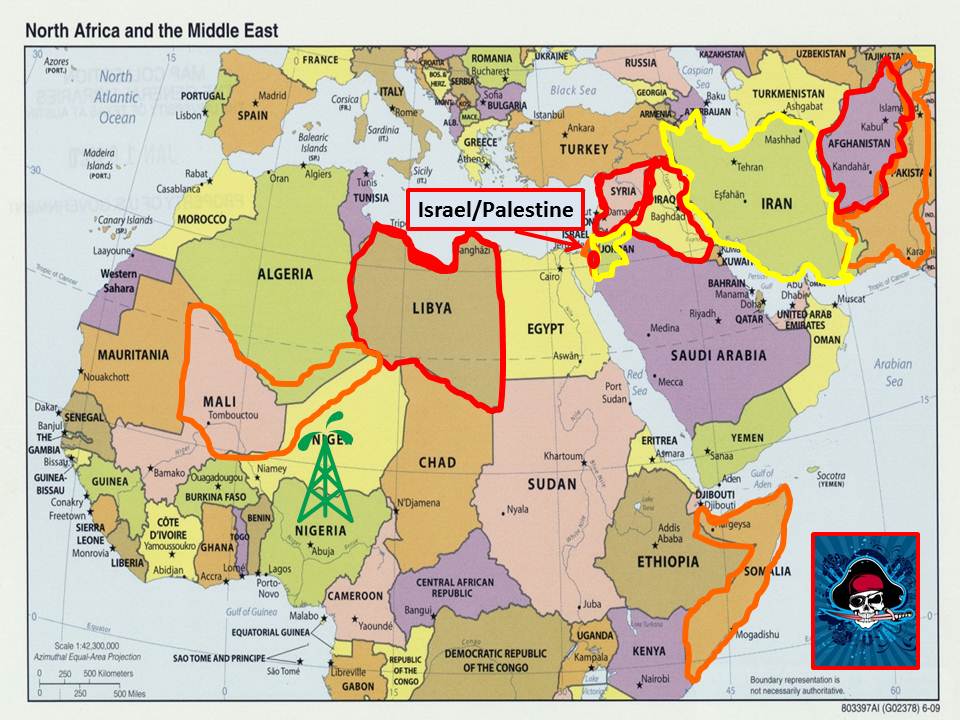
China-Mali:For the record. China has offered to send more than 500 soldiers to the UN force seeking to contain Islamist militants in Mali . This would be China's largest UN peacekeeping contingent.
Iraq: An attack at a military checkpoint at Taji, north of Baghdad, on Thursday killed 11 people, including four soldiers, and wounded five.
Comment: The pause appears ended. The fighting has killed 420 people this month.
Lebanon: Fighting in Tripoli continued for a fifth day. Overnight clashes killed six people and wounded 40. .The Middle East is now destabilized from the border of Iran to the Mediterranean.
Niger: Islamic militants executed coordinated attacks at two locations in Niger, the country east of Mali. In one attack, a suicide bomber detonated a car bomb at a French-Niger owned uranium mine in the town of Arlit. Simultaneously and 125 miles south, another bomber detonated a car bomb inside a military camp in the city of Agadez. Other jihadists in vehicles attempted to overrun the base, but were stopped by a firefight with Nigerian soldiers. The bombs killed 5 bombers, 25 people and injured 29, according to the Ministry of Defense. No expatriates were killed.
During this Watch, a surviving bomber is holding several Nigerien soldiers hostage
These were the first terrorist attacks of this kind in Niger. The two towns are in central Niger. Some of the facilities for processing uranium ore were damaged at Arlit.
An affiliate of al-Qaida in the Islamic Maghreb, known as the Movement for Unity and Jihad in West Africa (MUJAO) claimed responsibility. They were also involved in the Mali fighting. Nigerien officials judge the fighters came from Libya. One said that Libyan instability is destabilizing the entire region.
Early this year one military analyst judged that Niger was even less prepared than Mali to cope with Islamic militants and terrorists. Nevertheless, a Nigerien unit participated in clearing operations in Gao, Mali.
The key points are that the jihadists have not given up their plans to establish a base in Sahelian Africa and all the countries are vulnerable. Their territory is enormous with poor infrastructure. They are poor and have small, poorly supported security forces.
The attacks might compel France to deploy some of the troops withdrawing from Mali to Niger. Niger is France's single most important supplier of uranium for its extensive nuclear and electric power industries.
France might need to re-evaluate its strategy for providing security assistance to its former colonies. The threat calls for an integrated regional approach to security. The Sahelian nations and France will certainly need outside help.