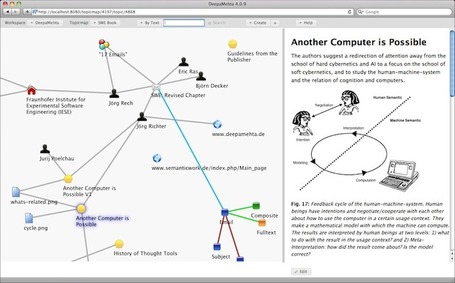
Looks like a more sociable version of Personal Brain — mindmapping plus communication. “DeepaMehta is a software platform for knowledge workers. The special feature of DeepaMehta is the situation-centered user interface: information belonging to one working context is — together with its content associations — displayed and edited in a single window. Whether it is text, images, documents, emails, websites, events or for example contacts.”
To judge a risk more clearly, it may help to consider it in a foreign language.
A series of experiments on more than 300 people from the US and Korea found that thinking in a second language reduced deep-seated, misleading biases that unduly influence how risks and benefits are perceived.
“Would you make the same decisions in a foreign language as you would in your native tongue?” asked psychologists led by Boaz Keysar of the University of Chicago in an April 18 Psychological Science study.
“It may be intuitive that people would make the same choices regardless of the language they are using, or that the difficulty of using a foreign language would make decisions less systematic. We discovered, however, that the opposite is true: Using a foreign language reduces decision-making biases,” wrote Keysar’s team.
Psychologists say human reasoning is shaped by two distinct modes of thought: one that’s systematic, analytical and cognition-intensive, and another that’s fast, unconscious and emotionally charged.
In light of this, it’s plausible that the cognitive demands of thinking in a non-native, non-automatic language would leave people with little leftover mental horsepower, ultimately increasing their reliance on quick-and-dirty cogitation.
Equally plausible, however, is that communicating in a learned language forces people to be deliberate, reducing the role of potentially unreliable instinct. Research also shows that immediate emotional reactions to emotively charged words are muted in non-native languages, further hinting at deliberation.
. . . . . . .
The researchers believe a second language provides a useful cognitive distance from automatic processes, promoting analytical thought and reducing unthinking, emotional reaction.
Phi Beta Iota: Integrity is not just about people making decisions. It is about the whole — the context, the clarity of communication, the diversity of views, the integrity of all feedback loops. Today there is very little integrity in the process of intelligence – on those rare occasions when it actually exists — and there is zero integrity in the policy process, something Paul Pillar and Morton Halperin (among many others) have documented nicely.
This morning I got this note from Co-Intelligence Institute board member Lyn Manju Bazzell, who lives in Ashland, a town in southern Oregon's Rogue Valley:
“A little news from the Rogue Valley: went to a meeting with 200 people last night. It was a panel of 2 Tea Party leaders and 2 Occupy leaders in the Rogue Valley answering questions from the audience. A very positive move for our area! Jeff Golden put it together with some help and there is a desire for ongoing conversations for the Rogue Valley. It is an outgrowth of one of his Immense Possibilities episodes that included these 4 people. Yea for Jeff – he's a mensch!
“Here are some areas of common ground that were shared by the panel: Personal liberty issues; Homeland Security; Election reform – concern about voting machines; lobbying; self-reliance; importance of local action; concentration of power in the hands of the elites (a bit of difference re: who is really holding the power, with the Tea Party focused on government and Occupy on big business, but the identification of lobbying as an issues offers an open window into a deeper discussion; size of the military and our aggressive global orientation (this was a surprise to me for Tea Partiers).”
An hour later I received the following article from Lance Bisaccia:
Two groups come together at forum; avoid ‘hot debate'
By John Darling for the Tidings Posted: 2:00 AM April 24, 2012
In their first public outing together, tea party and Occupy backers — and an audience of 200 — found a lot of common ground on the issue that corporations, lobbyists, the military and the federal government have a huge amount of power, are “bought” — and aren't very responsive to the needs of the average person.
Add to this idea a more open “peer review” process in place of the present obscure, back-scratching, club-based peer review process, and climate science might be well on its way to depoliticization.
Making research papers freely available is about much more than breaking the monopoly of rich academic publishers
Peter Coles is professor of theoretical astrophysics at Cardiff University, The Guardian, 20 April 2012
The Guardian's recent articles about the absurdities of the academic journal racket have brought out into the open some very important arguments that many academics, including myself, have been making for many years with little apparent effect.
Now this issue is receiving wider attention, I hope sufficient pressure will develop to force radical changes to the way research is communicated, not only between scientists but also between scientists and the public, because this is not just about the exorbitant cost of academic journals and the behaviour of the industry that publishes them. It's about the much wider issue of how science should operate in a democratic society.
Chase Madar's new book, The Passion of Bradley Manning, pulls together the essential facts that we should try to somehow deliver to television viewers and victims of our education system. The subtitle is “The Story of the Suspect Behind the Largest Security Breach in U.S. History.”
The book looks at Manning's life story, his alleged action (leaking voluminous materials to Wikileaks), the value of the material he made available to us, the status of whistleblowers in our country, the torture inflicted on Manning during his imprisonment, the similar treatment routinely inflicted on hundreds of thousands of U.S. prisoners without the same scandal resulting, and the value of running a society in accordance with written laws.
The table of contents sounds predictable, but the most valuable parts of Madar's book are the tangents, the riffs, the expansions on questions such as whether knowing the truth does or does not tend to set us free. Does learning what our government is up to help to improve our government's behavior? Has the rule of law become an empty phrase or worse? Who is standing up for Bradley Manning, and who should be?
(NaturalNews) Marijuana prohibition currently costs taxpayers billions of dollars a year to enforce, and it accomplishes little or nothing beneficial in terms of economic benefits. On the contrary, legalizing marijuana would not only save taxpayers billions of dollars a year in unnecessary costs, but it would also jumpstart the economy to the tune of $100 billion a year or more, say some economists.
Last year, over 850,000 people in America were arrested for marijuana-related crimes. Despite public opinion, the medical community, and human rightsexperts all moving in favor of relaxing marijuana prohibition laws, little has changed in terms of policy.
There have been many great books and articles detailing the history of the drug war. Part of America’s fixation with keeping the leafy green plant illegal is rooted in cultural and political clashes from the past.
However, we at Republic Report think it’s worth showing that there are entrenched interest groups that are spending large sums of money to keep our broken drug laws on the books:
1.) Police Unions: Police departments across the country have become dependent on federal drug war grants to finance their budget. In March, we published a story revealing that a police union lobbyist in California coordinated the effort to defeat Prop 19, a ballot measure in 2010 to legalize marijuana, while helping his police department clients collect tens of millions in federal marijuana-eradication grants. And it’s not just in California. Federal lobbying disclosures show that other police union lobbyists have pushed for stiffer penalties for marijuana-related crimes nationwide.
The maps in this web page are astonishing – it shows the sites of 63 active drone sites in the US. Officials were forced to reveal it after a FOIA lawsuit.
The real question, which the article does not explore much, is what kind of drone missions will these sites support? Will they support another leg in the elite's plan to conduct population reduction, sending out killer drones to cull the overeaters? Given the military and federal locations of some drone sites, such an impression is strengthened by an interesting fact revealed in one of the descriptions of the map for the DC area: “The Beltway around Washington DC has the highest concentration of urban and suburban drone sites, including the U.S. Marine Corp base as Quantico Station, Virginia.” Perhaps drone-generated genocide is too over-the-top. Maybe they are using them to merely assert much more control and oversight of the population, gathering much more private information more cheaply and effectively.