The speech delivered by CIA General Counsel Stephen Preston at Harvard yesterday is important and illuminating, and I agree with Ken the administration should be commended for it. But wow does it raise some troubling questions about how the CIA understands the legal authority for and constraints on its drone operations. There’s too much to unpack in it for one blog post, and I’d urge those who follow these interests to read it for themselves. Meantime, I’ll start with two issues: (1) the CIA’s understanding of its domestic authority to use force; (2) the CIA’s understanding of whether/how international law constrains its actions.
Domestic authority. Preston correctly explains that the CIA must have some source of authority under domestic U.S. law to carry out “hypothetical” activities involving the use of force abroad. In this inquiry, of course, international law is irrelevant. And I don’t read Preston to suggest that international law can give the U.S. government powers it does not otherwise possess under our own Constitution and laws. So what gives the CIA its authority to carry out drone strikes? Here’s Preston:
The US government pretends to live under the rule of law, to respect human rights, and to provide freedom and democracy to citizens. Washington’s pretense and the stark reality are diametrically opposed.
US government officials routinely criticize other governments for being undemocratic and for violating human rights. Yet, no other country except Israel sends bombs, missiles, and drones into sovereign countries to murder civilian populations. The torture prisons of Abu Gahraib, Guantanamo, and CIA secret rendition sites are the contributions of the Bush/Obama regimes to human rights.
Washington violates the human rights of its own citizens. Washington has suspended the civil liberties guaranteed in the US Constitution and declared its intention to detain US citizens indefinitely without due process of law. President Obama has announced that he, at his discretion, can murder US citizens whom he regards as a threat to the US.
For 3 days in late February, Russian businessman Dmitry Itskov gathered 500+ futurists in Moscow for a “Global Future 2045 Congress” – the latest manifestation of his “Russia 2045” movement. The Congress featured an impressive roster of Russian scientists, engineers and visionaries, along with American and West European futurist leaders like Ray Kurzweil, Randal Koene and John Smart.
As Kurzweil noted when I asked him about the conference, “The reference to ‘2045’ comes from my date for the Singularity. The conference was forward looking and was based on my ideas.“
The occurrence of a conference like this in Russia is no big shock, of course. Russia has a huge contingent of great scientists in multiple directly Singularity-relevant areas; and it also has an impressively long history of advanced technological thinking . My dear departed friend Valentin Turchinwrote a book with Singularitarian themes in the late 1960s, and the Russian Cosmists of the early 1900s discussed technological immortality, space colonization and other futurist themes long before they became popular in the West.
On the other hand, the overall social atmosphere in Russia is not so optimistic these days. In fact Russia is seeing a brain drain of sorts – around 1.25 million Russians have left the country in the last decade, including a large number of educated individuals. This is fairly dramatic for a country of 142 million with a death rate significantly higher than its birthrate.
The global economic crisis of 2008 reduced Russia’s GDP to a persistent 3% or so per year, compared to 7-8% beforehand. Russian polling agencies estimate that 20% of Russians are thinking of leaving, with the figure nearly 40% in the 18-25 age bracket.
So on the one hand there’s a struggling economy and brain drain; and on the other hand, a massive brain trust of brilliant scientists and a long tradition of visionary futurist thinking. Taken together, quite an interesting backdrop for Itskov’s event….
And, like the Russian Cosmists before him, Itskov has no lack of grand ambitions. As he told Sander Olsen in an interview last year:
[T]he most important thing is that we want to eliminate death and disease for all—to overcome the limitations of our protein-based body; to find a way out of the chain of various crises our civilization is facing.
As regards the Avatar project … this is a project to create a robot copy of a human that can be operated through the brain-computer interface.
We just talked about the Body B project, which is to create a brain life support system in order to extend human life by 100-200 years.
The Re-Brain project is a purely Russian project to create a computer brain model and a model of the human psyche using the method of reverse engineering, and to develop a way to transfer personality to an artificial carrier.
And Body D is our vision of the evolution of a personality carrier: a body that is like a hologram. This technology is not yet able to be made, but that is how we envision future human bodies.
Exciting visions indeed!
I’m splitting my time between Hong Kong and DC these days, so I’m fairly aware of Singularitarian happenings in the US and China (see e.g. my 2010 article, The Chinese Singularity, and followup comments in this interview). But Russia is largely unknown territory for me – so the Global Future 2045 conference piqued my interest particularly, and I regret I was too busy with work to attend. But I did my best to keep up to speed on the proceedings from a distance.
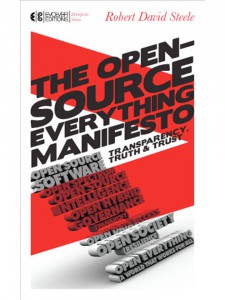
We are seeking a sponsor for the printing and free distribution of 2,000 copies of Robert Steele's new book, THE OPEN SOURCE EVERYTHING MANIFESTO: Transparency, Truth & Trust. Each book can contain a label on the inside front cover with whatever content the sponsor wishes to provide. The sponsor can specify the desired distribution, we recommend 1250 to Hackers on Planet Earth (HOPE) in NYC in July, 500 to Silicon Valley Hackers Conference in November, and 250 split between the Chaos Computer Club in Germany and Hac-Tic in The Netherlands. Cost per 1000 is $5,000. There is no other means on the planet by which to reach these specific populations at a cost of $5 each.
One copy of the book will be delivered to Tanya Pemberton, the ex-NRO ex-In-Q-Tel replacement for Doug Naquin. The idea that the NRO will be decommissioned and Tish Long will be the first Director of the Open Source Agency, with Tanya as her trusty side kick for gutting CIA, is most interesting.
ROBERT STEELE: I thought F/OSS had merged as a meme. Now I understand you to mean that while both have practical similarities in outcomes, the underlying ethics are completely different.
RICHARD STALLMAN:
Nothing has changed. The free software movement remains what it has always been since 1983: an ethical and political campaign for freedom for computer users.
Open source remains what it has been since 1998: a practical recommendation to let users change and redistribute source code.
I still champion free software, and disagree with the ideas of open source because they omit the most important idea.
INSERT: A program is free software if the program's users have the four essential freedoms:
The freedom to run the program, for any purpose (freedom 0).
The freedom to study how the program works, and change it so it does your computing as you wish (freedom 1). Access to the source code is a precondition for this.
The freedom to redistribute copies so you can help your neighbor (freedom 2).
The freedom to distribute copies of your modified versions to others (freedom 3). By doing this you can give the whole community a chance to benefit from your changes. Access to the source code is a precondition for this.
“FOSS” and “FLOSS” are ways of talking about both free software and open source without choosing between them. If you want to talk about the community's development practices, for instance, that sort of neutrality between the two philosophical camps may be useful.
Nearly all open source software is free software. The two terms describe almost the same category of software, but they stand for views based on fundamentally different values. Open source is a development methodology; free software is a social movement. For the free software movement, free software is an ethical imperative, because only free software respects the users' freedom. By contrast, the philosophy of open source considers issues in terms of how to make software “better”—in a practical sense only. It says that nonfree software is an inferior solution to the practical problem at hand. For the free software movement, however, nonfree software is a social problem, and the solution is to stop using it and move to free software.
“Free software.” “Open source.” If it's the same software, does it matter which name you use? Yes, because different words convey different ideas. While a free program by any other name would give you the same freedom today, establishing freedom in a lasting way depends above all on teaching people to value freedom. If you want to help do this, it is essential to speak of “free software.”
We in the free software movement don't think of the open source camp as an enemy; the enemy is proprietary (nonfree) software. But we want people to know we stand for freedom, so we do not accept being mislabeled as open source supporters.
INSERT: Beyond Software
Software manuals must be free, for the same reasons that software must be free, and because the manuals are in effect part of the software.
The same arguments also make sense for other kinds of works of practical use — that is to say, works that embody useful knowledge, such as educational works and reference works. Wikipedia is the best-known example.
Any kind of work can be free, and the definition of free software has been extended to a definition of free cultural works applicable to any kind of works.
Phi Beta Iota: Proprietary may be powerful in isolation, but it does not scale. Only infinite human intelligence applied as an open (free) collective is capable for creating infinitely scalable software. Those who suggest that machine intelligence will scale faster than we can imagine are missing the difference between linear and non-linear / intuitive scaling. IOHO.
Thanks for posting that. I have one small correction to suggest, though. That Guardian article from 2008 does not represent my latest thinking. Shortly after that, I realized that the term “cloud computing” is too broad — it includes many totally different practices. So I concluded that it is a mistake to formulate any statement using that term. Some of those practices are bad, and some are ok. So I do not say, “cloud computing is bad”. Rather, I say “the term ‘cloud computing' is too broad — let's talk about a specific topic.”
DENVER – New standards for air pollution caused by natural gas development – including standards for the process known as hydraulic fracturing (fracking) – are scheduled to be released next week by the Environmental Protection Agency (EPA). The industry claims fracking has minimal environmental impacts, but a study by the Colorado School of Public Health has found that health risks from cancers and asthma are higher than normal for people living near fracking sites in the state.
According to an attorney with Earthjustice, Robin Cooley, it has been 25 years since the EPA last reviewed some of these standards. The industry has changed significantly since then, she says.
In early 1976 the National Enquirer published a story that shocked the elite political class in Washington, D.C. The story disclosed that a woman named Mary Pinchot Meyer, who was a divorced spouse of a high CIA official named Cord Meyer, had been engaged in a two-year sexual affair with President John F. Kennedy. By the time the article was published, JFK had been assassinated, and Mary Pinchot Meyer herself was dead, a victim of a murder that took place in Washington on October 12, 1964.<
The murder of Mary Pinchot Meyer is the subject of a fascinating and gripping new book by Peter Janney, who was childhood friends with Mary Meyer’s three sons and whose father himself was a high CIA official. Janney’s father and mother socialized in the 1950s with the Meyers and other high-level CIA officials.
Amazon Page
Janney’s book, Mary’s Mosaic, is one of those books that you just can’t put down once you start reading it. It has everything a reader could ever want in a work of nonfiction – politics, love, sex, war, intrigue, history, culture, murder, spies, racism, and perhaps the biggest criminal trial in the history of our nation’s capital.
Just past noon on the day of the murder, Mary Meyer was on her daily walk on the C&O Canal Trail near the Key Bridge in Washington, D.C. Someone grabbed her and shot a .38-caliber bullet into the left side of her head. Meyer continued struggling despite the almost certainly fatal wound, so the murderer shot her again, this time downward through her right shoulder. The second bullet struck directly into her heart, killing her instantly.
A 21-year-old black man named Raymond Crump Jr., who lived in one of the poorest sections of D.C., was arrested near the site of the crime and charged with the murder. Crump denied committing the crime.
There were two eyewitnesses, neither of whom, however, personally identified Crump. One witness, Henry Wiggins Jr., said that he saw a black man standing over the body and that the man wore a beige jacket, a dark cap, dark pants, and dark shoes. Another witness, William L. Mitchell, said that prior to the murder, he had been jogging on the trail when he saw a black man dressed in the same manner following Meyer a short time before she was killed.