Koko: National Intiative for Democracy

Uncategorized
0Shares
Koko

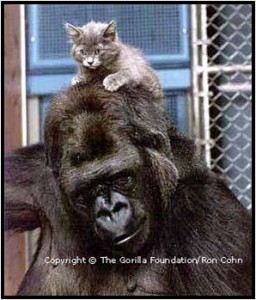
Koko signs:   Even animals practice democracy! NY Times article

The National Initiative for Democracy

A “Plan B” when Congress doesn't Represent

How we're getting Better and NATIONAL Ballot Initiatives

Led by former US Senator Mike Gravel, the National Initiative empowers us to check and balance representatives, similar to ballot initiativesin 24 States, but at all levels from local to national and with major improvements. It gives us a “Plan B” whenever representatives don't represent us. (Do torture, perpetual wars and debt, domestic spying and bailouts for the rich represent you??)

People tried to get this power from Congress, both in 1907 and 1977, with no success. Gravel adopted the Founders' solution: rather than beg the existing 13 Legislatures to ratify the Constitution, the Founders had delegates of The People ratify the Constitution at the Constitutional Conventions. James Madison said “The people were in fact, the fountain of all power, and by resorting to them, all difficulties were got over.”(His 2nd response in the 1787 Debate)

Gravel now resorts to you to read and vote to ratify the National Initiative, to make real the promise of “government by the people.” The National Initiative consists of the brief Democracy Amendment and the more detailed Democracy Act.


Read more and vote if you wish.

Mini-Me: TheyRule Web Site Back Online

02 China, 03 Economy, 06 Russia, 07 Other Atrocities, 08 Wild Cards, Commerce, Commercial Intelligence, Corruption, Money, Banks & Concentrated Wealth, Power Behind-the-Scenes/Special Interests
0Shares
Who? Mini-Me?

They were online many years ago, then gone, now back.

They Rule – Facts & Charts

See Also:

Who Rules the World

How the Crown Rules the World

Who is the ‘Goldman Sachs rules the world' trader?

Review: Gods of Money – Wall Street and the Death of the American Century

Review: Griftopia–Bubble Machines, Vampire Squids, and the Long Con That Is Breaking America

Journal: $750 Billion Wall Street Scam, Russian Anger, Chinese Intent, We are NOT Making This Up!

John Steiner: Public Intelligence App Hypothes.is

Advanced Cyber/IO, Autonomous Internet, Collective Intelligence
0Shares
John Steiner

$200K raised, thanks to all who contributed.

VISIT THEM to a) reserve your user name and/or b) make a contribution to their Kickstarter campaign.

Hypothes.is <http://hypothes.is>  will be a distributed, open-source platform for the collaborative evaluation of information. It will enable sentence-level critique of written words combined with a sophisticated yet easy-to-use model of community peer-review. It will work wherever you are‹as an overlay on top of news, blogs, scientific articles, books, terms of service, ballot initiatives, legislation and regulations, software code and more‹without requiring participation of the underlying site.

It is based on a new draft standard for annotating digital documents currently being developed by the Open Annotation Collaboration, a consortium that includes the Internet Archive, NISO, O'Reilly Books, Amazon, Barnes and Noble, and a number of academic institutions.

Media Coverage:  Techcrunch, Forbes, ReadWriteWeb, KurzweilAI, SkepTools, Researchity

Phi Beta Iota:  Apart from rapidly exposing lies by governments and corporations (“put enough eyeballs on it, no bug is invisible”) this has potential for also exposing covert sources of mis-information, connections between sources being harmonized covertly, and so on.  This has great promise.

See Also:

Advanced Cyber/IO (671)
Autonomous Internet (123)

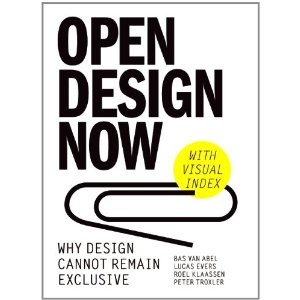
Two Books: Open Government: Collaboration, Transparency, & Participation (Tired), Open Design Now: Why Design Cannot Remain Exclusive (Wired)

Change & Innovation, Consciousness & Social IQ, Economics
0Shares
Amazon Page

The most basic definition of open government is the idea that people have the right to access the documents and proceedings of government. Being able to closely examine decisions, policies, and procedures is foundational to having the ability to make intelligent and informed decisions as a citizen, especially in a democracy where an informed electorate is vital if good choices are to be made by voters when selecting leaders or holding them accountable.

The Open Government movement is not officially organized as a group or party, rather it is a growing collection of concerned citizens who want to help create better government by increasing citizens' access to information. It has been heavily influenced by the open source software movement and has similar aims: increased collaboration through making options available to any interested party willing to read and study, increased transparency by making source materials freely available for anyone to peruse and examine, and increased participation by eliminating closed systems wherever possible.

Open Government: Collaboration, Transparency, and Participation in Practice is a collection of 34 essays written by a wide variety of people who are interested in both promoting the philosophy of open government and in suggesting practical ways to implement procedures that will assist in applying that philosophy.

Amazon Page

How Much of the Economy is Friction?

Shared ownership vs. peer to peer rentals

#OccupyWallStreet and the issue of power: on not confusing Power-to and Power-over

The world-historical importance of #15M and #OccupyWallstreet: Using Lateral Power to Transform the Political/Economic Landscape

P2P Microfinance’s thousand points of light: Kiva’s Intercontinental Ballistic Visualization

Producing for our own consumption: generalizing the Scott Bader experience

Arthur Brock & Eric Harris-Braun explain the Metacurrency Project at #OccupyWallStreet

McKenzie Wark: #OccupyWallStreet as an Occupation, not a Movement

Mini-Me: Graduates versus Oligarchs–Reality Knocking

03 Economy, Civil Society, Commerce, Commercial Intelligence, Corruption, Cultural Intelligence, Government
0Shares
Who? Mini-Me?

Paul Krugman recollects a point he made years ago that Chuck Spinney and Joseph Stiglitz and Martin Auerbach have been pressing home for over a decade.  Absentee landlords and capital flight from the heartland.  TWO sucking chest wounds.

Graduates Versus Oligarchs

Paul Krugman

New York Times, 1 November 2011

Dean Baker raises an important point here: it’s really awfully late in the game to be saying that the important inequality issue is college graduates versus non-graduates. It’s not clear that this was ever true, and it certainly hasn’t been true for a while.

I wrote about this years ago, using Ben Bernanke’s maiden testimony as Fed chair as an entry point. As I said then, Bernanke — like many others — had made:

a fundamental misreading of what’s happening to American society. What we’re seeing isn’t the rise of a fairly broad class of knowledge workers. Instead, we’re seeing the rise of a narrow oligarchy: income and wealth are becoming increasingly concentrated in the hands of a small, privileged elite.

Read full article (two graphics).

Graphic: US Combat Veteran Unemployment & Suicide [Current Suicide Headline Links Added]

Budgets & Funding, Citizen-Centered, Corruption, Political, Threats, Tribes, True Cost
0Shares
Click on Image to Enlarge

Source of original graphic (blue). Red added by Phi Beta Iota. Sources for suicide below.  The US Government lies to the public with deliberate manipulation of government statistics.  The actual unemployment rate in the USA today is closer to 25%, and from this we speculate that the actual unemployment rate in the USA for veterans, including veterans under disability care for post-combat mental issues, is as high as 50%.  This is only going to get worse–much worse.  This is the truest cost of war–elective wars on the basis of lies and incurred debt, with our young men and women as the casualties on the home front.  In Iraq for the past few years, more veterans have committed suicide in-country than have been killed in combat.  The US Government generally, and the US military specifically, is OUT OF CONTROL.

Tip of the Hat to John Robb.

Veteran's Day: Knocking on Heaven's Door  (11 Nov 2011)

Pick the statistic that makes it mean the most to you: between 2005 to 2010, active duty service members took their own lives at a rate of approximately one every 36 hours. The Veteran's Administration estimates that a vet at home dies by suicide every 80 minutes. The Army reported a record number of suicides in a single month for June 2010, thirty- one soldiers in all, more than one a day for the whole month. For July 2011, it was thirty-two, a dubious new record.

Together We Stand – Benefit Concert to End Veteran Suicide  (5 Sep 2011)

According to the 2008 VA statistic, more than 18 veterans committed suicide per day, which is one every 80 minutes or over 6,500 per year. In 2011, the number of active duty and veteran suicides continues to climb.

Military veterans: Soldier suicides now at epidemic rate (10 Aug 2011)

With Veteran Suicides Rising, The VA Must Improve its Mental-Health Services  (10 Jun 2011)

Senators tell VA to reduce veteran suicides  (25 May 2011)

18 veterans commit suicide each day  (22 Apr 2010)

VA’s suicide hotline has been receiving about 10,000 calls a month from current and former service members.

Kevin Carson: How Much of the Economy is Friction?

Advanced Cyber/IO, Blog Wisdom, Civil Society, Counter-Oppression/Counter-Dictatorship Practices, Cultural Intelligence, Government
0Shares
Kevin Carson

How Much of the Economy is Friction?

Charles Hugh Smith raises the question of how much of the U.S. economy consists of the actual output of goods and services, versus the friction entailed in producing them.  As a small example, he cites a physicians’ group that includes ten doctors — and twelve billing clerks.

That’s the general subject of a research paper I did for Center for a Stateless Society (C4SS), The Political Economy of Waste.

The larger and more hierarchical institutions become, and the more centralized the economic system, the larger the total share of production that will go to overhead, administration, waste, and the cost of doing business.  The reasons are structural and geometrical.

Continue reading “Kevin Carson: How Much of the Economy is Friction?”