Peter Thiel (PayPal) on Education Bubble

04 Education, 07 Other Atrocities, Academia, Corruption, IO Impotency, Methods & Process, Misinformation & Propaganda, Standards, Waste (materials, food, etc)
0Shares
John Robb

JOURNAL: The Education Bubble

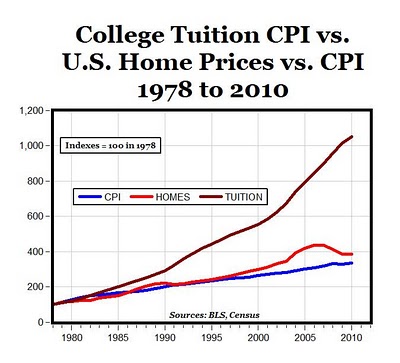
Peter Thiel (Paypal and other ventures) has been making some waves for his position that higher education in the US is the next bubble.   In short, he's right.  Given what we now have available in terms of tools, it should be possible to get an Ivy league education for $20 a month.

Instead we are getting a stagnant product that is so out of date that it doesn't deliver much social and economic value.  Even worse: it's undergoing hyper-inflationary price increases.

. . . . . . .

The solution to this problem is to help create employment  opportunities (like what we are doing with our open venture start-up) that don't use a degree as a gating mechanism.  A solution that creates its own educational modules if needed (from scratch using modern tools and techniques). A solution that delivers something better than an Ivy league eduction and then backs it up with economic and social opportunities that exceed what you get in the global econonomic and social sprawl.
Click on Image to Enlarge

Peter Thiel: We’re in a Bubble and It’s Not the Internet. It’s Higher Education.

Sarah Lacy Apr 10, 2011

TechCrunch

Image Source: Mark J. Perry (read article)

Fair warning: This article will piss off a lot of you.

I can say that with confidence because it’s about Peter Thiel. And Thiel – the PayPal co-founder, hedge fund manager and venture capitalist – not only has a special talent for making money, he has a special talent for making people furious.

. . . . . . .

Like the housing bubble, the education bubble is about security and insurance against the future. Both whisper a seductive promise into the ears of worried Americans: Do this and you will be safe. The excesses of both were always excused by a core national belief that no matter what happens in the world, these were the best investments you could make. Housing prices would always go up, and you will always make more money if you are college educated.

Like any good bubble, this belief– while rooted in truth– gets pushed to unhealthy levels.

. . . . . . .

But Thiel’s issues with education run even deeper. He thinks it’s fundamentally wrong for a society to pin people’s best hope for a better life on  something that is by definition exclusionary.

. . . . . . .

Thiel’s solution to opening the minds of those who can’t easily go to Harvard? Poke a small but solid hole in this Ivy League bubble by convincing some of the most talented kids to stop out of school and try another path. The idea of the successful drop out has been well documented in technology entrepreneurship circles. But Thiel and Founders Fund managing partner Luke Nosek wanted to fund something less one-off, so they came up with the idea of the “20 Under 20″ program last September, announcing it just days later at San Francisco Disrupt. The idea was simple: Pick the best twenty kids he could find under 20 years of age and pay them $100,000 over two years to leave school and start a company instead.

Read entire article by Sarah Lacy….

Web Stack

Phi Beta Iota: Read the chapter “Paradigms of Failure” in ELECTION 2008: Lipstick on the Pig (EIN, 2008) to understand that the depth and breadth of the integrity failure in the USA.  “Credentialling” is a form of top-down sub-prime scam, selling a credential instead of an education.  As Thiel suggests, time for change at the top is long over-due.

Reference: Internet Censorship Circumvention

Autonomous Internet, Counter-Oppression/Counter-Dictatorship Practices, Tools, White Papers
0Shares
Venessa Miemis

Global Voices Blog Critique from Jacob Appelbaum: My motivation for writing this response is to inform readers of the serious concerns that many people, myself included, have about the recent Freedom House report. I am always pleased to see more analysis of censorship circumvention and Internet security tools, but I have concerns about this report’s methodologies and resulting conclusions. The report in its current form could be dangerous to the users it aims to help.

The reporting methodology is sloppy at best and the information in the report is often inaccurate or poorly written. The report demonstrates a general disconnection from the language used by the projects and the circumvention community as a whole.

Read full critique.

Click on Image to Enlarge

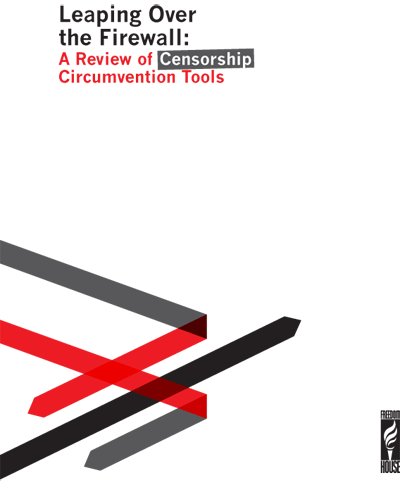
Internet censorship poses a large and growing challenge to online freedom of expression around the world. Censorship circumvention tools are critical to bypass restrictions on the internet and thereby to protect free expression online.

Circumvention tools are primarily designed to bypass internet filtering. Therefore, the core principle behind these technologies is to find alternative paths for data packets. These alternative paths use one or more collaborative servers in order to bypass the network of blocking mechanisms.

This document provides a comparison among different circumvention tools, both in terms of their technical merits, as well as how users of these tools describe their experience with them. The countries included in this report are Azerbaijan, Burma, China and Iran.

Source: Freedom House

Phi Beta Iota: Within the emerging Autonomous Internet, these tools assume use of the existing grid, and can in turn be used by the authorities, sometimes with the collaboration of the Internet Service Providers, to identify dissidents.  The Autonomous Internet seeks first to bypass local interception points (local solar-powered nodes using leased satellite communications), and ultimately to permit all individuals everywhere to enjoy the Internet for free and in liberty.  Novices forget that anonymous is not the same as invisible, and that security is needed at the point of receipt as well (counter-intelligence outside the denied area is focused on identifying dissidents on the basis of leaks outside the denied area).  NOTE:  Freedom House has a trojan virus–if you don't see the deletion notice your security program is not up to par.

Worth a Look: The Daily Bail on End the Fed

Corruption, Worth A Look
0Shares
Michael Ostrolenk Recommends...

The most important video they have every offered (we agree).

Sample headlines

Costliest Government Program Of All? – The $5 Trillion In Undeclared Wars Over The Last Decade

Senator's Husband’s Firm Cashes In On Crisis

“You put Lloyd Blankfein in pound-me-in-the-ass prison for one six-month term, and all this bullshit would stop, all over Wall Street,” says a former congressional aide, “That's all it would take, Just once”

Debt & Deficit Portal. Bailout News. Federal Reserve Corruption.

The Daily Bail

Event: 7-8 June San Antonio Cyber Intelligence and Unclassified Tradecraft (AFCEA)

Uncategorized
0Shares

Conference Page

Phi Beta Iota: The sponsor has the best of intentions, but we find the program appalling.  With a couple of exceptions there is no one here that actually knows anything, and there is zero evidence that this is anything other than a meet and greet within the closed circle that will be blowing $12 billion in US taxpayer funds better spent on substance or not spent at all.  Perhaps most telling is the absence of any representation from the ostensible purveyor of unclassified intelligence, the CIA's Open Source Center (OSC).

See Also:

Reference: Open Source Agency (OSA)

2010: OPINION–America’s Cyber Scam

2011 Cyber-Command or IO 21 + IO Roots

US Intelligence Unwitting of Most Open Sources

Waves of Unrest–Where is Open Source Tri-Fecta?

Liberation Technology Snap-Shot

02 Diplomacy, Cultural Intelligence, Government, IO Multinational, IO Technologies, Technologies
0Shares

Liberation technology: dreams, politics, history

Armine Ishkanian, 5 April 2011

openDemocracy

The doctrinal commitment to new cyber and social technologies as a means of solving political problems needs to learn from the past and take a more realistic view, says Armine Ishkanian.

Read full article with many links.

From Google Group The Next Net:

I just finished a conference call on the minimal mandatory requirements for liberation technology for a specific area (there are at least another 50 that would need the same stuff–a generic capability–but in 50 other languages).

1.  $169 cell phone to satellite communications converters, but structured to look like some other popular digital music device, along with a turnkey solar-powered Internet hotspot.

2.  Open satellite channel over the area in question that can receive collect calls from anyone in the area of interest using an announced number and one of the devices.

3.  Downloadable encryption for any cell phone on a use and delete basis from the satellite channel…like digital one time pads with no residue.

3.  Satellite radio into the area of interest with real news relevant to that population including news of the diaspora and exile leadership.

4.  Internet steganography.

I thought CIA, BBG, and JSOG were supposed to be able to do all that.  Evidently not.  I am being told that a fund-raising campaign is starting up to provide these capabilities to no fewer than three areas, possibly expanding to sixteen, all privately funded because the USG is not doing it.

– – – – – –

Dawn McCall

Here is a sample headline that sums up the current state of US Government attention to “liberation technology.”

Bureau of International Information Programs Coordinator Dawn L. McCall Travels to Los Angeles and San Francisco, California April 11 – April 15

Phi Beta Iota: Ms. McCall is a very accomplished Discovery Channel executive with remarkable achievements in one to many broadcasting.  She has been in her current position since 27 July 2010 and does not appear to be headed for Assistant Secretary status anytime soon.  The Undersecretary of Public Diplomacy and Public Affairs is Ms. Judith A. McHale, formerly President and CEO of Discovery Communications, parent of the Discovery Channel.

See Also:

Reference: Open Source Agency (OSA) [Sister to BBG]
2009 DoD OSINT Leadership and Staff Briefings
2006 Briefing to the Coalition Coordination Center (CCC) Leadership at the U.S. Central Command (USCENTCOM)–Multinational Intelligence: Can CENTCOM Lead the Way? Reflections on OSINT & the Coalition
2004 The New Craft of Intelligence: How “State” Should Lead
2004: Information Peacekeeping A Nobel Objective

Graphic: The Economic Pyramid

Budgets & Funding, Citizen-Centered, Corruption, Multinational Plus, Policies-Harmonization, Political, Strategy-Holistic Coherence, Threats
0Shares
Click on Image to Enlarge

Source

See Also:

Review: The Fortune at the Bottom of the Pyramid–Eradicating Poverty Through Profits (Hardcover)

Review: Building Social Business–The New Kind of Capitalism that Serves Humanity’s Most Pressing Needs

Design for the Other 90% Exhibit + “Micro-Giving” Global Needs Index to Connect Rich to Poor/Fullfill Global-to-Local Requests

Creating a Healthy Society

Government, IO Multinational, Non-Governmental
0Shares
Rob Sentse

Shaping the conditions to build a healthy society, a healthy nation consisting of healthy people who are motivated to look ahead..

To shape such conditions the international community should create a comprehensive approach.

It would be beneficial for the country, in this case South-Sudan (GoSS), if the UN / EU would deploy civil servants from crucial workplaces and from several levels of “our” own governmental management into South Sudan, to work as a coach for their fellow civil servants.

Continue reading “Creating a Healthy Society”