
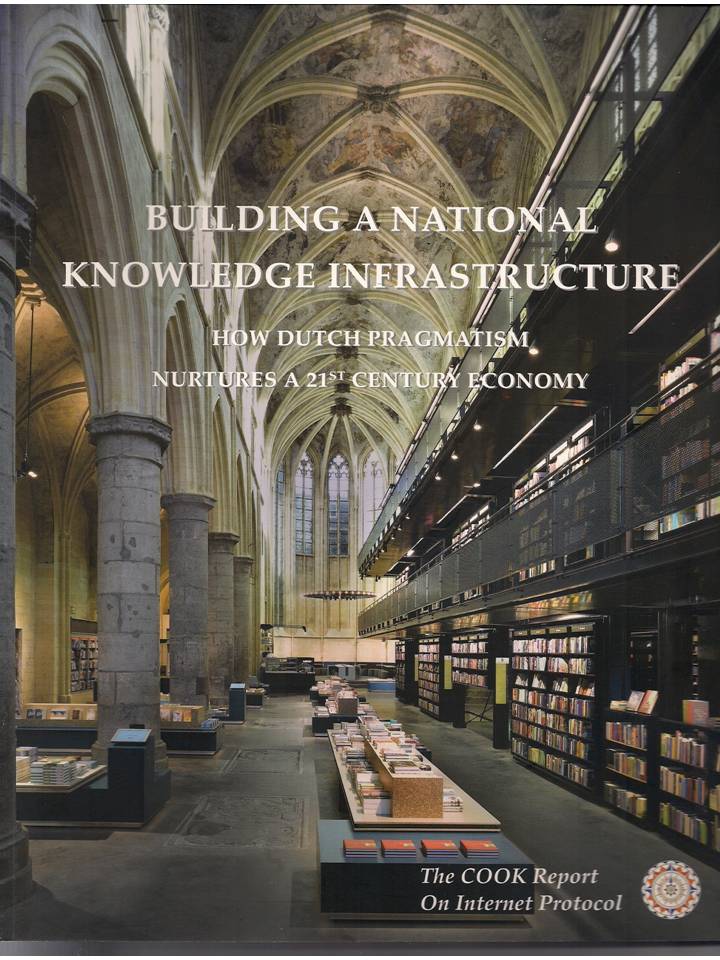
Reference: Building National Knowledge Infrastructure–How Dutch Pragmatism Nurtures a 21st Century Economy (The Cook Report on Internet Protocol)

Advanced Cyber/IO, Autonomous Internet, Collaboration Zones, Communities of Practice, Ethics
0Shares
Click on Image to Enlarge

P2P Foundation Post on the Book

Download Book from CookReport

FREE Color Copy to New Subscribers to the Private List of Dr. Gordon Cook, email him to his last name only @cookreport.com.

See Also:

Reference: Cook Report on Internet Protocol V4 E Pluribus Unum* Resurrected: How Human Ingenuity, DIY Technology, and Global R&E Networks Are Remaking the World Part 1 of 2 Parts

Who’s Who in Collective Intelligence: Gordon Cook

Autonomous Internet [Open, Free, Distributed]

Range Networks: The ONLY OpenBTS Real Deal

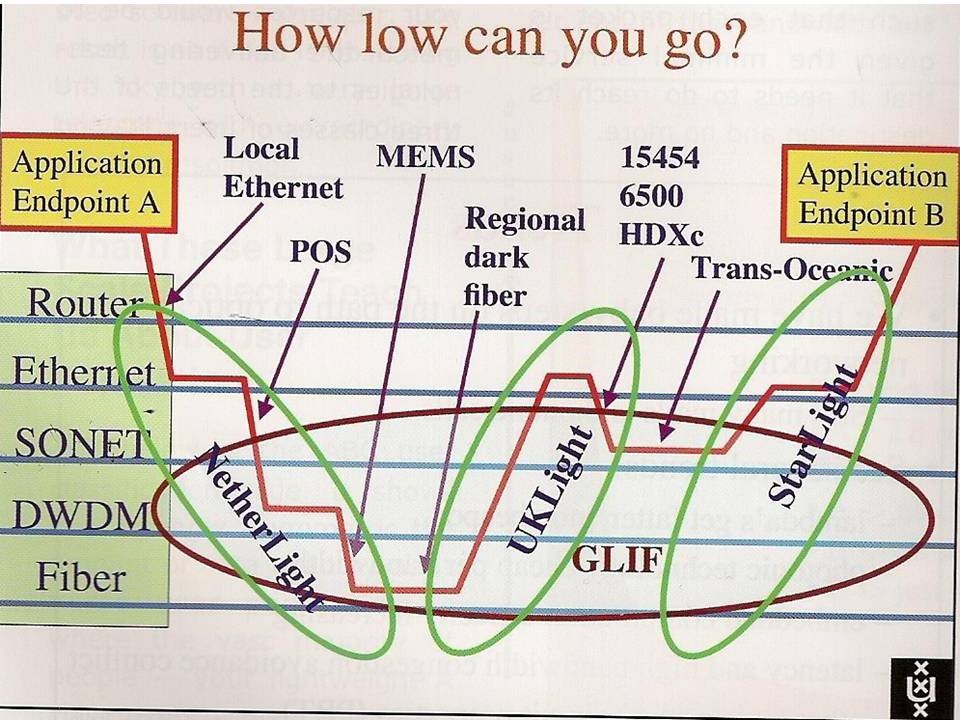
Core Graphic from this Reference
Click on Image to Enlarge

The Dutch, unaffected by the corruption that plagues the US government and its corporate patrons (aptly documented in Matt Tabbi's GRIFTOPIA), have done it right.  They have built Roger Karraker's  “Highways of the Mind, done so from the bottom-up, and recognized the massive efficiencies that come from a combination of optical paths and clever holistic architectures that allow data to move at lower levels when the fit is right.  The Dutch are deep and holistic; the US is superficial and corrupt.  That's the story.

Related Commentary:

We need to ignite a Layer-1 revolution

Security: Risk and Reward By Andreas M. Antonopoulos, Network World March 02, 2011 10:57 AM ET

Crowd-Sourcing Comes of Age on Libya

Advanced Cyber/IO, Analysis, Civil Society, Collective Intelligence, Corruption, Counter-Oppression/Counter-Dictatorship Practices, Ethics, Government, info-graphics/data-visualization, InfoOps (IO), Intelligence (government), IO Sense-Making, Methods & Process, Mobile, Real Time
0Shares
May the Crowd be with you, always.

Volunteers Behind Libya Crisis Map: A True Story

Patrick Meier, iRevolutiion, 8 March 2011

My colleague Clay Shirky called it “Cognitive Surplus” in his recent book. Don Tapscott and Anthony Williams refer to it as “MacroWikinomics” in theirs.

What is cognitive surplus? The trillion hours of free time enjoyed by the world's educated population every year. Don and Tony describe MacroWikinomics as mass distributed collaboration on scales we've never seen before thanks to technology.

We're familiar with deficits and shortages, writes, Clay, but when it comes to surplus social capital, things quickly become unpredictable—especially when this capital scales thanks to the use of social networking platforms and Web 2.0 technologies. But then again, says Clay, “Many of the unexpected uses of communication tools are surprising because our old beliefs about human nature were so lousy.”

Rest of story, maps, photos….

Phi Beta Iota: Over bagels and lox yesterday, Doug Rushkoff summarized his intention for ContactCon: “to take us back to 1992, but this time with 2012 technology and human understanding.”  Here is what the US Government was told in 1992 about crowd-sourcing.  20 years and 1 trillion dollars later (20 years, average of 50 billion a year), we still have the world's most expensive ineffective wasteland pretending to “do” intelligence.  The lunacy continues.

1992 AIJ OSS Steele’s Original Vision

1992 AIJ Fall ‘New Paradigm” and Avoiding Future Failures

Reference: 1992 USMC C4I Campaign Plan

1992 E3i: Ethics, Ecology, Evolution, & intelligence (An Alternative Paradigm)

Ruckus Wireless Leading Mesh Wireless Market

Autonomous Internet
0Shares

Ruckus Garnered 41 Percent of the 2010 Worldwide Market for Wi-Fi Mesh Node Shipments to Service Providers in New Dell'Oro Wireless Report

SUNNYVALE, Calif., March 8, 2011 /PRNewswire/ — Ruckus Wireless™, an innovator of advanced Smart Wi-Fi technology and one of the fastest growing suppliers of advanced wireless products, today announced that in 2010 it had shipped more Wi-Fi mesh access points to service providers around the world than any other supplier, according to the Dell'Oro Q4 2010 WLAN Report.

The new market research shows that in 2010 Ruckus garnered 41 percent of the worldwide market for unit shipments of Wi-Fi mesh nodes to service providers around the world.

Read complete release….

Tip of the Hat to Freenet Grinnell.

Death Row Inmates Willing to Donate Organs are Rejected/Wasted

07 Health, 09 Justice, Waste (materials, food, etc)
0Shares

Giving Life After Death Row

By CHRISTIAN LONGO
March 5, 2011

Salem, Ore. EIGHT years ago I was sentenced to death for the murders of my wife and three children. I am guilty. I once thought that I could fool others into believing this was not true. Failing that, I tried to convince myself that it didn’t matter. But gradually, the enormity of what I did seeped in; that was followed by remorse and then a wish to make amends.  I spend 22 hours a day locked in a 6 foot by 8 foot box on Oregon’s death row. There is no way to atone for my crimes, but I believe that a profound benefit to society can come from my circumstances.  I have asked to end my remaining appeals, and then donate my organs after my execution to those who need them. But my request has been rejected by the prison authorities. According to the United Network for Organ Sharing, there are more than 110,000 Americans on organ waiting lists. Around 19 of them die each day.

Continue reading “Death Row Inmates Willing to Donate Organs are Rejected/Wasted”

Event: 12-13 May Washington DC Reinventing Work

Uncategorized
0Shares

Practice-partners-large

If you would like to learn more about the reinvention of management, please join me for two days on May 12-13, 2011 in Washington DC in a workshop that is all about cool, innovative and serious fun. More details here.

On hand will be some of the co-creators of the new world of work, including Seth Kahan, author of Getting Change Right and Rod Collins, author of Leadership in a Wiki World: Leveraging Collective Knowledge To Make the Leap To Extraordinary Performance, and Madelyn Blair, author of Riding The Current.


Reference: Reinventing Management

Advanced Cyber/IO, Articles & Chapters, Commercial Intelligence, Communities of Practice
0Shares
Feb. 26 2011 – 12:42 pm By STEVE DENNING

My article, The Reinvention of Management” has just been published in a special issue of Strategy & Leadership on “outracing change: learning to foresee, adapt, re-invent and innovate faster.” (Strategy & Leadership, 2011, Vol. 39 Issue: #2, pp.9 – 17)

The article explains why business leaders and writers are increasingly exploring a fundamental rethinking of the basic tenets of management. It synthesizes a number of books including Umair Haque’s  The New Capitalist Manifesto, The Power of Pull by John Hagel, John Seely Brown and Lang Davison and my own book, The Leader’s Guide to Radical Management. The article shows how management is being reinvented with five fundamental shifts:

  • the firm’s goal (a shift from inside-out to outside-in);
  • the role of managers (a shift from controller to enabler);
  • the mode of coordination (from command and control to dynamic linking);
  • the values practiced (a shift from value to values); and
  • the communications (a shift from command to conversation).

The raison d’être of the firm changes from a focus on reducing transaction costs to scalable collaboration, learning and innovation. The shifts are interdependent: if only some shifts are made, the firm will slide back into hierarchical bureaucracy.

By adopting a people-centered goal, a people-centered role for managers, a people-centered coordination mechanism, people-centered values and people-centered communication the leaders of a firm can focus on the people who are its customers.

The article is available here.