Great Content, Rotten Pricing, Free Options Online
October 2, 2010
Antulio Joseph Echevarria
I have known the author for many years, and my own work, monographs for the Strategic Studies Institute where he has been the Director of Research, benefited considerably from his mature and measured editing. His most helpful work for me is his piece on “The American Way of Battle,” a brilliant analysis of how the US Government has lost the ability to do strategy (“strategic decrepitude” is when you confuse ideology, body counts, and powerpoint briefings with being a strategy) and instead obsessed on training, equipping, and organizing to do battles–and then our less well educated officers call the Taliban cowards, unmindful of the fact that they have held a “modern” armored force at stalemate for a decade wearing robes and sandals and using old single-shot weapons. Viet-Nam deja vu.
This is an important book and I consider it an outrage that it is being offered for such a high price. I could not find it easily at the Strategic Studies Institute but believe it to be available free online there. Certainly all the rest of this author's many great contributions to strategic thought are free online there, as well as those of Colin Gray, Max Manwaring, Steve Metz, and many others.
This book should be offered to the public in soft copy at no more than $29. Until that happens, go find a free copy online, and recognize that the source site, Strategic Studies Institute, offers everything they produce at taxpayer expense free online. Search for the author's name and enjoy most of what he offers at no additional cost.
At Phi Beta Iota the Public Intelligence Blog, where I have more discretion, you can see all of my reviews on Strategy, on Force Structure, on Sorrows of Empire, etcetera, easily grouped (I read in 98 categories, all non-fiction). All my reviews lead back to the Amazon Page, and to my often buried contributions, should you wish to vote or comment. I respond to comments daily. At my review of this book there, you will find a link to Dr. Echevarria's SSI Home Page, where his SSI contributions (not those external to SSI) can be accessed free.
Wanna know how incestuous amplification works in the politico's OODA loop … or put another way, why the Hall of Mirrors that is Versailles on the Potomac has become so disconnected from reality? … See if you have the stomach to read this disgusting drivel.
Truth in advertising: I did not have the stomach to finish it, but you don't need to finish it to appreciate the sicko psychology of worshipping at the altar of inside-the-beltway
Before he goes to sleep, between 11 and midnight, Dan Pfeiffer, the White House communications director, typically checks in by e-mail with the same reporter: Mike Allen of Politico, who is also the first reporter Pfeiffer corresponds with after he wakes up at 4:20. A hyperactive former Eagle Scout, Allen will have been up for hours, if he ever went to bed. Whether or not he did is one of the many little mysteries that surround him. The abiding certainty about Allen is that sometime between 5:30 and 8:30 a.m., seven days a week, he hits “send” on a mass e-mail newsletter that some of America’s most influential people will read before they say a word to their spouses.
EXTRACT:
“The people in this community, they all want to read the same 10 stories,” he said, table-chopping in the Hay-Adams. “And to find all of those, you have to read 1,000 stories. And we do that for you.”
As a practical matter, here is how Allen’s 10 stories influence the influentials. Cable bookers, reporters and editors read Playbook obsessively, and it’s easy to pinpoint exactly how an item can spark copycat coverage that can drive a story. Items become segment pieces on “Morning Joe,” the MSNBC program, where there are 10 Politico Playbook segments each week, more than half of them featuring Allen. This incites other cable hits, many featuring Politico reporters, who collectively appear on television about 125 times a week. There are subsequent links to Politico stories on The Drudge Report, The Huffington Post and other Web aggregators that newspaper assigning editors and network news producers check regularly. “Washington narratives and impressions are no longer shaped by the grand pronouncements of big news organizations,” said Allen, a former reporter for three of them — The Washington Post, The New York Times and Time magazine. “The smartest people in politics give us the kindling, and we light the fire.”
Phi Beta Iota: We read the whole thing, and here is the bottom line–Washington is incest on steroids. It has little to do with reality, with the needs of the public, with balancing the books, or with actually engaging in public service. It has become its own bog, Of, By, and For Washington. And that does, as Brother Chuck suggests, make one sick with shame.
UPDATE 02: Guatemalan president ‘very angry' at US tests (BBC short video). Note reference to this probably happening in other countries. We sense a need for–and recommend–a global investigation.
U.S. Government Apologizes for 1940s STD Testing on Guatemalans
The U.S. government apologized Friday for a secret program conducted more than 40 years ago in which prisoners and mental hospital patients in Guatemala were intentionally infected with gonorrhea, syphilis and other sexually transmitted diseases.
The “unethical” and “reprehensible” program was discovered after a professor documented how U.S. scientists intentionally infected people in the Central American country with sexually transmitted diseases.
Susan Reverby, a women's studies professor at Wellesley College, published a paper detailing the joint research program between the U.S. and Guatemalan governments. From 1946-1948, doctors enabled men in prison to be infected with syphilis or gonorrhea by allowing prostitutes carrying the disease to visit them. From there, they studied inoculation techniques. The tests, which also involved mental hospital patients, involved about 1,500 subjects, according to the study.
3 Ways the Underwear Bomber Changed Counterterrorism
December 25, 2009 was a pivotal day for U.S. counterterrorism. Although the airline bombing failed, the reverberations from the attempt are still being felt. Here’s how this incident changed U.S. counterterrorism policy, as told by Mike Leiter, the director of the National Counterterrorism Center.
Popular Mechanics By Joe Pappalardo September 16, 2010 2:30 PM
Deaf Leading the Blind
1) The incident saved the Counterterrorism Center's budget.
2) New teams were formed to chase leads, not write reports.
3) The failed attack focused the Obama administration on counterterrorism.
Phi Beta Iota: Click on the photo for the full story at Popular Mechanics. Above we just list the three “ways,” each of them a perfect outcome for a fraudulent staged “threat” that was almost certainly concocted with Israeli help. Until the guy video-taping the whole thing from in front is produced, our professional judgment is that the Underpants Bomber was an agent of the US Government doing precisely what this worthless activity wanted: give it a reason, however absurd, to keep on being worthless. [Covert Operations against a US audience are illegal, but who cares about the Constitution or laws, these days?] NCTC's leader, a decent well-intentioned politically-appointed lawyer who knows nothing relevant, is the poster child for what is wrong with the entire US national security domain.
Defense Dog (DefDog) is under very deep cover, and to all outward appearances is the perfect Pentagon Staff Officer–creased uniform changed daily, shaves twice a day if necessary, and always has a piece of candy for the boss. We regret we cannot tell you more about this stalwart defense of freedom and the American Way of War.
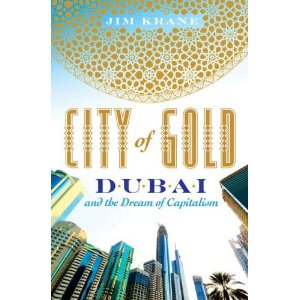
TThe author and I reconnected on LinkedIn and he had the publisher send me a copy of this book. I would not normally have bought it for myself, thinking it a “tourism” or “travel” kind of book, and I would have been very very wrong. The sub-title, “and the Dream of Capitalism,” might better read “Case Study in Emirate Capitalism at Its Best.”
This book starts very early in the history of Dubai, back when it was such a hole that no one even knew it was there or wanted to go anywhere within thousands of miles of it. The early part of the book persuaded me that the author has done some deep, serious, utterly professional and thorough homework, and the books reads easily, with gifted turns of phrase that educate and often inspire.
Putting the book down just now (and recommending the paperback that comes with a second epilogue for 2010) I reminded myself to recommend this book as a case study for both business and public administration graduate courses, as well as recommended reading for undergraduates. I certainly believe the author himself should be invited–and very well paid–to interact with the most serious and gifted of business and public administration adult students, both on and off the record. This book is a GOLD MINE of insights into what worked in an environment where, as the author describes so beautifully, the leadership knew that lawyers are generally worthless and bureaucracies are pathetic things to be dismissed. For that section alone this book goes into the Beyond 5 Stars (6 Stars and Above) and will be so rated at Phi Beta Iota the Public Intelligence Blog.
This book will be cataloged there in Capitalism, not just regional or country, in Leadership, and in a number of other categories as well. I have not, in as long as I can recall, had the pleasure of reading a book about a people, a place, a leadership, and a time that is as detailed, as harmonized in the telling, as instructive, and as enjoyable as this one.
The level of detail is EXTRAORDINARY and yet not burdensome. The detail is present as the filigree to the main wall, the story told in well-planned segments. The detail gives life to this book. This book is both educational and inspiring.
I am NOT “down on Dubai” and I don't think the author is either. In 58 years of travel and 48 years of reading–the last thirty focused on non-fiction, I have not seen any book do a better job of capturing the essence, in detail, of a culture, a place, and a living time.
The book ends with very serious challenges to Dubai being presented in a professional, responsible manner. The leaders of Dubai are clearly extraordinary people with extraordinary sensibilities, and I suspect they will rise to these challenges, not the least of which are spoiled citizens receiving $55,000 a year, and an energy and carbon footprint that could alone take down the Earth if proliferated. But even here, one sees the beauty of Emirate Capitalism as I choose to call it: every building now has to meet the LEEDS standard, and other measures are being put into place. Having said that, one must also recognize that Emirate Capitalism can be brutal to some, a form of robber=baronism, and that now that the world is in an economic decline, Dubai's leaders are going to have to think twice as boldly, listen to twice as many advisors, and be twice as tough and focused as they have been, if they are to survive.
If you are going to Dubai, if you know anyone at all in Dubai, if you own shares in any company based in Dubai, if you even THINK you might one day fly OVER Dubai, buy and read this book (the paperback, but frankly, although I got the new epilogue in Xerox form, it does not add that much, so for those of us that love hard-copy covers, go with the hard copy and forego the new epilogue, which I am suggesting to the author be put on line so as not to diminish sales of the remaining hard copies.
The author covers the Iran-US and other regional issues well enough, but this is not a book about politics, it is a book about Emirate Capitalism that should be studied for the next century, along with other books that needs to be written about Arab Capitalism as–and if–Arab Capitalism can be inspired by Emirate Capitalism.
This book needs a sequel, perhaps one that expands north and south and brings us all up to date on Emirate Capitalism, Iranian/Persian Capitalism (it does exist), and Arab Capitalism.
As one person cited in the book points out, Dubai is both the most magnificent fastest built marvel of the Earth, and also a microcosm of everything that is wrong with Western engineering ignorant of ecological economics or “true cost” of goods and services. Dubai is an OPPORTUNITY. City of Gold is the opening act–I cannot wait for the sequel. This is “jolly good stuff” and an absolutely riveting read–and not one to be skimmed over, either. This is a serious book for serious people.
I am not going to link to other books here. This book has no peers. Visit Phi Beta Iota the Public Intelligence Blog for the 1,600 or so non-fiction books, organized in 98 categories, which provide the backdrop from my praise of this book by this author. Righteous!


 Great Content, Rotten Pricing, Free Options Online






 Beyond 5 Stars and Merits a Sequel