Review (Guest): The Vanishing Face of Gaia: A Final Warning

4 Star, Atlases & State of the World, Environment (Problems), Environment (Solutions), Nature, Diet, Memetics, Design
0Shares
Amazon Page

4.0 out of 5 stars An important book on our planet's future

April 13, 2009

Review by Future Watch Rider

Book by James Loveluck

Lovelock merits our attention because he has been proven right in predicting grim events. Indeed, Lovelock's grim views have in some ways been too optimistic in light of the speed with which the global environmental situation has been declining.

I think his views in this book are too pessimistic but Lovelock is a creative original thinker about science who does not fit into neat categories. He has infuriated a lot of his fellow environmentalists with his advocacy of nuclear power. He does so because he sees the huge size of the gap between what is needed and what exists. For example, President Obama has promised to “double” the percentage of renewable energy America uses in a few years. It sounds great….. until you realize renewable energy is less than one percent of America's energy now. (Meanwhile, renewable energy is being very badly hurt by the global economic crisis.) Optimistic predictions about a “boom” in renewable energy over the past 20 years by various environmental advocates have turned out to be pie in the sky. It hasn't happened. Hopefully, it will happen now. However, according to predictions of the International Energy Agency, the share of the world's energy coming from coal, the worst form of energy, is going to go up, not down by 2020. This is why Lovelock also supports research on making coal less disastrous although it's never going to be “clean” as claimed by the coal industry and its millions of dollars in advertising. (Some environmental purists have also attacked him for this.)

Continue reading “Review (Guest): The Vanishing Face of Gaia: A Final Warning”

Review (Guest): Whole Earth Discipline

5 Star, Culture, Research, Environment (Solutions), Science & Politics of Science, Stabilization & Reconstruction, Survival & Sustainment, Technology (Bio-Mimicry, Clean), Values, Ethics, Sustainable Evolution, Water, Energy, Oil, Scarcity
0Shares
Amazon Page

5.0 out of 5 stars Perhaps the most important — certainly the most thought-provoking — book in years

October 22, 2009

Review by Jesse Kornbluth

Book by Stewart Brand

I was interviewing George Soros as the Dow rapidly shed 300 points and crashed through the 10,000 level.

“Is this it?” I asked.

Soros shrugged — a very calm reaction from an investor who might have seen his portfolio shrink by hundreds of millions of dollars in a matter of minutes.

I lost much less that day, but I had a different reaction — panic. The thing to do, I concluded, was to trade my beloved Classic 6 in Manhattan for a self-sustaining house in the country. Ten acres would suffice, as long as they had decent water, land suitable for a large garden and enough sunlight for the solar panels.

I bought a URL for the web site I planned to launch: […]. This was no back-to-the-land hippie retreat. I would be stepping into the smart future: small town/rural purity (Woodsmoke) with the 21st century benefits of a fast Internet (Broadband) and Amazon.com's free shipping.

Given all that, you will understand that I was quite stunned to read “Whole Earth Discipline: An Ecopragmatist Manifesto” — by Stewart Brand, creator of the 1960s and 1970s classic, the “Whole Earth Catalog” — and discover that the last place its author would have me go is back to the land.

Continue reading “Review (Guest): Whole Earth Discipline”

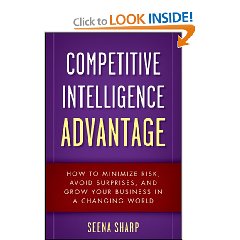
Review: Competitive Intelligence Advantage: How to Minimize Risk, Avoid Surprises, and Grow Your Business in a Changing World

5 Star, Intelligence (Commercial)
0Shares
Amazon Page

REPOSTED to end Russian spammer constant hitting on former URL.

5.0 out of 5 starsBest Possible Starting Point for Executives & Students

October 20, 2009

Seena Sharp

This book is a gem. It is a rare book that I would recommend equally to senior executives and students thinking about a career path, but this is such a book. I agreed to review this book for the publisher and received a free copy. I've known the author since the early 1990's when the U.S. Government first tried to learn how to do commercial intelligence, calling it Open Source Intelligence (OSINT). They still don't get it, for the same reason most executives don't get it: arrogance, ignorance, and a complacency that comes from having too much money and not enough accountability.Before laying down my notes, let me first place this book squarely in the top twelve books in English. This is the one I would recommend to anyone as a starter, followed by:

Continue reading “Review: Competitive Intelligence Advantage: How to Minimize Risk, Avoid Surprises, and Grow Your Business in a Changing World”

Journal: Who will trust open source security from the government? Any government?

Collaboration Zones, Collective Intelligence, Communities of Practice, Computer/online security, InfoOps (IO), Key Players, Methods & Process
0Shares
Looking for Integrity...

Sometimes the old joke is true. Sometimes the government is just trying to help.

An open source consortium funded by military and civilian security agencies within the U.S. government has released a final version of Suricata, a new security framework.

. . . . . . .

Unfortunately the timing of the release could not have been worse, coming as it did the same week the Washington Post launched its series Top Secret America, detailing just how immense and intrusive the nation’s national security apparatus has become, an economic boom for Washington seen as increasingly dangerous by many on both the left and right.

Jonkman acknowledged the help of ā€œthousands of peopleā€ in delivering Version 1.0 of the software, which was immediately fisked by Martin Roesch, creator of Snort, who called it a cheap knock-off funded with taxpayer dollars.

. . . . . . .

Continue reading “Journal: Who will trust open source security from the government? Any government?”

Journal: New Strategy for Afghanistan? Or Just a New Naked Emperor and a 2012 Bow Wave?

08 Wild Cards
0Shares
Chuck Spinney Recommends

TheĀ  report of Damian McElroy in the Telegraph [UK] describes General Petraeus new strategy for Afghanistan.Ā  It will be have a broad emphasis on counterinsurgency, like McChrystal's strategy, butĀ McElroy highlighted the following (presumed) differences or distinguishing features:

Recognition that Taliban defections are crucial to achieving goal of ending war in 4 yrs (2014). … Observation: no talk about the drawdown starting in summer 2011, 2014 is now a “given.” So one benefit of substituting Petraeus for McChrystal is that politicians and generals can save face and keep defense budgets high while ā€œbow-wavingā€ the end of the war to 2014, well beyond the end of Mr. Obama’s presidency, and at which time, new excuses to continuing the wars of empire will materialize. ā€œBow wavingā€ problems into the future is business as usual in the hall of mirrors that is Versailles on the Potomac.

Petraeus’ new strategy will induce more defections by paying Taliban defectors. Observation: this implies a rent-a-Pashtun strategy like Petraeus' rent-a-Sunni strategy in Iraq, even though recent events in Iraq show that renting Sunnis did not end sectarian violence in Iraq; nor did it provide conditions for a lasting peace.Ā  It did provide enough of a reduction in violence to let us declare victory and begin something of a drawdown (50,000 troops will remain in permanent bases).Ā  Renting Pastuns, by the way, is not a new way to exit Afghanistan.Ā  Alexander the Great, for example, had to bribe local tribes to ā€œremoveā€ the hostile tribes who were blocking his exit route by controlling the Khyber Pass.Ā  My guess that the tribes split the profits and something similar will happen to our rental payments.

Continue reading “Journal: New Strategy for Afghanistan? Or Just a New Naked Emperor and a 2012 Bow Wave?”

Who’s Who in Peace Intelligence: Walter Dorn

Alpha A-D, Peace Intelligence
0Shares

Dr. Walter Dorn

Walter Dorn is an Associate Professor at the Royal Military College of Canada, a senior member of the external faculty of the Pearson Peacekeeping Centre and an Adjunct Research Professor at Carleton University. A physical scientist by training (Ph.D., Univ. of Toronto), he did graduate work on the detection of chemical weapons and on the technical verification of arms control treaties. After graduation, he was a Research Associate of the International Relations Programme of Trinity College (University of Toronto) and a consultant to Yale University (UN Studies).

He served with the UN in East Timor, in Ethiopia, and at UN headquarters as a Training Adviser with the Department of Peacekeeping Operations. He currently teaches courses on peacekeeping and is writing a book titled “Global Watch” on the evolution of UN monitoring.

His new home page provides ready access to his publications, lectures, and longer biography.Ā  Professor Dorn is the de facto “dean” of peace intelligence scholars with deep field experience.

NEW:

Blue Sensors: Technology and Cooperative Monitoring for UN Peacekeeping

Continue reading “Who's Who in Peace Intelligence: Walter Dorn”

NIGHTWATCH Extract: Koreas Analysis

Uncategorized
0Shares

Asia Times 24 July 2010 South Korea reels as US backpedals By Peter Lee

Special Note. An Asia Times Online analysis of Allied behavior during this confrontation contains several points worth restating. First is that any effort to obtain Chinese and Russian support for the findings of the joint investigation into the sinking of the Cheonan was doomed to fail because South Korea did not invite either nation to send experts to join the investigation. This is a colossal political blunder no matter what the findings were and how the experts agreed or disagreed.

Continue reading “NIGHTWATCH Extract: Koreas Analysis”